

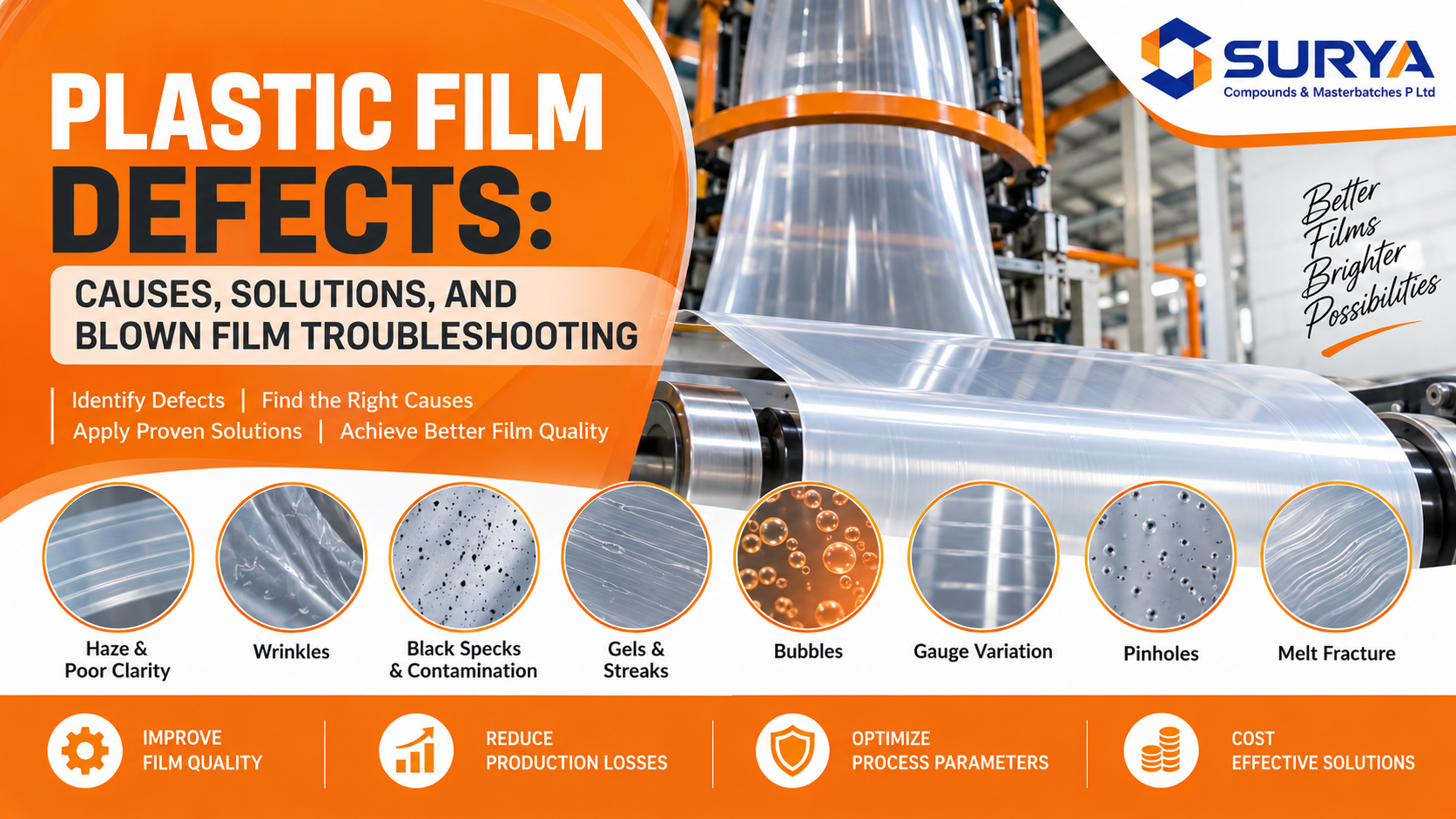
Plastic film defects affect appearance, thickness, strength, sealing, transparency, printability, and production efficiency. Common problems include thickness variation, gels, fish eyes, bubble instability, wrinkles, poor clarity, blocking, die lines, black spots, poor sealing, and low mechanical strength.
These problems can originate at different points in the film extrusion process. The cause might be the polymer, masterbatch, additives, moisture, extrusion temperature, screw and barrel, die, air ring, bubble control, nip rolls, or winding system.
A good troubleshooting process starts with the defect pattern instead of immediately changing machine settings.
This guide explains the most common plastic film defects, their causes, solutions, and prevention methods. It also explains how masterbatch selection affects blown film quality.
Quick Answer: What Are the Most Common Plastic Film Defects?
The most common film defects include:
- Uneven film thickness
- Gauge variation
- Bubble instability
- Gels and fish eyes
- Die lines
- Melt fracture or sharkskin
- Poor transparency and haze
- Wrinkles and folds
- Film blocking
- Poor heat sealing
- Poor slip performance
- Black specks and contamination
- Colour streaks
- Poor masterbatch dispersion
- Low tensile strength
- Low tear or impact strength
- Pinholes
- Surface roughness
- Odour
- Poor winding
- Edge defects
- Film brittleness
- Poor interlayer adhesion in multilayer films
The right solution depends on whether the defect comes from the material, extrusion system, die, cooling system, bubble control, downstream equipment, or masterbatch.
Plastic Film Defects Troubleshooting Table
|
Plastic film defect |
Common causes |
Recommended checks |
|
Thickness variation |
Die gap, air ring, temperature, output fluctuation |
Check the alignment, airflow and extrusion stability |
|
Bubble instability |
Uneven cooling, unstable output, incorrect BUR |
Check air ring, IBC, melt temperature and feed |
|
Gels |
Unmelted resin, degraded polymer, contamination |
Check temperature profile, screen pack and material |
|
Fish eyes |
Poor dispersion, unmelted polymer, contamination |
Check resin, masterbatch and filtration |
|
Die lines |
Die buildup, damaged die lip, contamination |
Inspect and clean die |
|
Melt fracture |
Excessive shear, low melt temperature, high output |
Adjust temperature, die gap or output |
|
Poor clarity |
Cooling conditions, resin grade, additives |
Check cooling and optical properties |
|
Wrinkles |
Bubble instability, poor alignment, winding tension | Check collapsing frame, nip and tension |
| Blocking | Insufficient antiblock, excess heat, winding pressure |
Check antiblock and cooling |
|
Poor sealing |
Incorrect formulation, excessive orientation, wrong temperature |
Review resin, additives and sealing conditions |
|
Black specks |
Degradation, contamination, machine buildup |
Inspect resin, screw, barrel and die |
|
Colour streaking |
Poor dispersion or inconsistent dosing |
Check masterbatch and dosing |
|
Low strength |
Incorrect resin, orientation or additives | Review polymer and processing conditions |
| Pinholes | Gels, contamination, thin spots |
Check material cleanliness and gauge |
|
Surface roughness |
Melt fracture, poor plasticization, contamination |
Check melt temperature and die |
| Poor winding | Gauge variation, tension, wrinkles, static |
Check film profile and winding tension |
What Causes Plastic Film Defects?
Plastic film defects usually fall into six major categories:
- Raw material problems
- Masterbatch and additive problems
- Extrusion problems
- Die and cooling problems
- Bubble and downstream problems
- Environmental and handling problems
Understanding these categories makes film extrusion troubleshooting faster.
1. Uneven Film Thickness and Gauge Variation
Uneven thickness is one of the most important plastic film defects because it affects material consumption, strength, sealing, printing, and converting performance.
The film might be thicker in some areas and thinner in others.
Common causes
- Uneven die gap
- Die misalignment
- Uneven die temperature
- Unstable extrusion output
- Uneven air-ring airflow
- Incorrect blow-up ratio
- Incorrect traction speed
- Bubble instability
- Poor raw material consistency
Industry troubleshooting guides also identify die gap, cooling airflow, extrusion speed, and bubble conditions as major contributors to thickness variation.
Solutions
Check the problem in this order:
- Measure the film thickness profile.
- Identify whether the variation is machine-direction or cross-direction.
- Inspect the die gap.
- Check die centering.
- Check air-ring alignment.
- Verify uniform cooling airflow.
- Check extrusion output.
- Check nip and haul-off speed.
- Review blow-up ratio.
Do not increase or decrease overall film thickness before identifying where the variation originates.
2. Bubble Instability
Bubble instability is a major blown film defect.
The bubble might:
- Move from side to side
- Expand and contract
- Vibrate
- Lean toward one side
- Change diameter continuously
- Produce inconsistent film thickness
Common causes
- Uneven cooling
- Unstable resin feeding
- Inconsistent extrusion output
- Incorrect melt temperature
- Incorrect blow-up ratio
- Poor air-ring alignment
- External airflow
- Poor internal bubble cooling
- Incorrect nip conditions
Megaplast also identifies irregular resin feeding, uneven temperature, and inconsistent airflow as causes of unstable film bubbles.
How to fix bubble instability
Check:
- Extruder output stability
- Melt temperature
- Die centering
- Air-ring alignment
- Cooling airflow
- Internal bubble cooling, if used
- Blow-up ratio
- Nip-roll alignment
- External airflow around the tower
Do not adjust bubble air pressure randomly. First determine whether the instability is caused by material flow or cooling imbalance.
3. Gels and Fish Eyes
Gels and fish eyes appear as small spots or particles in the film.
They are especially problematic in:
- Packaging film
- Printing film
- Lamination film
- Agricultural film
- Stretch film
- High-clarity film
Common causes
- Unmelted polymer
- Degraded resin
- Contaminated resin
- Poor masterbatch dispersion
- Additive agglomeration
- Excessive residence time
- Dead spots in the extruder
- Die buildup
- Inadequate filtration
Gels can originate from impurities, degraded polymer, or inadequate melting.
Solutions
Check:
- Resin quality
- Recycled material
- Screen pack
- Extruder temperature profile
- Screw condition
- Die condition
- Masterbatch dispersion
- Residence time
If gels appear randomly, investigate the raw material and melt stream.
If the defect appears repeatedly at the same position, inspect the die and downstream equipment.
4. Die Lines and Surface Streaks
Die lines appear as continuous lines running along the film.
They often indicate a problem close to the die.
Possible causes
- Dirty die lip
- Die buildup
- Scratched die surface
- Degraded polymer
- Contamination
- Uneven die gap
- Poor melt flow
- Additive or pigment buildup
Troubleshooting
Inspect the die lip and melt path.
Check whether the line:
- Appears continuously
- Appears at a fixed position
- Changes after die cleaning
- Appears after changing material
- Appears only at high output
A die-related defect should be addressed at the die rather than compensated for by changing winding or cooling settings.
5. Melt Fracture or Sharkskin
Melt fracture produces a rough or distorted surface as polymer exits the die.
It is associated with excessive shear stress at the die exit.
Common causes
- High extrusion rate
- Low melt temperature
- Narrow die gap
- High shear
- Resin rheology unsuitable for the process
- Insufficient processing aid
Possible solutions
Depending on the polymer and formulation:
- Adjust melt temperature within the resin’s recommended range.
- Reduce output rate.
- Review die gap.
- Check die lip condition.
- Review resin grade.
- Evaluate a suitable processing aid.
Do not raise temperature without considering polymer stability. Excessive heat can create degradation and another set of defects.
6. Poor Transparency, Haze and Cloudiness
Poor optical properties reduce the appearance and performance of transparent films.
Common causes
- Incorrect resin grade
- Poor cooling
- Incorrect melt temperature
- Moisture
- Contamination
- Incorrect additive dosage
- Poor masterbatch dispersion
- Excessive or unsuitable antiblock
- Incorrect blow-up ratio
Cooling conditions have a strong effect on film optical properties. Blown-film troubleshooting references recommend checking melt temperature, cooling air, resin selection, and antiblock formulation when clarity is poor.
Solutions
Check:
- Resin grade
- Melt temperature
- Cooling-air temperature
- Air-ring performance
- Frost-line stability
- Masterbatch type
- Antiblock level
- Film thickness
Do not assume that increasing cooling always improves clarity. The correct cooling condition depends on the polymer and film structure.
7. Wrinkles and Folds
Wrinkles reduce film quality and create problems during printing, lamination, slitting, and bag making.
Common causes
- Unstable bubble
- Uneven thickness
- Misaligned collapsing frame
- Incorrect nip-roll pressure
- Poor guide-roll alignment
- Incorrect winding tension
- Uneven cooling
- Excessive blow-up ratio
Solutions
Inspect the complete path from bubble to winder.
Check:
- Bubble stability
- Collapsing frame alignment
- Nip-roll parallelism
- Guide-roll alignment
- Film tension
- Winding tension
- Thickness profile
Wrinkles should not automatically be treated as a winding problem. The root cause often starts earlier in the film line.
8. Film Blocking
Blocking occurs when adjacent film layers stick together.
It creates problems during:
- Unwinding
- Printing
- Slitting
- Bag making
- Packaging
- Automatic feeding
Antiblock additives reduce the contact between film layers and are widely used to control blocking.
Common causes
- Insufficient antiblock
- Excessive film temperature
- Slow cooling
- High winding pressure
- High surface smoothness
- Excessive pressure between layers
- Incorrect additive formulation
Solutions
Check:
- Antiblock masterbatch dosage
- Cooling efficiency
- Winding temperature
- Winding tension
- Roll pressure
- Film formulation
Read more about Antiblock Additives for Plastic Film Manufacturing.
9. Poor Heat Sealing
Poor sealing creates leakage and package failure.
The film might require excessive sealing temperature or fail to form a strong seal within the normal sealing window.
Possible causes
- Incorrect sealant resin
- Excessive orientation
- Incorrect additives
- Poor surface condition
- Excessive blow-up or draw ratio
- Incorrect cooling
- Wrong sealing temperature
- Film contamination
Troubleshooting
Check:
- Seal initiation temperature
- Seal strength
- Film structure
- Sealant layer
- Additive package
- Film orientation
- Processing history
Do not treat every sealing problem as a sealing-machine problem. The film formulation and extrusion process determine much of the final sealing behaviour.
10. Black Specks and Contamination
Black spots are among the easiest plastic film defects to see and one of the most common quality complaints.
Common causes
- Burnt polymer
- Degraded resin
- Contaminated regrind
- Foreign material
- Excessive residence time
- Barrel deposits
- Screw deposits
- Die buildup
- Contaminated masterbatch
Surya Compounds & Masterbatches’ troubleshooting guide identifies degradation, contamination, and machine buildup as common sources of black specks.
Solutions
Check:
- Raw material cleanliness
- Regrind
- Hopper
- Screw
- Barrel
- Screen pack
- Die
- Temperature profile
- Residence time
If the defect increases after running a particular material, isolate the material lot before changing the entire process.
11. Colour Streaks and Poor Masterbatch Dispersion
Colour streaking appears as:
- Light and dark bands
- Swirls
- Uneven colour
- Spots
- Shade variation
- Non-uniform opacity
Common causes
- Incorrect masterbatch dosage
- Poor dispersion
- Incompatible carrier
- Poor mixing
- Inconsistent dosing
- Pigment agglomeration
- Incorrect processing conditions
There is an important distinction between distribution and dispersion.
Distribution means how evenly the masterbatch is spread through the polymer.
Dispersion refers to how well pigment or additive agglomerates are broken down.
Streaks often point toward distribution or mixing problems, while spots and specks can indicate dispersion problems.
How to solve colour streaking
Check:
- Masterbatch compatibility
- Masterbatch dosage
- Feeder accuracy
- Mixing conditions
- Screw configuration
- Polymer MFI
- Masterbatch dispersion
- Material moisture
- Temperature profile
Surya Compounds & Masterbatches recommends selecting the masterbatch and let-down ratio according to the polymer, application, pigment or additive concentration, and required final properties.
Read more: Masterbatch Dosage & Let-Down Ratio.
12. Low Film Strength
Film strength depends on:
- Polymer grade
- Molecular structure
- Film orientation
- Thickness
- Processing temperature
- Blow-up ratio
- Draw ratio
- Additives
- Cooling conditions
Common causes of low strength
- Incorrect resin
- Excessive filler
- Poor dispersion
- Incorrect orientation
- Excessive melt temperature
- Incorrect BUR
- Unstable bubble
- Excessive cooling
- Contamination
Megaplast also identifies polymer blending, stretching, and additive selection as factors affecting film strength.
Solutions
Check:
- Resin grade
- MFI
- Blow-up ratio
- Take-up speed
- Film thickness
- Additive loading
- Filler loading
- Tensile strength in MD and TD
Do not evaluate strength from thickness alone. Two films with identical thickness can show different mechanical properties because their formulation and orientation differ.
13. Pinholes
Pinholes are tiny holes through the film.
They are critical in packaging, agricultural, medical, and barrier applications.
Possible causes
- Gels
- Contamination
- Extremely thin sections
- Poor material dispersion
- Foreign particles
- Excessive filler
- Mechanical damage
- Unstable extrusion
Troubleshooting
First determine whether pinholes are:
- Random
- Repeating
- Associated with gels
- Concentrated in thin-gauge areas
- Related to a particular material batch
If a gel consistently becomes a pinhole during stretching, investigate the masterbatch, resin cleanliness, and dispersion.
14. Poor Slip Performance
Slip affects film handling and friction.
A film with insufficient slip can cause:
- Difficult unwinding
- Poor bag making
- Feeding problems
- Excessive friction
- Poor stacking
Slip additives reduce surface friction and improve film handling and processing.
Common causes
- Insufficient slip additive
- Incorrect slip masterbatch
- Incorrect dosage
- Poor additive migration
- Incompatible formulation
- Incorrect storage time before testing
Solution
Review:
- Slip masterbatch grade
- Dosage
- Carrier compatibility
- Processing temperature
- Film age
- Coefficient of friction target
Read more about Slip Additive Masterbatch for Plastic Films.
15. Poor Surface Finish
A rough or uneven film surface can originate from:
- Melt fracture
- Poor plasticization
- Contamination
- Die damage
- Poor masterbatch dispersion
- Unmelted polymer
- Incorrect extrusion temperature
Troubleshooting approach
Look at the film immediately after the die.
If the defect is already present, investigate:
- Extruder
- Melt temperature
- Screw
- Die
- Masterbatch
If the film surface is smooth at the die but becomes defective downstream, inspect:
- Cooling
- Collapsing frame
- Nip rolls
- Guide rollers
- Winder
16. Odour in Plastic Film
Film odour can originate from the polymer, additives, contamination, or thermal degradation.
Common causes
- Excessive processing temperature
- Polymer degradation
- Contaminated resin
- Recycled material
- Additive decomposition
- Poor purging
- Insufficient ventilation
Chaoxin identifies resin characteristics, excessive extrusion temperature, and inadequate bubble cooling among possible contributors to film odour.
Solutions
- Check the resin lot.
- Review processing temperature.
- Inspect residence time.
- Check recycled content.
- Inspect additive compatibility.
- Purge and clean the machine according to the equipment manufacturer’s procedure.
Machine-Direction vs Cross-Direction Film Defects
This is one of the most useful ways to troubleshoot film extrusion problems.
Machine-direction defects
These run along the length of the film.
Possible sources include:
- Extruder
- Screw
- Die
- Melt flow
- Material feeding
- Winder
Examples:
- Continuous streaks
- Die lines
- Gauge bands
- Colour streaks
- Gels
Cross-direction defects
These vary across the film width.
Possible sources include:
- Die gap
- Air ring
- Cooling airflow
- Bubble alignment
- Die centering
- Internal bubble cooling
Examples:
- Edge-to-edge thickness variation
- Uneven cooling
- Cross-web colour variation
- Gauge profile problems
Random defects
Random defects often point toward:
- Contamination
- Material variation
- Degraded polymer
- Poor dispersion
- Foreign particles
This pattern-based approach helps narrow the source before operators start changing multiple settings. Current extrusion troubleshooting guidance also recommends identifying whether defects are machine-direction, cross-direction, random, or periodic before changing process parameters.
Plastic Film Problems Caused by Masterbatch
Masterbatch affects film appearance and processing because it introduces concentrated pigments or functional additives into the polymer.
An unsuitable masterbatch can contribute to:
- Colour variation
- Poor dispersion
- Gels
- Surface defects
- Blocking
- Excessive friction
- Poor slip
- UV degradation
- Static
- Processing instability
The carrier resin should be compatible with the base polymer and processing conditions.
MFI also matters. It describes how easily molten polymer flows under specified test conditions and helps processors evaluate material flow behaviour.
For example, a masterbatch carrier with unsuitable flow behaviour can affect dispersion and extrusion stability, especially in thin films.
How to Select Masterbatch for Film Extrusion
Before selecting a masterbatch, provide the supplier with:
- Base polymer
- Resin grade
- MFI or MFR
- Film thickness
- Blown or cast film process
- Single-layer or multilayer structure
- Target colour
- Opacity requirement
- Slip requirement
- Antiblock requirement
- UV exposure
- Food-contact requirements, where applicable
- Target masterbatch dosage
- Production temperature
Surya Compounds & Masterbatches develops colour and additive masterbatch solutions for plastic processing applications, including film extrusion.
The correct formulation depends on the polymer and the required film performance.
Role of Antiblock Masterbatch in Film Production
Antiblock additives reduce the tendency of film layers to stick together.
They are especially useful in:
- Packaging film
- PE film
- PP film
- Agricultural film
- Stretch film
- Industrial film
Antiblock performance depends on the additive system, particle characteristics, dosage, film formulation, surface characteristics, cooling, and winding conditions.
Using more antiblock is not automatically better. Excessive additive loading can affect optical properties and other film characteristics.
Role of Slip Masterbatch in Plastic Film
Slip masterbatch reduces friction between film surfaces.
It helps with:
- Film handling
- Bag making
- Unwinding
- Feeding
- Stacking
- Packaging-machine performance
The required dosage depends on the target coefficient of friction and the polymer system.
See Slip Additive Masterbatch for more information.
Role of UV Masterbatch in Outdoor Film
Outdoor films face UV exposure that can accelerate polymer degradation.
UV masterbatch is used in applications such as:
- Agricultural films
- Outdoor packaging
- Construction films
- Industrial covers
- Geomembranes
- Outdoor plastic products
The correct UV package depends on:
- Polymer type
- Film thickness
- UV exposure
- Climate
- Expected service life
- Pigment system
- Other additives
A UV masterbatch should be selected as part of the complete formulation rather than treated as a universal additive.
Blow-Up Ratio and Film Defects
Blow-up ratio, or BUR, affects film orientation, bubble stability, thickness, and mechanical properties.
A simplified relationship is:
BUR = Bubble Diameter ÷ Die Diameter
Changing BUR changes the geometry and stretching conditions of the film.
A high BUR might affect:
- Bubble stability
- Film thickness
- Orientation
- Tensile properties
- Sealability
A low BUR can also create its own processing and optical issues.
Therefore, BUR should be considered together with:
- Take-up ratio
- Melt temperature
- Resin grade
- Die gap
- Cooling
- Film thickness
Research on film blowing also identifies BUR, melt temperature, and cooling conditions as important variables affecting bubble stability and film properties.
A Practical Blown Film Troubleshooting Process
When you find a defect, use this sequence.
Step 1: Describe the defect
Record exactly what you see.
For example:
“Film has 20 to 30 micron thickness variation across the web.”
This is more useful than:
“Film quality is poor.”
Step 2: Identify the pattern
Ask:
- Machine direction?
- Cross direction?
- Random?
- Periodic?
- One side only?
- Entire film width?
Step 3: Check material
Inspect:
- Resin
- Regrind
- Masterbatch
- Additives
- Moisture
- Contamination
- Material lot
Step 4: Check extrusion
Review:
- Temperature
- Screw speed
- Output
- Melt pressure
- Screen pack
- Residence time
Step 5: Check die
Inspect:
- Die gap
- Die centering
- Die lip
- Die contamination
- Melt distribution
Step 6: Check cooling
Inspect:
- Air-ring alignment
- Airflow
- Air temperature
- Internal bubble cooling
- Frost-line stability
Step 7: Check downstream equipment
Inspect:
- Collapsing frame
- Nip rolls
- Guide rollers
- Haul-off
- Winder
- Tension
Step 8: Change one variable
Do not change temperature, speed, air pressure, BUR, and dosage at the same time.
Change one parameter.
Record the result.
Then make the next adjustment.
This creates a repeatable troubleshooting process instead of trial and error.
Plastic Film Defects: Material vs Machine vs Masterbatch
|
Defect source |
Examples | What to check |
|
Polymer |
Low strength, poor clarity, unstable bubble | Resin grade, MFI, lot consistency |
|
Masterbatch |
Color streaks, gels, blocking, poor slip |
Carrier, dispersion, dosage |
| Extruder | Black specks, gels, unstable output |
Temperature, screw, residence time |
|
Die |
Lines, gauge variation | Die gap, alignment, buildup |
| Air ring | Bubble instability, gauge variation |
Airflow and alignment |
|
Cooling |
Haze, instability, poor properties | Air temperature and flow |
| Nip/winder | Wrinkles, poor rolls |
Alignment and tension |
| Environment | Moisture, static, unstable bubble |
Temperature and humidity |
How to Prevent Plastic Film Defects
A preventive film-quality program should include:
- Approved resin grades
- Controlled masterbatch dosage
- Raw material inspection
- Moisture control where required
- Regular die cleaning
- Screen-pack monitoring
- Extruder temperature verification
- Air-ring cleaning
- Bubble stability checks
- Film thickness measurement
- Tensile testing
- Seal-strength testing
- Coefficient-of-friction testing
- Roll-quality inspection
- Documented machine settings
Keep a defect log.
Record:
- Date
- Machine
- Resin grade
- Masterbatch grade
- Dosage
- Film thickness
- Production speed
- Melt temperature
- BUR
- Air-ring settings
- Defect type
- Corrective action
- Result
Over time, this data helps identify recurring causes.
Final Thoughts
Plastic sheet film defects are process signals. The visible defect often appears downstream from its actual cause.
A gauge variation problem might begin at the die or air ring. A color streak might originate from masterbatch dispersion. A wrinkle might start with bubble instability. A black speck might originate from degraded polymer inside the extruder.
The most reliable approach is to identify the defect pattern first, then inspect the process in sequence.
For film manufacturers, masterbatch selection also matters. Carrier compatibility, dispersion, dosage, MFI, thermal stability, antiblock performance, slip performance, and UV requirements should match the polymer and application.
Surya Compounds & Masterbatches supplies colour and additive masterbatch solutions for plastic processing applications. If your film line is experiencing colour variation, blocking, poor slip, gels, surface defects, UV-related degradation, or inconsistent processing, provide the polymer grade, film application, thickness, masterbatch dosage, and production conditions for a more targeted formulation discussion.
Explore Surya Compounds & Masterbatches for masterbatch and polymer compound solutions.
Frequently Asked Questions About Plastic Film Defects
What are the most common plastic film defects?
Common plastic film defects include thickness variation, bubble instability, gels, fish eyes, die lines, melt fracture, haze, wrinkles, blocking, poor sealing, black specks, colour streaks, poor dispersion, pinholes, and low film strength.
What causes defects in blown film?
Blown film defects can originate from the resin, masterbatch, extrusion temperature, screw, die, air ring, bubble cooling, blow-up ratio, nip rolls, winding tension, or environmental conditions.
What causes thickness variation in blown film?
Common causes include uneven die gaps, die misalignment, inconsistent extrusion output, uneven cooling airflow, unstable bubbles, incorrect blow-up ratio, and fluctuating traction speed.
How do you fix bubble instability?
Check extrusion output, melt temperature, die centering, air-ring alignment, cooling airflow, internal bubble cooling, blow-up ratio, and external airflow around the film tower.
What causes gels in plastic film?
Gels can result from unmelted polymer, degraded resin, contamination, poor masterbatch dispersion, additive agglomeration, die buildup, or excessive residence time.
What causes fish eyes in film?
Fish eyes are often associated with unmelted polymer, contamination, gel particles, or poorly dispersed additives and pigments.
What causes wrinkles in blown film?
Wrinkles can result from bubble instability, thickness variation, collapsing-frame misalignment, uneven cooling, incorrect nip pressure, guide-roll misalignment, or winding tension.
How do you prevent film blocking?
Use an appropriate antiblock system, control film cooling, avoid excessive winding pressure, and match the additive formulation to the polymer and application.
Can masterbatch cause plastic film defects?
Yes. Poor carrier compatibility, inadequate dispersion, incorrect dosage, contamination, and unsuitable additive systems can contribute to colour variation, gels, surface problems, blocking, and processing instability.
Does MFI affect film extrusion?
Yes. MFI or MFR indicates polymer flow behaviour under defined test conditions. The selected polymer and masterbatch carrier should provide flow behaviour suitable for the film process and equipment.
How do you troubleshoot film extrusion problems?
Start by identifying the defect pattern. Separate machine-direction, cross-direction, random, and periodic defects. Then check material, masterbatch, extrusion, die, cooling, bubble control, and downstream equipment.
