

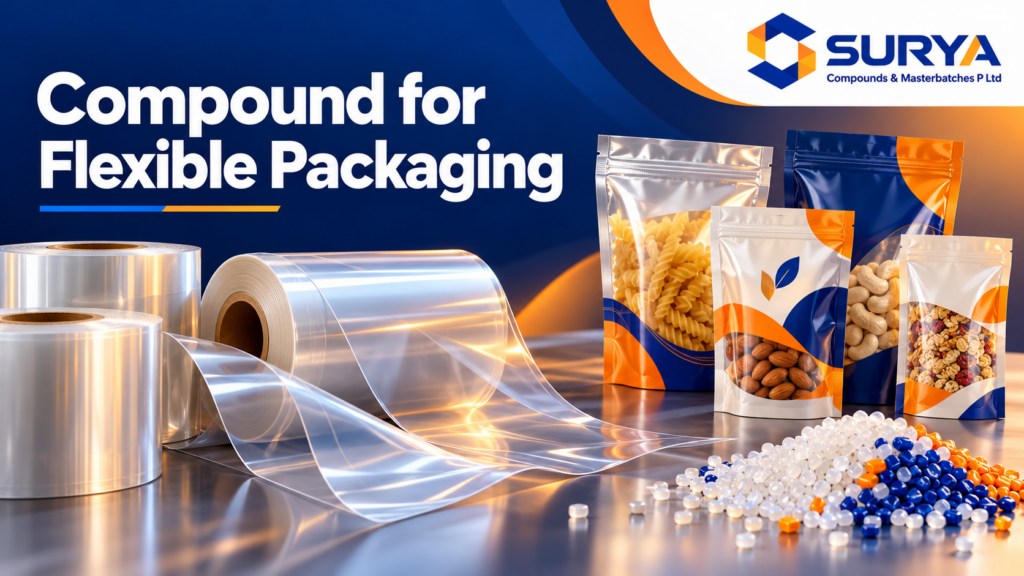
Compound for Flexible Packaging
Flexible packaging needs materials that balance strength, sealability, flexibility, printability, and reliable processing. A Compound for Flexible Packaging is designed to help converters and manufacturers achieve consistent film and packaging performance while matching the requirements of the selected polymer and production process. Common flexible formats include pouches, bags, wraps, liners, rollstock, and films. Flexible packaging can use plastic film alone or in combination with other materials, depending on the application and required barrier properties.
What Is a Compound for Flexible Packaging?
A compound for flexible packaging is a polymer-based formulation engineered for flexible packaging applications. It combines a base resin with selected additives, modifiers, fillers, or other performance ingredients to achieve the required processing and end-use properties. The formulation depends on whether the product is made by blown film, cast film, extrusion coating, lamination, or another process.
Why Is a Compound for Flexible Packaging Important?
Flexible packaging must survive production, filling, transport, storage, and handling. The material also needs to provide the right balance between toughness and flexibility. A well-designed compound supports stable extrusion, consistent film quality, controlled sealing, and reliable mechanical performance. Industry sources identify flexible packaging formats such as bags, pouches, labels, liners, wraps, and rollstock, with benefits linked to efficient use of packaging material and transport space. citeturn0search19
Applications of Compounds for Flexible Packaging
Flexible packaging compounds are used across food, personal care, household, industrial, agricultural, and consumer-product packaging. Common applications include shopping and carry bags, food pouches, liners, stretch and protective films, multilayer film structures, and speciality packaging films.
- Food and snack packaging films
- Stand-up and flat pouches
- Shopping and carry bags
- Industrial liners and sacks
- Agricultural and protective films
- Stretch, shrink, and wrapping films
- Personal care and household-product packaging
Key Properties to Consider
The right formulation depends on the final product and process. Important properties include tensile strength, elongation, puncture resistance, tear strength, impact performance, seal strength, coefficient of friction, clarity or opacity, stiffness, and thermal stability. For barrier packaging, oxygen, moisture, aroma, and light protection requirements also influence material selection.
How to Select a Compound for Flexible Packaging
Use a structured selection process to reduce trial-and-error and improve production consistency.
- Step 1: Define the packaging format and end-use.
- Step 2: Identify the base polymer, such as LDPE, LLDPE, HDPE, PP, or a compatible blend.
- Step 3: Confirm the processing method and machine conditions.
- Step 4: Set mechanical, sealing, appearance, and barrier targets.
- Step 5: Check regulatory and food-contact requirements where relevant.
- Step 6: Run laboratory and production trials before final approval.
Benefits of Using the Compound for Flexible Packaging
- More consistent extrusion and film quality
- Improved mechanical strength and toughness
- Better sealing performance
- Controlled surface properties and appearance
- Reduced processing problems when the formulation matches the resin and equipment
- Opportunity to tailor performance for specific packaging applications
Flexible Packaging Compound: Tips for Better Results
Keep the formulation consistent and monitor raw-material quality. Processing temperature, screw design, cooling, film thickness, and additive dispersion all affect final performance. A formulation should be validated under real production conditions, not only in a laboratory. Flexible film recycling and circularity are also active industry focus areas, so material selection should consider the intended end-of-life pathway where relevant. citeturn0search22
Key Material and Application Comparison
Requirement | Typical Material Options | What to Check | Packaging Benefit |
Film strength | Tensile, tear, puncture, elongation | Durable packaging | |
Seal performance | PE-based film compounds | Seal initiation and seal strength | Reliable closing |
Surface behavior | Polymer + functional additives | COF, slip, blocking | Smooth processing |
Barrier needs | Multilayer-compatible structures | Moisture, oxygen, aroma, light | Product protection |
Best Practices for Better Packaging Compounds
- Define the end-use first. Film, pouch, bag, bottle, cap, tub, and tray applications need different performance targets.
- Match the compound to the base resin and processing method. Check compatibility before full-scale production.
- Control moisture and contamination. Clean raw materials and stable processing conditions improve consistency.
- Test key properties before approval. Typical checks include melt flow, tensile strength, impact, seal performance, appearance, and dimensional stability.
- Use controlled addition rates for additives, colors, and functional modifiers. Validate the final formulation through production trials.
- Review food-contact, regulatory, recycled-content, and sustainability requirements for the intended market before commercialisation.
Common Mistakes to Avoid
- Choosing a compound only on price without checking application performance.
- Using the same formulation across different polymers or processing conditions.
- Ignoring sealability, stiffness, impact, or barrier needs during material selection.
- Skipping trial runs and relying only on laboratory assumptions.
- Changing raw materials without rechecking process stability and final-product performance.
Why Choose Surya Compounds & Masterbatches for Flexible Packaging?
Surya Compounds & Masterbatches focuses on polymer compounds and masterbatch solutions for demanding plastic applications. A packaging compound should deliver consistent processing, predictable properties, and suitability for the final product. Surya Compounds & Masterbatches can support material selection around resin compatibility, processing requirements, appearance, and application performance.
Selecting the right compound for flexible packaging starts with the final packaging format, resin, processing method, and performance targets. A properly matched formulation supports stable processing and consistent product quality. Work with Surya Compounds & Masterbatches to evaluate your application and identify a compound suited to your production requirements.
Talk to Surya Compounds & Masterbatches about your packaging application, resin, processing method, and required performance. Share your specifications to discuss a suitable compound solution for your production needs.
FAQ
Which polymers are used in flexible packaging compounds?
Common options include LDPE, LLDPE, HDPE, and PP. The right polymer depends on film structure, sealing, strength, stiffness, and application requirements.
What properties should flexible packaging compounds provide?
Typical requirements include strength, flexibility, puncture resistance, sealability, process stability, surface performance, and, where needed, barrier properties.
How do I choose a compound for film production?
Start with the film structure, polymer, processing method, thickness, performance targets, and regulatory requirements. Then validate the formulation through trials.
Are flexible packaging compounds suitable for food packaging?
Some formulations are designed for food-contact applications, but suitability depends on the exact formulation, intended use, and applicable regulations. Compliance should be verified before commercial use.
What makes Surya Compounds & Masterbatches a reliable supplier?
Surya Compounds & Masterbatches delivers consistent product quality, customized solutions, and expert technical support to meet diverse industry requirements.