

Anti Rodent Masterbatch and Anti Termite Masterbatch
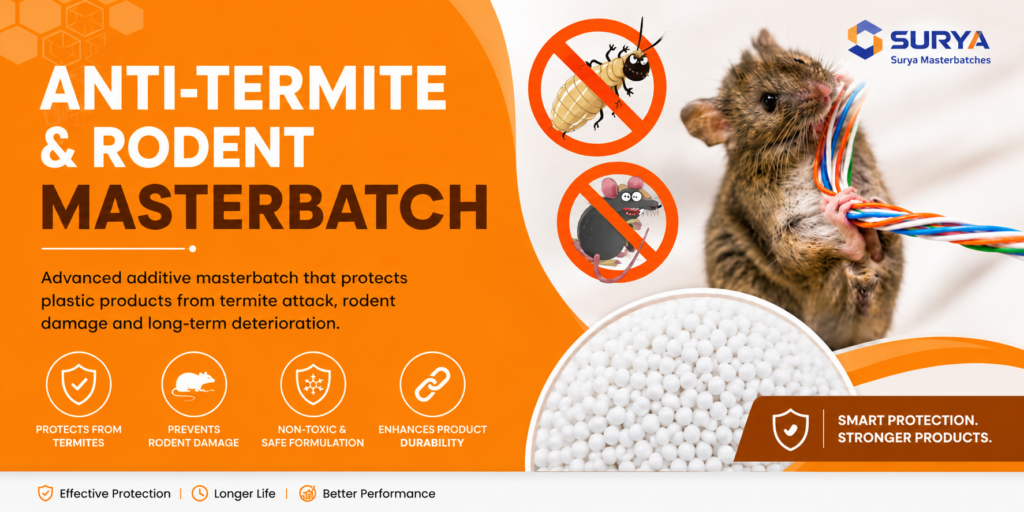
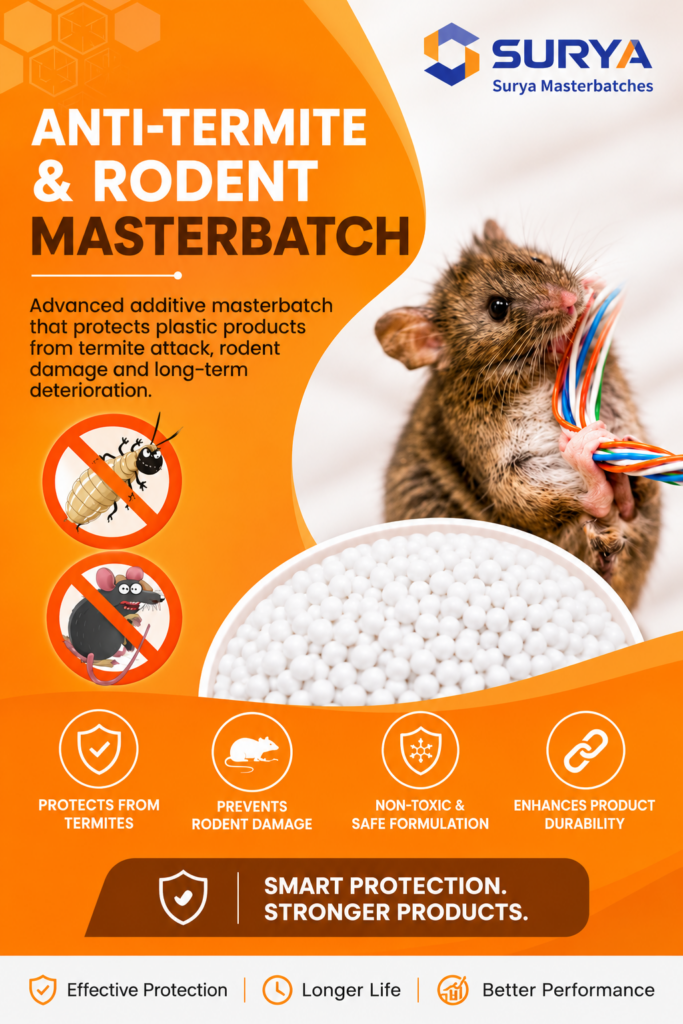
Anti rodent masterbatch is a concentrated additive blended into plastic during manufacturing to help discourage rats and mice from gnawing on the finished product. It can be used for cable outer sheaths, fibre-optic ducts, plastic pipes, and other parts exposed to rodents.
Surya Compounds & Masterbatches manufactures anti rodent masterbatch in India and offers separate anti termite and combination grades. Share your base resin, manufacturing process, and end-use conditions so our team can help you select a grade for a production trial.
Request a Grade Recommendation or Trial Sample
How Does Anti Rodent Masterbatch Work?
An anti rodent masterbatch, also called anti rodent MB, introduces a deterrent into the polymer during processing. A bitter-taste formulation is designed to make the exposed plastic surface unpleasant to gnaw. In cable manufacturing, the outer jacket is a common layer to evaluate because it is the surface exposed to rodents.
Grade selection starts with the base resin and the layer you want to treat. The carrier resin, processing temperature, jacket or wall thickness, and service environment all matter when planning a trial.
What Is Anti Termite Masterbatch Used For?
Anti termite masterbatch is an additive concentrate designed for plastic components exposed to termite activity. Applications to evaluate include buried ducts, protective conduits, pipes, and selected films and geomembranes.
Tell us whether the part will be buried, in contact with soil or moisture, or used outdoors. That information helps determine the trial conditions and the evidence needed for your application. If both rodents and termites are a concern, ask about a combination grade and the test evidence for each pest.
Which Masterbatch Grade Should You Evaluate?
Exposure | Grade to evaluate | What to confirm before a trial |
Rats or mice | Anti rodent masterbatch | Base resin, exposed layer, trial dosage, and rodent test evidence |
Termites | Anti termite masterbatch | Base resin, soil or moisture exposure, and termite test evidence |
Rodents and termites | Combination grade | Compatibility with your formulation and separate evidence for both targets |
Applications for Cables, Pipes and Plastic Products
Wire, Cable and Fibre-Optic Ducts
For power cables, telecom cables, and fibre-optic ducts, identify the exposed layer during grade selection. Share the jacket resin, extrusion temperature, sheath thickness, and the cable specification. During the line trial, check surface finish and the mechanical and electrical properties required by your specification.
Explore Surya’s cable masterbatch range.
Pipes, Conduits and Buried Components
For pipes and conduits, share the resin grade, wall thickness, installation conditions, and target pest. Use a sample from the production line to check dimensions, surface finish, and the relevant pipe or conduit performance requirements.
Explore masterbatches for plastic pipes.
Films, Tarpaulins and Moulded Parts
For films and tarpaulins, share the film thickness, layer structure, and exposure conditions. Check appearance, tear strength, and seal performance where relevant. For moulded parts, check the exposed surface, finish, and impact or strength requirements for the part.
Dosage, Polymer Compatibility and Line Trials
What Dosage Should You Use?
Use the starting let-down rate recommended for the selected grade and your application. The let-down rate is the percentage of masterbatch in the final blend by weight. Batch size, the layer being treated, and other additives in the formulation are useful details when requesting a trial recommendation.
Which Polymers Are Compatible?
Share the exact resin or compound you process, such as LDPE, HDPE, PP, or PVC, along with the processing temperature. Surya can review the carrier fit for your formulation. For multilayer products, tell us which layer will contain the additive and whether the blend includes fillers, pigments, UV stabilisers, or flame retardants.
How Should You Run a Production Trial?
- Select the grade. Share your base resin, process, target pest, and finished-part requirements.
- Dose and process a trial batch. Follow the grade-specific dosing and processing instructions. Record the blend ratio, processing settings, and observations from the line.
- Compare treated and untreated samples. Check dispersion, appearance, and the properties your finished part must meet. Where pest resistance is a purchase requirement, agree on a test method and acceptance criteria for the finished sample.
Technical Documents and Test Evidence
When you request a grade recommendation, ask for the technical data sheet (TDS), the safety data sheet (SDS), and any available performance test documentation for that grade. For a customer approval or tender, share the required test method and acceptance criteria with our team.
When reviewing a performance report, check the tested polymer, specimen thickness, dosage, target pest, and exposure conditions. These details help you judge how closely the test matches your own part and its service conditions.
Request a Sample or Bulk Quote
Surya Compounds & Masterbatches is an anti rodent masterbatch manufacturer in India. For grade selection, a trial sample, or a bulk quote, share the following:
- Your finished product and target pest
- Polymer grade or compound and manufacturing process
- Processing temperature and treated layer or part thickness
- End-use conditions and any required test standard
- Trial quantity, estimated order volume, and delivery location


 Trustindex verifies that the original source of the review is Google.
 Trustindex verifies that the original source of the review is Google.
 Trustindex verifies that the original source of the review is Google.
 Trustindex verifies that the original source of the review is Google.
Frequently Asked Questions (FAQs)
Q1. What is anti-rodent masterbatch, and how does it work?
Anti-Rodent Masterbatch is a polymer additive concentrate that incorporates bitter-tasting compounds into plastic. When rodents bite into treated plastic, the unpleasant taste stops them immediately and discourages future attempts. The rodent then signals its community, creating a self-reinforcing repellent effect. |
Q2. Is Anti-Rodent Masterbatch safe for humans and animals?
Yes. Our formulation uses non-toxic, non-hazardous ingredients. The repellent works purely through taste and odor—not poison—making it completely safe for humans, pets, and the environment. |
Q3. What is Anti-Termite Masterbatch used for?
Anti-termite masterbatch is used in plastic products exposed to termite-prone environments—such as underground pipes, agricultural films, construction conduits, and outdoor furniture. It releases compounds that are deeply unpleasant to termites and keeps them away long-term. |
Q4. Can I use both anti-rodent and anti-termite masterbatch together?
Yes. For applications that face both threats—such as outdoor conduits or agricultural films — you can use both, or ask us about our combination-grade product. Our technical team will guide you on the right dosage and processing conditions. |
Q5. What is the recommended dosage for these masterbatch products?
The typical dosage is 1–3% by weight of the total polymer. The exact amount depends on your application, risk level, and base polymer. We recommend consulting our technical team for precise guidance tailored to your product. |
Q6. Which polymers are compatible with Surya's masterbatch products?
Our Anti Rodent MB and Anti Termite MB are compatible with PE, PP, PVC, HDPE, LDPE, and most standard commodity polymers used in cable, pipe, film, and molding applications. |
Q7. How long does the repellent effect last in the finished product?
The effect is designed to last throughout the service life of the product. Active ingredients are released in a controlled manner over time, ensuring long-term protection without rapid depletion. |
Q8. Why choose Surya Compounds & Masterbatches over other manufacturers?
Surya Compounds & Masterbatches combines in-house R&D, consistent quality control, and a strong technical support team. We offer custom grades, competitive pricing, and a deep understanding of Indian processing conditions—making us a dependable long-term partner for your masterbatch needs. |
Q9. Can one grade help deter both rodents and termites?
Surya offers combination grades for applications where both pests are a concern. Ask for evidence covering each pest and check whether the tested conditions match your application.
Q10. Can I use this masterbatch in food-contact packaging?
Confirm the intended use with Suryamb and request written food-contact documentation for the exact grade, application, and market before specifying it.