

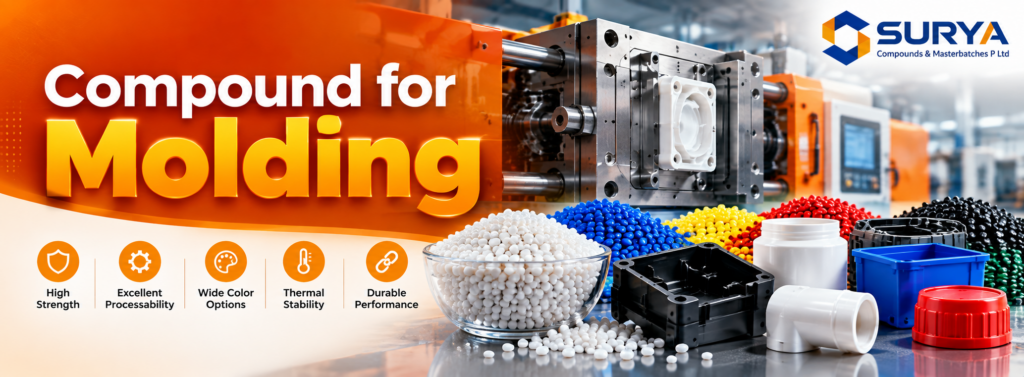
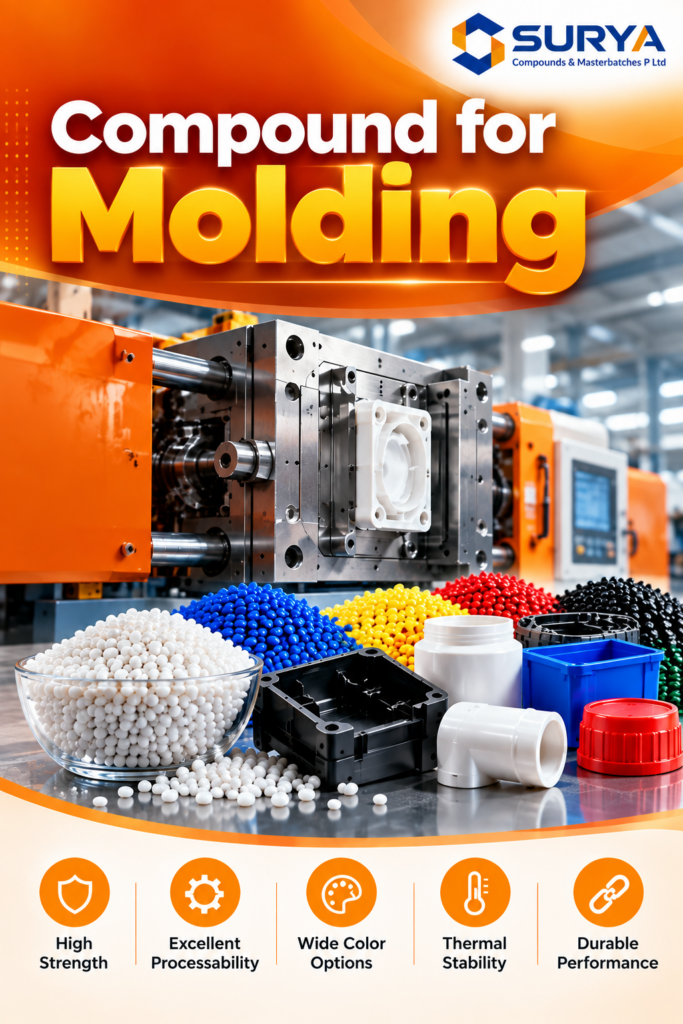
Compound for Molding Customized Plastic Solutions
Compound for Molding is a specially formulated plastic material designed to deliver consistent processing, strength, appearance, and performance in moulded plastic products. Manufacturers use moulding compounds for parts made through injection moulding, compression molding, and other thermoplastic processing methods. The right material helps control flow, shrinkage, surface finish, impact strength, heat resistance, and dimensional stability.
Surya Compounds & Masterbatches develops plastic compounds for different molding requirements. Each formulation can be selected according to the polymer, processing method, end-use environment, and required physical properties.
What Is Compound for Moulding?
A Compound for Molding is a prepared polymer formulation that combines a base resin with selected additives, fillers, reinforcements, stabilizers, pigments, or performance modifiers. The formulation is engineered to provide a predictable processing window and consistent finished-part properties.
A plastic molding compound is supplied in a form suitable for industrial processing, commonly as pellets or granules. During molding, heat and pressure soften or melt the material. The compound then fills the mold cavity and forms the required component after cooling or curing.
Types of Compound for Molding
Different applications need different resin systems and property profiles. Common options include:
- PP-based compounds for lightweight molded parts, automotive components, containers, and consumer products.
- ABS compounds for housings, electrical parts, appliance components, and products requiring good impact strength and surface finish.
- PA compounds for engineering parts that need strength, stiffness, wear resistance, and temperature performance.
- TPE and other flexible compounds for molded products that require elasticity, soft touch, or grip.
- Mineral-filled and reinforced compounds for improved stiffness, dimensional stability, and structural performance.
- Specialty compounds with UV, flame-retardant, anti-static, heat-stabilized, or other functional properties.
Plastic Molding Compound Manufacturer: What to Look For
Choosing a Plastic Molding Compound Manufacturer involves more than comparing material price. A reliable supplier should understand your polymer, molding machine, processing conditions, product geometry, and end-use requirements.
- Consistent raw material quality and batch-to-batch performance.
- Formulation support based on application and processing conditions.
- Stable melt flow and predictable molding behavior.
- Quality testing for mechanical, thermal, and physical properties.
- Technical support for material selection, trials, and process optimization.
- Ability to develop customized formulations when standard grades do not meet the application.
Importance of Compound for Molding
The correct molding compound improves both production efficiency and finished-part performance. Key benefits include:
- Better process consistency: A controlled formulation supports stable molding cycles.
- Improved product strength: Reinforcements and fillers can increase stiffness, strength, and durability.
- Better surface finish: Suitable additives and resin selection help reduce surface defects.
- Dimensional stability: Properly designed compounds help control shrinkage and warpage.
- Application-specific performance: The material can be designed for heat, impact, wear, UV, or chemical exposure.
- Lower production risk: Consistent pellets and predictable melt behavior reduce processing variation.
Plastic Molding Compound Selection Guide
Requirement | Suitable Material Approach | Typical Benefit | Common Applications |
High impact | Impact-modified polymer | Improved toughness | Automotive and consumer parts |
High stiffness | Mineral or glass-filled compound | Higher rigidity | Structural molded components |
Heat resistance | Heat-stabilized engineering compound | Better thermal performance | Electrical and industrial parts |
Flexible feel | TPE or flexible compound | Elasticity and soft touch | Grips, seals, flexible parts |
Outdoor use | UV-stabilized formulation | Better weathering resistance | Outdoor and automotive parts |
Why Choose Surya Compounds & Masterbatches?
The correct molding compound improves both production efficiency and finished-part performance. Key benefits include:
- Better process consistency: A controlled formulation supports stable molding cycles.
- Improved product strength: Reinforcements and fillers can increase stiffness, strength, and durability.
- Better surface finish: Suitable additives and resin selection help reduce surface defects.
- Dimensional stability: Properly designed compounds help control shrinkage and warpage.
- Application-specific performance: The material can be designed for heat, impact, wear, UV, or chemical exposure.
- Lower production risk: Consistent pellets and predictable melt behavior reduce processing variation.
Get the Right Compound for Your Molding Application
The right Compound for Molding helps you achieve stable processing, consistent dimensions, reliable strength, and the performance your finished product needs. Material selection should consider the polymer, molding conditions, product geometry, end-use environment, and required properties.
Surya Compounds & Masterbatches can help you identify a suitable compound for your molding application and discuss custom formulation requirements.
Need the right compound for your molding application? Contact Surya Compounds & Masterbatches to discuss your material requirements and product specifications.
FAQS
What is Compound for Molding?
Compound for Molding is a formulated polymer material designed to provide controlled processing and specific properties in molded plastic products.
What is a plastic molding compound used for?
It is used to manufacture molded components where controlled strength, stiffness, impact resistance, surface finish, dimensional stability, or other performance properties are required.
How do I choose the right plastic molding compound?
Consider the base polymer, molding process, melt flow, temperature, mechanical requirements, chemical exposure, appearance, and expected service conditions.
What does a Plastic Molding Compound Manufacturer provide?
A manufacturer supplies formulated compounds and supports material selection, customization, testing, and processing requirements.
Can molding compounds be customized?
Yes. Formulations can be adjusted for properties such as impact strength, stiffness, flexibility, heat resistance, UV stability, color, or other application needs.