

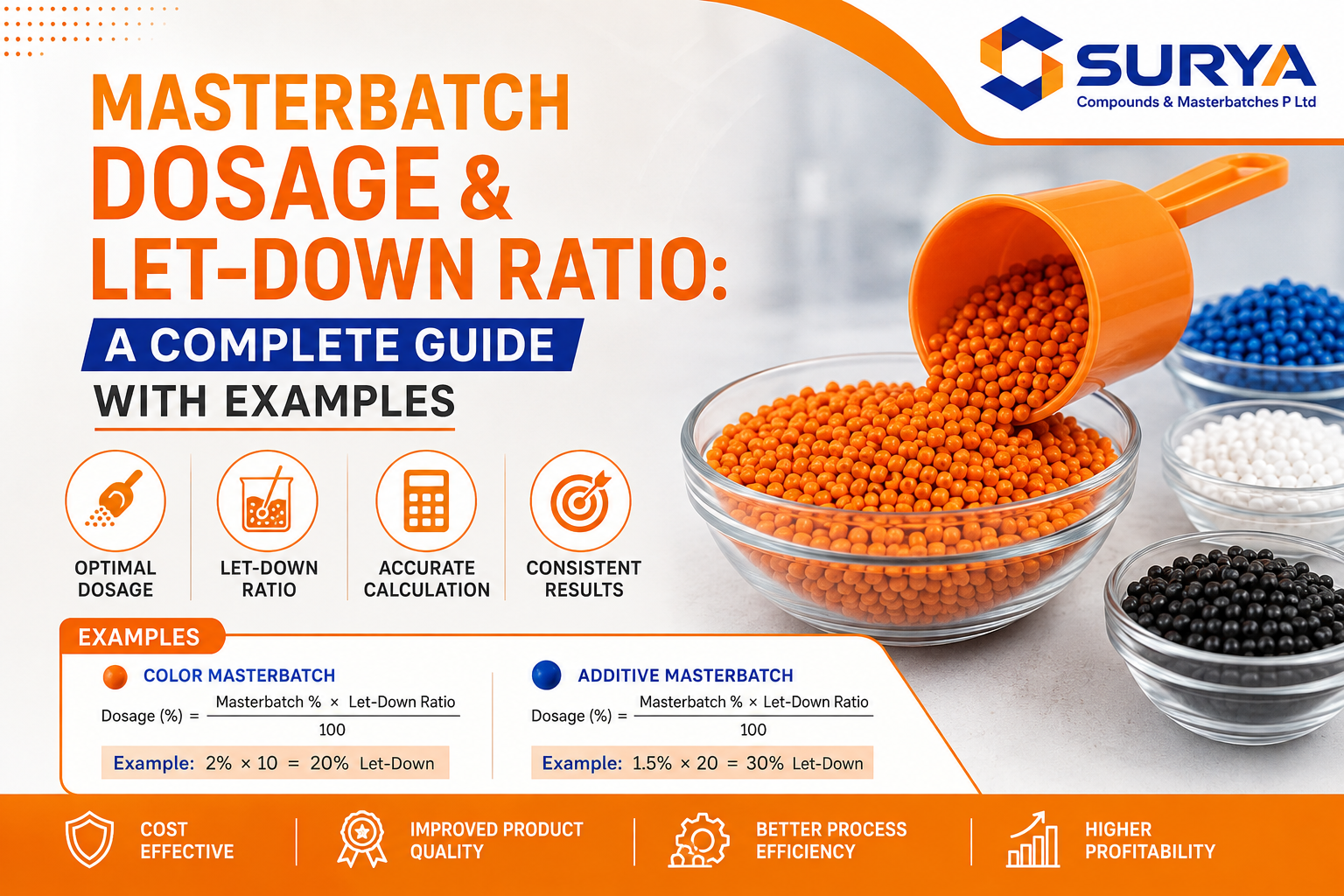
Masterbatch dosage is the percentage of masterbatch you add to your base polymer to achieve the required color or performance. This guide explains the let-down ratio (LDR), gives the exact formula with worked examples, lists typical dosage percentages, and shows how to avoid the mistakes that cause color variation and scrap.
| Quick answer: Most masterbatches are dosed between 1% and 5% of total product weight. Color masterbatch is commonly added at 2–4%, transparent and translucent shades at 3% or more, and white (opacifying) masterbatch often at 3–8%. Additive masterbatch dosage depends on the active level required in the final part—always follow the supplier’s technical data sheet. |
What is the masterbatch let-down ratio (LDR)?
The let-down ratio (also called addition rate or dosing rate) is the percentage of masterbatch blended into the base polymer to make the finished product. An LDR of 3% means 3 kg of masterbatch for every 100 kg of base polymer (or 3 g per 100 g). A lower LDR means a more concentrated masterbatch, which can reduce cost per kg of finished product but demands thorough mixing to distribute the color or additive evenly.
The masterbatch dosage formula
Masterbatch required (kg) = Total batch weight (kg) × LDR
Rearranged for the base polymer in a batch:
- Masterbatch weight = Total shot / batch weight × LDR
- Base polymer weight = Total weight − Masterbatch weight
Worked example 1 — colour masterbatch at 3% LDR
You are molding a 100 kg batch and your supplier recommends a 3% let-down ratio:
- Masterbatch = 100 × 0.03 = 3 kg
- Base polymer = 100 − 3 = 97 kg
Worked example 2 — per-part dosing
For a part with a 200 g shot weight at 2% LDR:
- Masterbatch per shot = 200 g × 0.02 = 4 g
Over a 10,000-part run, that is 40 kg of masterbatch — useful for forecasting purchase quantities and cost.
Typical masterbatch dosage percentages
The table below shows common starting points. Exact figures depend on pigment loading, opacity target, wall thickness, and the required additive level — always confirm with the supplier’s TDS.
|
Masterbatch type |
Typical LDR | Notes |
|
Colour (opaque) |
2–4% | Depends on shade depth and pigment concentration |
|
Transparent / translucent colour |
≥3% |
Higher dosing ensures even distribution in clear polymers |
|
White (TiO₂ / opacifying) |
3–8% |
Higher for opacity in thin films and containers |
|
Black |
1–3% |
High-tint carbon black pigments allow low dosing |
| Filler (CaCO₃ / talc) | 10–40% |
Loaded for cost saving and stiffness, not colour |
| Additive (UV, slip, antiblock, etc.) | 1–5% |
Set by required active level in the final part |
How to choose the right dosage
- Start from the supplier’s recommended LDR on the technical data sheet — it is calibrated to that masterbatch’s pigment/additive loading.
- Check the functional requirement. For additive masterbatch (UV, flame retardant, slip), the dosage must deliver the correct active concentration in the final part, not just a colour target.
- Account for opacity and wall thickness. Thin films and transparent parts usually need higher dosing to look consistent.
- Validate with a trial run and measure color against a standard before scaling to production.
- Use gravimetric dosing where possible for tighter accuracy than volumetric feeders, especially at low LDR.
Common dosing mistakes to avoid
- Chasing the lowest LDR for cost: an under-dosed, highly concentrated masterbatch can cause streaking if mixing is inadequate.
- Ignoring the additive level: reducing dosage to save cost can drop UV or flame-retardant protection below the level the part needs to perform.
- Volumetric feeders at very low LDR: small errors become large color shifts; gravimetric systems are more reliable.
- No incoming or in-process color check: without a reference standard, drift goes unnoticed until parts are rejected.
Frequently Asked Questions
What is a let-down ratio in masterbatch?
The let-down ratio (LDR) is the percentage of masterbatch added to the base polymer to make the finished product. A 3% LDR means 3 kg of masterbatch per 100 kg of base polymer.
How do I calculate masterbatch percentage?
Multiply the total batch or shot weight by the LDR. For a 100 kg batch at 3% LDR, you need 100 × 0.03 = 3 kg of masterbatch and 97 kg of base polymer.
What is the typical dosage for colour versus additive masterbatch?
Opaque color masterbatch is commonly dosed at 2–4%, transparent shades at 3% or more, and white at 3–8%. Additive masterbatch dosage is set by the active level the final part requires, usually 1–5%, per the supplier’s data sheet.
Does over-dosing masterbatch cause defects?
Yes. Over-dosing can shift colour, raise cost, and, in some cases, affect mechanical properties or cause surface issues such as plate-out. Under-dosing a concentrated masterbatch can cause streaking. Follow the recommended LDR and validate with a trial.
