

Quick Answer
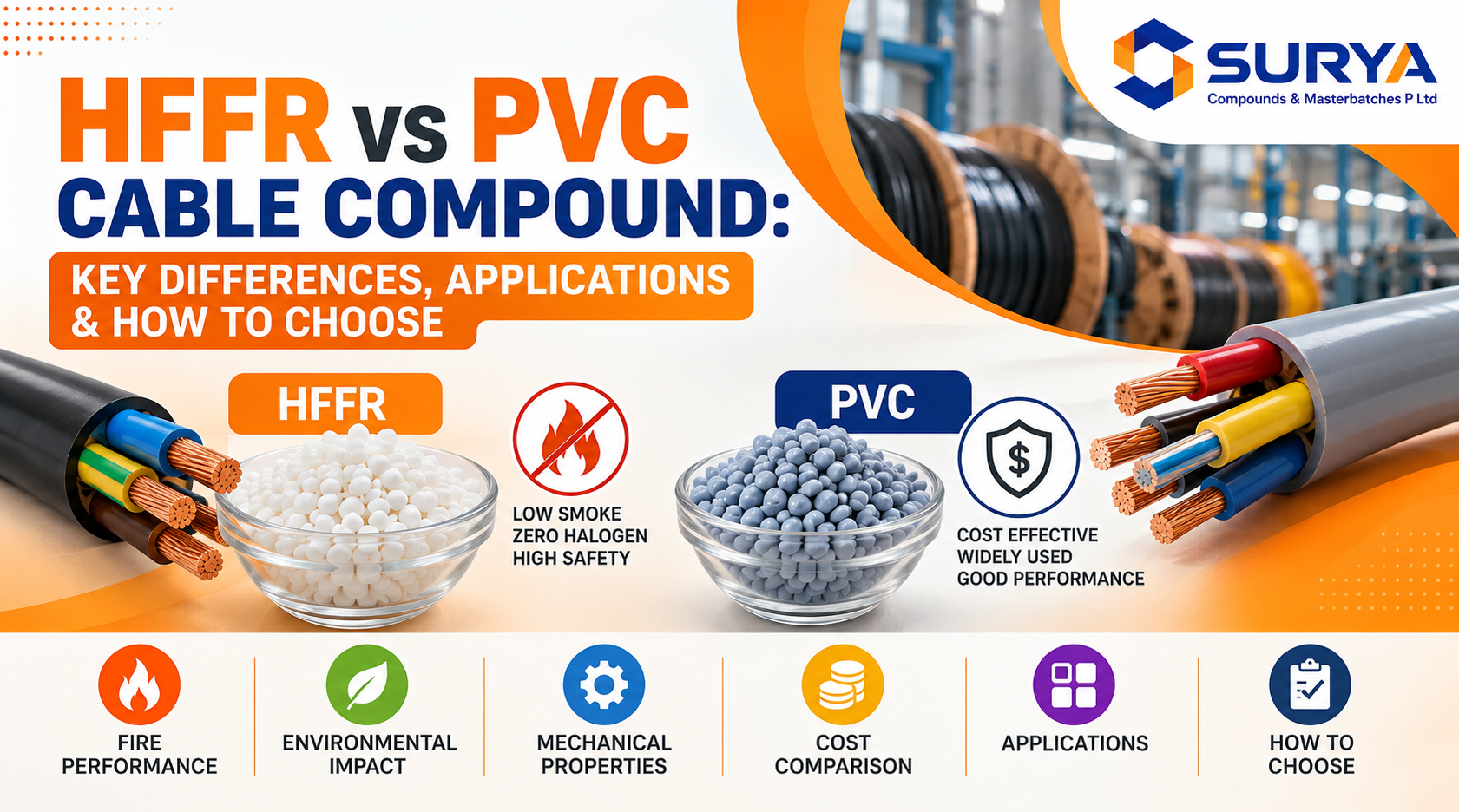
The main difference between HFFR and PVC cable compound is how they behave in a fire. PVC contains chlorine, so when it burns, it gives off dense black smoke and corrosive hydrogen chloride (HCl) gas. HFFR (Halogen-Free Flame Retardant) compound contains no halogens and uses mineral fillers that release water vapour when heated, so it produces low smoke and almost no corrosive acid gas.
PVC is cheaper, more flexible, and easier to process, which makes it the standard choice for general wiring. HFFR is the safer choice for crowded or enclosed spaces such as metro systems, hospitals, airports, data centres, and high-rise buildings.
This guide explains both compounds in simple terms, so cable manufacturers can pick the right one for each application.
What Is PVC Cable Compound?
PVC cable compound is polyvinyl chloride resin blended with plasticisers, heat stabilisers, fillers, lubricants and other additives, supplied as ready-to-extrude granules. It is used as insulation around conductors and as the outer sheath of wires and cables.
PVC has been the most widely used cable material for decades because it is:
- Affordable and easily available
- Easy to process on standard extrusion lines at high speeds
- Flexible and tough, with good abrasion, oil and moisture resistance
- Naturally flame resistant, thanks to its chlorine content
- Easy to colour for core identification
A PVC cable insulation compound is made in several grades: general-purpose insulation, sheathing, heat-resistant grades (for 85°C and 105°C ratings), and FR or FRLS (Flame Retardant Low Smoke) grades. In India, PVC insulation and sheathing compounds for cables are generally made to meet IS 5831, and the cables built with them follow standards such as IS 694 and IS 1554.
The limitation: PVC still contains chlorine. FRLS grades reduce smoke and acid gas, but they do not remove them. When PVC burns, it releases HCl gas, which is toxic to people and corrosive to electrical and electronic equipment.
What Is HFFR (Halogen-Free) Cable Compound?
HFFR (Halogen-Free Flame Retardant) cable compound is a polyolefin base, usually EVA or polythene, filled with mineral flame retardants such as aluminium trihydrate (ATH) or magnesium hydroxide (MDH). It is also called halogen-free cable compound, LSZH or LS0H (Low Smoke Zero Halogen), and ZHFR (Zero Halogen Flame Retardant).
When an HFFR cable is exposed to fire, the mineral fillers break down and release water vapour. This cools the material, dilutes the flammable gases, and leaves a protective char layer on the surface. The result is:
- Low smoke, so escape routes stay visible
- No halogen acid gas, so the smoke is far less toxic and corrosive
- Reduced flame spread along the cable run
The mineral fillers make up a large share of the compound. That is why HFFR needs careful formulation to balance fire performance, mechanical strength and smooth extrusion.
HFFR vs PVC Cable Compound: Side-by-Side Comparison
PVC wins on cost, flexibility and ease of processing; HFFR wins on smoke, toxicity and corrosion in a fire.
| Property | PVC Cable Compound | HFFR Cable Compound |
|---|---|---|
|
Base material |
PVC resin + plasticisers + stabilisers | Polyolefin (EVA/PE) + mineral fillers (ATH/MDH) |
|
Halogen content |
Contains chlorine | Halogen-free |
|
Smoke when burning. |
Dense black smoke (less in FRLS grades) |
Low smoke |
| Corrosive acid gas | Releases HCl |
Negligible |
|
Flame retardancy |
Good, from chlorine content | Good, from mineral fillers |
| Flexibility | Very good |
Good, depends on formulation |
|
Abrasion and oil resistance |
Very good | Moderate |
| Moisture resistance | Very good |
Moderate |
|
Processing |
Easy, high line speeds | Needs tighter process control |
| Material cost | Lower |
Higher |
| Typical use | House wiring, building wires, control and power cables |
Metros, tunnels, hospitals, airports, data centres, ships, high-rises |
Fire Safety: The Biggest Difference
In most building fires, smoke and toxic gas cause more harm than the flames. This is where HFFR clearly leads.
- Smoke density: HFFR cables produce much less smoke, which keeps exits visible and helps rescue teams. Smoke density is commonly tested to IEC 61034.
- Toxic and corrosive gas: Burning PVC releases HCl, which irritates the lungs and turns into hydrochloric acid when it meets moisture. That acid can damage electronics and metal structures long after the fire is out. Halogen-free compounds are tested for acid gas under IEC 60754.
- Flame spread: Both FR-grade PVC and HFFR compounds can be formulated to pass flame propagation tests such as IEC 60332.
Simple rule: if people could be trapped in an enclosed space, or if costly equipment must be protected from corrosion, choose HFFR.
Mechanical Properties, Processing and Cost
Mechanical performance. PVC compounds offer excellent flexibility, tensile strength, abrasion resistance and resistance to oils and moisture. HFFR compounds carry a high mineral filler load, so a poorly made grade can be stiffer, less elongating and weaker in abrasion. A well-formulated HFFR compound closes much of this gap, which is why compound quality matters so much.
Processing. PVC runs easily on most extruders at high line speeds. HFFR needs more control:
- Lower and more stable melt temperatures, so the fillers do not start breaking down in the barrel
- Suitable screw design and tooling, since highly filled melts behave differently
- Dry material, because mineral fillers can pick up moisture
- Often slower line speeds than PVC
A consistent, well-dispersed compound from the supplier makes these settings far easier to hold on the shop floor.
Cost. PVC compound costs less per kilogram, and HFFR compounds are also denser, so you need more material by weight for the same cable length. However, the total cost picture should include safety compliance, project specifications and the cost of damage from smoke and acid gas in a fire.
Applications: Which Compound Should You Choose?
Choose based on where the cable will be installed and what the project specification demands.
| Choose PVC cable compound for | Choose HFFR cable compound for |
|---|---|
|
House and building wiring |
Metro rail, railways and tunnels |
|
Industrial control and power cables |
Hospitals, schools and malls |
|
Flexible cords and appliance wires |
Airports and public buildings |
| Outdoor and underground cables (suitable grades) |
Data centres and telecom rooms |
| Budget-sensitive general projects |
Ships, offshore and high-rise buildings |
Ask these four questions before you decide:
- Will many people be in an enclosed space? If yes, lean towards HFFR.
- Is there sensitive or costly equipment nearby? Halogen-free cables protect it from acid corrosion.
- What does the tender or customer specification say? Many infrastructure projects now ask for halogen-free or LSZH cables.
- What are the mechanical and budget needs? For general wiring where cost and toughness matter most, PVC remains the practical choice.
Why Choose Surya Compounds & Masterbatches
Surya Compounds & Masterbatches has manufactured polymer compounds and masterbatches in India since 1986, from its plant in Kundli, Haryana. For cable makers, it supplies both sides of this comparison:
- PVC Compound grades for cable insulation and sheathing
- ZHFR / HFFR Compound grades for low-smoke, halogen-free cables
- Cable Compound and Masterbatch for Cables for colour and performance
With in-house R&D, Surya can help you choose or customise a compound to match your extrusion line and the standards your cables must meet.
Frequently Asked Questions
What is the main difference between HFFR and PVC cable compound?
PVC contains chlorine and releases dense smoke and corrosive HCl gas when burning. HFFR is halogen-free, so it gives low smoke and almost no corrosive gas.
Is HFFR the same as LSZH or ZHFR?
In practice, yes. HFFR, LSZH, LS0H and ZHFR all describe halogen-free, low-smoke, flame-retardant cable materials. Exact properties depend on the grade and the standard it meets.
Is HFFR cable compound better than PVC?
HFFR is better for fire safety in enclosed or crowded spaces. PVC is better for cost, flexibility and ease of processing in general wiring.
Why is HFFR compound more expensive than PVC?
It uses special polymers and a high load of mineral flame retardants, needs careful compounding, and is denser, so more material is used per metre of cable.
Is FRLS PVC the same as halogen free?
No. FRLS PVC reduces smoke and acid gas but still contains chlorine. Only halogen-free compounds such as HFFR avoid halogen acid gas.
Can HFFR compound run on a PVC extrusion line?
Usually yes, but temperature profile, screw design and drying need adjustment. Your compound supplier can recommend the right settings.
Where is halogen-free cable compound mandatory?
It is often specified for metros, tunnels, airports, hospitals, data centres and ships. Always check the project tender and the applicable standards.
Get the Right Cable Compound for Your Application
Not sure whether PVC or HFFR fits your next cable project? Share your cable type, standard, and extrusion setup with the Surya Compounds & Masterbatches team, and get a grade recommendation and samples. Contact us
