

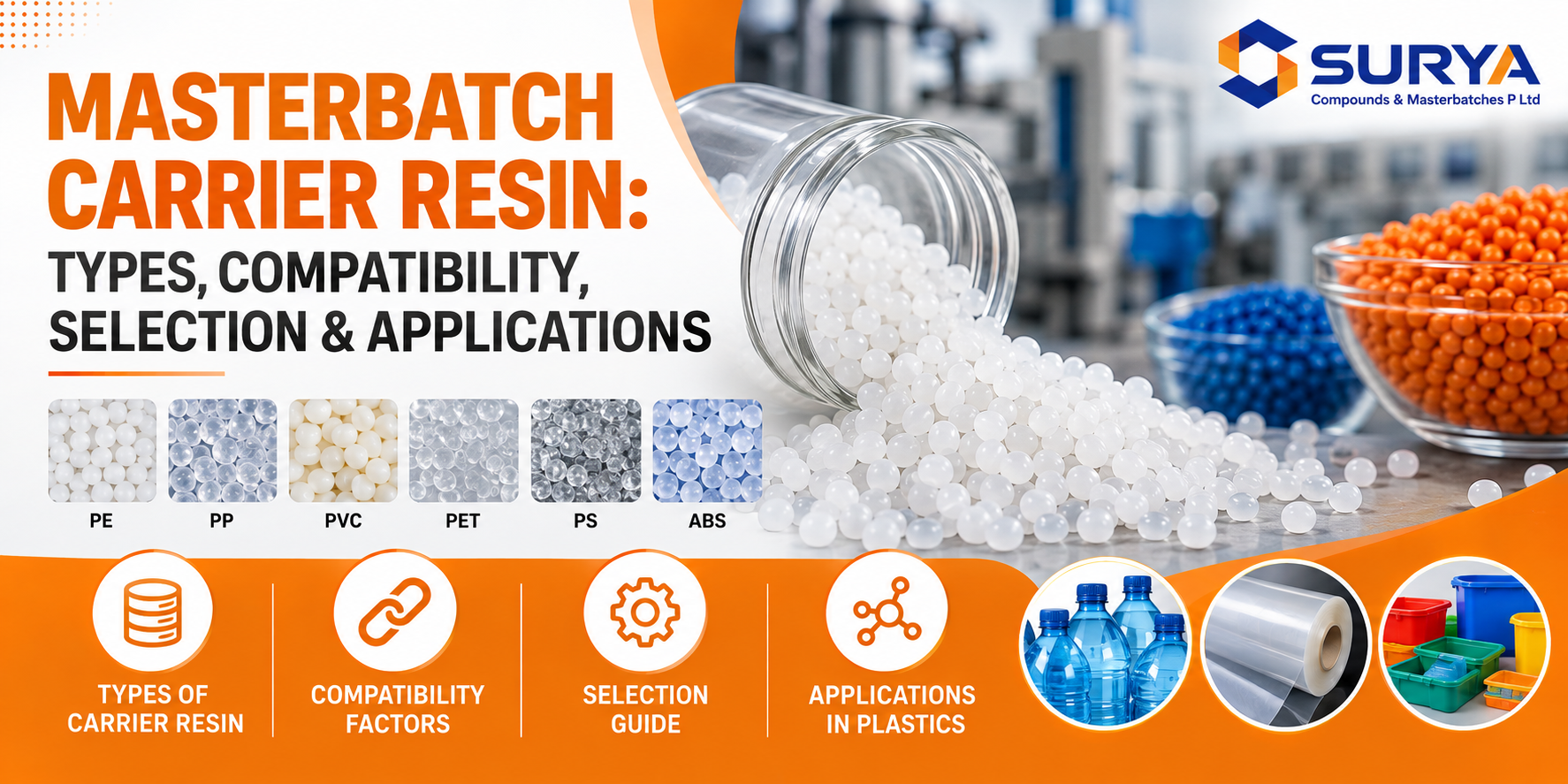
Masterbatch carrier resin is the polymer base that carries pigments, dyes, or functional additives and helps distribute them throughout the final plastic material. Selecting the right carrier resin affects color dispersion, processing stability, surface appearance, mechanical properties, and the performance of the finished plastic product.
The carrier resin should be selected according to the base polymer, processing method, melt-flow behavior, processing temperature, application requirements, and required dispersion.
For example, a PE carrier masterbatch is commonly considered for polyethylene and selected polyolefin applications, while PP, PET, ABS, PA, and other polymer systems often require carrier systems designed around their specific processing and compatibility requirements.
This guide explains masterbatch carrier resin, carrier resin compatibility, PE carrier masterbatch, carrier selection criteria, common compatibility problems, and practical ways to choose the right carrier for your application.
Quick Answer: What Is a Masterbatch Carrier Resin?
A masterbatch carrier resin is the polymer matrix in which pigments, dyes, or additives are dispersed at high concentration.
During production, the masterbatch is mixed with the base resin at a specified dosage. The carrier melts and blends with the base polymer, helping distribute the pigment or additive throughout the final product.
A typical masterbatch formulation can contain:
- Carrier resin
- Pigments or dyes
- Functional additives
- Dispersing agents
- Processing aids
- Other formulation components
The carrier is therefore an active part of the masterbatch formulation. Its compatibility with the final polymer affects how efficiently the concentrate disperses and how the finished product performs.
Why Is Carrier Resin Important in Masterbatch?
Carrier resin does more than hold pigment or additives together.
It influences:
- Pigment dispersion
- Additive distribution
- Melt flow
- Processing behavior
- Color consistency
- Surface appearance
- Mechanical properties
- Thermal stability
- Migration behaviour
- Production stability
When the carrier and base polymer work well together, the masterbatch is more likely to disperse consistently during extrusion, injection molding, blow molding, film production, fibre production, or other polymer-processing operations.
When compatibility is poor, processors might experience streaks, specks, poor colour development, surface defects, inconsistent properties, or processing instability. These effects are also highlighted in current carrier-resin compatibility guidance.
Masterbatch Carrier Resin vs Base Resin
These terms are related but are not always interchangeable.
The carrier resin is the polymer used inside the masterbatch.
The base resin is the polymer used to manufacture the final plastic product.
For example:
Base resin: HDPE
Masterbatch carrier: PE-based carrier
The masterbatch is added to the HDPE at the recommended dosage. During processing, the carrier and HDPE form the polymer mixture in which the pigment or additive is distributed.
The goal is to select a carrier that works effectively with the final base resin and processing conditions.
How Does Carrier Resin Compatibility Affect Masterbatch Performance?
Carrier resin compatibility refers to how effectively the carrier interacts and mixes with the target polymer during processing.
Compatibility affects several stages of masterbatch performance.
1. Dispersion
A compatible carrier helps the pigment or additive distribute uniformly through the base polymer.
Poor compatibility can contribute to:
- Color streaks
- Pigment agglomeration
- Specks
- Uneven color
- Inconsistent additive performance
2. Processing
The carrier should melt and flow appropriately within the processing window of the base resin.
A significant mismatch in rheological behavior can make dispersion more difficult.
3. Surface Quality
Poor compatibility can contribute to visible surface problems such as:
- Streaking
- Spots
- Gloss variation
- Haze
- Flow marks
- Surface irregularities
4. Mechanical Properties
The carrier becomes part of the final polymer system after let-down.
An unsuitable carrier can affect properties such as:
- Tensile strength
- Impact performance
- Elongation
- Flexibility
- Stiffness
The effect depends on the polymer combination, carrier concentration, masterbatch dosage, formulation, and application.
5. Production Consistency
A compatible carrier supports repeatable colour and additive performance across production batches.
This is especially important for:
- Thin films
- Fibres
- Packaging
- Automotive components
- Consumer products
- Technical parts
Types of Masterbatch Carrier Resin
Different polymer systems require different carrier approaches.
The most common carrier families include:
|
Carrier resin |
Typical target polymers/applications |
Key consideration |
| LDPE, LLDPE, HDPE and selected polyolefin applications | Good fit for many PE-based applications | |
| PP products, woven applications, injection moulding | Match to PP processing conditions | |
| PET bottles, sheets, fibres | High-temperature stability is important | |
|
PS |
PS and selected styrenic applications |
Check compatibility with the specific styrenic resin |
| ABS |
ABS and selected engineering applications |
Carrier should match the engineering polymer system |
| PA | Nylon/PA applications |
Thermal stability and compatibility are critical |
| Flexible and specialty applications | Carrier and processing window require careful selection | |
| Specialty carriers | Specific polymer or multi-polymer applications |
Require application-specific testing |
This does not mean every polymer in the same family is automatically interchangeable. LDPE, LLDPE, HDPE, and PP have different processing characteristics, so the carrier should be evaluated against the actual resin and application.
PE Carrier Masterbatch
PE carrier masterbatch uses polyethylene as the primary carrier system.
It is widely considered for applications based on:
- LDPE
- LLDPE
- HDPE
- Selected polyolefin systems
Common applications include:
- Flexible packaging film
- Shopping bags
- Agricultural film
- Blown film
- Extruded sheets
- Containers
- Blow-molded products
- Injection-molded PE products
- Industrial packaging
However, “PE carrier” is not a complete technical specification.
The specific PE carrier grade matters.
Its:
- MFI
- Molecular structure
- Processing behavior
- Melt viscosity
- Thermal stability
- Additive compatibility
should be evaluated against the target resin.
Is PE Carrier Masterbatch Suitable for PP?
A PE carrier can work in selected PP applications because PE and PP are both polyolefins. However, compatibility should not be assumed for every formulation or application.
For critical applications, test the masterbatch under actual production conditions.
This is particularly important for:
- High-speed production
- Thin-wall products
- Fibre
- Transparent products
- High-impact parts
- Applications with strict mechanical-property requirements
Current industry guidance also distinguishes between broad polyolefin compatibility and application-specific performance.
PE Carrier vs PP Carrier
PE and PP are both polyolefins, but they are not identical.
|
Factor |
PE Carrier | PP Carrier |
|
Primary use |
PE-based applications | PP-based applications |
| Common polymers | LDPE, LLDPE, HDPE |
PP homopolymer and copolymer |
|
Typical applications |
Films, bags, containers, packaging |
Injection moulding, woven products, rigid packaging |
|
Compatibility |
Strongest within suitable PE systems |
Strongest within suitable PP systems |
|
Selection factors |
MFI, melt behaviour, application |
MFI, melt behaviour, processing temperature |
| Testing | Recommended for critical applications |
Recommended for critical applications |
The correct choice depends on the actual formulation rather than polymer names alone.
What Factors Determine Carrier Resin Compatibility?
Carrier resin compatibility depends on more than chemical similarity.
You should evaluate at least these factors.
1. Polymer Chemistry
The carrier should have suitable interaction with the target polymer.
A large difference in polymer chemistry or polarity can create compatibility problems.
For example, a carrier designed for a non-polar polyolefin system should not automatically be treated as suitable for polar engineering polymers.
2. Melt Flow Index
MFI, or melt flow index, indicates how readily a thermoplastic flows under a specified test condition.
The carrier’s flow behaviour should be considered alongside the base polymer.
A large rheological mismatch can affect:
- Mixing
- Dispersion
- Extrusion stability
- Colour development
- Processing consistency
However, MFI should not be used as the only compatibility test.
Two materials with similar MFI values are not automatically compatible.
Read more about this topic in Surya Compounds & Masterbatches’ guide to Melt Flow Index in Plastics.
3. Processing Temperature
The carrier must remain stable within the processing temperature range.
If the carrier or additive system is exposed to unsuitable temperatures, degradation might occur.
This can contribute to:
- Discolouration
- Odour
- Black specks
- Gas formation
- Poor surface quality
- Loss of additive performance
4. Rheology
The viscosity and flow behaviour of the carrier should work with the base resin and machine.
This becomes particularly important in:
- Film extrusion
- Fibre spinning
- Injection moulding
- Blow moulding
- Sheet extrusion
5. Processing Method
The same masterbatch formulation might perform differently in different processes.
Consider whether the final product is manufactured by:
- Blow moulding
- Injection moulding
- Film extrusion
- Sheet extrusion
- Pipe extrusion
- Fibre spinning
- Rotational moulding
The required carrier characteristics can differ between these processes.
6. End-Use Requirements
Compatibility should also be evaluated against the final product requirements.
These might include:
- Transparency
- Gloss
- Impact strength
- Flexibility
- UV resistance
- Food-contact requirements
- Outdoor durability
- Chemical resistance
- Surface friction
- Printability
How to Select the Right Carrier Resin for Masterbatch
Use this practical selection process.
Step 1: Identify the Base Polymer
Start with the exact polymer grade.
Do not stop at “PE” or “PP.”
Record:
- Polymer family
- Grade
- MFI/MFR
- Supplier
- Application
- Processing temperature
Step 2: Identify the Processing Method
Tell the masterbatch supplier whether you use:
- Blown film
- Cast film
- Injection moulding
- Blow moulding
- Extrusion
- Fibre spinning
- Sheet extrusion
- Rotational moulding
Step 3: Define the Masterbatch Type
Specify whether you need:
- Colour masterbatch
- Black masterbatch
- White masterbatch
- Additive masterbatch
- Filler masterbatch
- UV masterbatch
- Anti-static masterbatch
- Anti-block masterbatch
- Slip masterbatch
- Antioxidant masterbatch
Step 4: Define the Target Dosage
The carrier should be evaluated at the actual masterbatch dosage.
For example:
Natural resin: 98 kg
Masterbatch: 2 kg
Total blend: 100 kg
Masterbatch dosage: 2%
A carrier that performs well at 2% should be evaluated differently from one designed for a 10% addition.
Step 5: Check Processing Temperature
Confirm:
- Barrel temperature
- Die temperature
- Melt temperature
- Residence time
The carrier and active ingredients should remain stable within the production window.
Step 6: Run a Production Trial
For critical applications, test:
- Colour
- Dispersion
- Surface appearance
- MFI/MFR behaviour
- Mechanical properties
- Processing stability
- Product dimensions
- Final application performance
Carrier Resin Compatibility Matrix
The following is a practical starting point, not a substitute for application testing.
|
Base polymer |
Common carrier approach | Compatibility priority |
|
LDPE |
PE | High |
|
LLDPE |
PE |
High |
| HDPE | PE |
High |
| PP, selected PE/polyolefin systems |
Application dependent |
|
| PET-compatible system |
High |
|
| ABS | ABS/styrenic-compatible system |
High |
| PA-compatible system | High | |
| PA66 | PA-compatible system |
High |
|
PS |
PS/styrenic-compatible system | High |
| TPU | TPU/specialty-compatible system |
High |
| PVC | PVC-compatible system |
High |
The table should be treated as a formulation-selection guide. Actual compatibility depends on the carrier grade, base-resin grade, additives, dosage, processing conditions, and application.
What Happens When Carrier Resin Is Not Compatible?
Carrier resin incompatibility often becomes visible through processing or product defects.
Poor Colour Dispersion
The pigment does not distribute evenly.
You might see:
- Streaks
- Color variation
- Specks
- Pigment clusters
Surface Defects
The finished product might show:
- Haze
- Gloss variation
- Flow marks
- Surface spots
- Fish eyes
Mechanical Property Changes
An unsuitable carrier can affect the structure of the final polymer blend.
Potential effects include changes in:
- Tensile strength
- Impact strength
- Elongation
- Stiffness
Processing Instability
You might experience:
- Pressure variation
- Poor melt flow
- Inconsistent extrusion
- Screen-pack loading
- Die build-up
The exact defect depends on the material system and processing conditions.
Carrier Resin Compatibility in Film Applications
Film production is particularly sensitive to masterbatch quality.
A small agglomerate that is difficult to notice in a thick injection-moulded component can become a visible defect in a thin film.
For film applications, evaluate:
- Carrier compatibility
- Pigment dispersion
- MFI
- Gel count
- Fish-eyes
- Surface appearance
- COF
- Blocking
- Transparency
- Masterbatch dosage
For high-speed blown film, run production trials using the actual resin grade and machine conditions.
Carrier Resin Compatibility in Blow Moulding
Blow moulding requires consistent melt behaviour and adequate material distribution.
An unsuitable carrier system might contribute to:
- Colour streaking
- Poor dispersion
- Wall-thickness variation
- Surface defects
- Processing instability
The carrier should be selected based on:
- Base polymer
- MFI
- Melt strength
- Processing temperature
- Blow moulding process
- Masterbatch dosage
For related troubleshooting, see Surya Compounds & Masterbatches’ guide on blow moulding defects.
Carrier Resin Compatibility in Injection Moulding
Injection moulding requires consistent filling, cooling, and surface quality.
Carrier selection becomes particularly important for:
- Thin-wall components
- High-gloss products
- Automotive parts
- Consumer products
- Electrical components
- Precision moulded parts
A masterbatch should be evaluated at the actual processing temperature and injection cycle.
Carrier Resin and Masterbatch Dosage
Carrier compatibility and masterbatch dosage work together.
Suppose a masterbatch has a recommended dosage of 2%.
Increasing the dosage to 5% changes the proportion of carrier entering the final polymer.
This might affect:
- Flow
- Colour
- Mechanical properties
- Surface appearance
- Cost per finished product
Always follow the supplier’s recommended dosage and validate it against your application.
For more information, read Surya Compounds & Masterbatches’ Masterbatch Dosage & Let-Down Ratio Guide.
Does Higher Pigment Loading Mean Better Masterbatch?
No.
A high pigment concentration does not automatically mean better performance.
The masterbatch needs a balance between:
- Pigment loading
- Carrier resin
- Dispersion
- Additive package
- Processing stability
- Recommended dosage
A highly concentrated masterbatch that disperses poorly might perform worse than a lower-concentration masterbatch with better dispersion.
The correct comparison is performance at the required let-down ratio.
Carrier Resin and Dispersion Quality
Dispersion is one of the most important functions of a masterbatch.
During masterbatch production, pigments or additives are incorporated into the carrier using controlled mixing and compounding.
The final masterbatch should provide consistent distribution when added to the base resin.
Poor dispersion at the masterbatch stage might result in:
- Pigment agglomerates
- Colour streaks
- Specks
- Uneven additive performance
- Surface defects
A good carrier system supports efficient dispersion, but pigment properties, dispersing agents, compounding conditions, screw configuration, temperature, and shear also affect the result.
Carrier Resin Selection for Colour Masterbatch
For colour masterbatch, evaluate:
- Base polymer
- Carrier type
- Pigment chemistry
- Pigment loading
- Desired colour
- Opacity
- Processing temperature
- Light and heat stability
- Required dosage
- End-use requirements
The carrier should allow the pigment system to disperse effectively without creating unwanted changes in the final product.
Carrier Resin Selection for Additive Masterbatch
Additive masterbatch requires additional consideration because the carrier must deliver a functional additive into the polymer.
Examples include:
- UV stabilizers
- Antioxidants
- Slip additives
- Anti-block additives
- Anti-static additives
- Anti-fog additives
- Processing additives
- Flame retardant systems
The additive’s thermal stability, concentration, compatibility, and required dosage should be evaluated alongside the carrier.
Surya Compounds & Masterbatches provides application-focused masterbatch solutions for colour and functional requirements.
Common Carrier Resin Problems and Solutions
|
Problem |
Possible cause |
What to check |
|
Poor colour dispersion |
Carrier mismatch or poor pigment dispersion | Carrier, pigment loading, mixing and dosage |
|
Colour streaks |
Inadequate dispersion or incompatible carrier |
Carrier compatibility and processing |
|
Black specks |
Degradation or contamination |
Temperature, residence time and material cleanliness |
|
Gloss variation |
Phase behaviour or processing instability | Carrier, base resin and mould/process conditions |
| Poor flow | Rheological mismatch |
MFI/MFR and processing temperature |
|
Surface defects |
Incompatibility or agglomeration | Carrier, dispersion and dosage |
| Mechanical-property changes | Carrier affects final polymer phase |
Carrier percentage and compatibility |
| Processing instability | Carrier/base-resin mismatch |
Rheology, temperature and dosage |
How to Test Carrier Resin Compatibility
Before full-scale production, conduct a controlled trial.
Test 1: Visual Dispersion
Prepare samples at the recommended masterbatch dosage.
Check:
- Colour uniformity
- Streaking
- Specks
- Surface defects
Test 2: Processing Behaviour
Run the masterbatch under actual production conditions.
Monitor:
- Melt pressure
- Extrusion stability
- Die pressure
- Screw load
- Temperature stability
Test 3: Mechanical Testing
Where relevant, compare:
- Tensile strength
- Elongation
- Impact strength
- Flexural properties
Test 4: Application Testing
Evaluate the finished product under its intended conditions.
For example:
Film:
- Gel count
- Transparency
- COF
- Blocking
Bottle:
- Colour
- Wall distribution
- Drop performance
- Appearance
Injection moulded part:
- Surface finish
- Dimensions
- Impact
- Colour consistency
7 Questions to Ask Your Masterbatch Supplier
Before purchasing a masterbatch, ask:
- What carrier resin is used?
- Is the carrier compatible with my exact base resin?
- What is the recommended dosage?
- What is the carrier’s MFI/MFR?
- What processing temperature range is recommended?
- Has the masterbatch been tested in my processing method?
- What technical data or trial samples are available?
Also provide your supplier with the exact resin grade instead of only saying “PP,” “PE,” or “PET.”
This gives the formulation team more useful information for carrier selection.
How Surya Compounds & Masterbatches Selects Carrier Systems
Surya Compounds & Masterbatches focuses on matching masterbatch formulations to the polymer and application rather than treating carrier selection as a one-size-fits-all decision.
Important parameters include:
- Base polymer
- Resin grade
- Processing method
- MFI/MFR
- Processing temperature
- Masterbatch dosage
- Colour or additive requirement
- End-use application
- Performance requirements
This approach helps manufacturers evaluate carrier resin compatibility before moving to full-scale production.
Explore Surya Compounds & Masterbatches for color masterbatch, additive masterbatch, black masterbatch, white masterbatch, and polymer compound solutions.
Frequently Asked Questions About Masterbatch Carrier Resin
What is a carrier resin in masterbatch?
A carrier resin is the polymer matrix used to disperse pigments, dyes, or additives in a masterbatch. It helps deliver these ingredients into the base polymer during processing.
What is carrier resin compatibility?
Carrier resin compatibility describes how effectively the masterbatch carrier interacts and blends with the target base polymer during processing. Good compatibility supports dispersion, processing stability, and consistent product performance.
Which carrier resin is best for masterbatch?
There is no single carrier resin that is best for every application. The appropriate carrier depends on the base polymer, processing method, MFI/MFR, temperature, masterbatch type, dosage, and final product requirements.
What is PE carrier masterbatch?
PE carrier masterbatch uses polyethylene as the carrier resin. It is commonly used for LDPE, LLDPE, HDPE, and selected polyolefin applications.
Can PE carrier masterbatch be used with PP?
A PE carrier might work in selected PP applications because both are polyolefins, but compatibility should be confirmed for the specific formulation and application. Critical products should be tested under actual production conditions.
Why is carrier resin important for colour masterbatch?
The carrier helps distribute pigment through the base polymer. An unsuitable carrier can contribute to poor dispersion, colour streaks, specks, surface defects, and processing problems.
Does MFI affect carrier resin selection?
Yes. The flow behaviour of the carrier and base polymer should be considered together. However, MFI alone does not determine compatibility. Polymer chemistry, rheology, temperature, processing method, dosage, and application requirements also matter.
What happens if the carrier resin is incompatible?
Possible problems include poor dispersion, colour variation, streaks, surface defects, processing instability, and changes in mechanical properties.
Is universal carrier masterbatch better?
A universal carrier offers broader compatibility in some applications, but it is not automatically better than a polymer-specific carrier. For demanding applications, a carrier specifically matched to the base polymer often deserves consideration.
How do I choose a carrier resin for masterbatch?
Start with the exact base resin grade. Then evaluate processing method, MFI/MFR, temperature, masterbatch dosage, pigment or additive type, and end-use requirements. Run a production trial before large-scale use.
Final Takeaway
Masterbatch carrier resin is a critical part of masterbatch formulation.
The carrier affects how pigments and additives enter the base polymer and influences dispersion, processing, surface quality, colour consistency, and final product performance.
For PE applications, PE carrier masterbatch is a common choice, but the correct carrier should still be matched to the specific resin grade and processing conditions.
For PP, PET, ABS, PA, TPU, PVC, and other polymer systems, carrier selection should follow the chemistry and processing requirements of the target polymer.
The practical rule is simple:
Base polymer + carrier compatibility + processing conditions + dosage = masterbatch performance.
Before selecting a masterbatch, provide your supplier with the exact polymer grade, processing method, MFI/MFR, processing temperature, required colour or additive, dosage, and final application.
Surya Compounds & Masterbatches develops colour, additive, black, white, and application-specific masterbatch solutions for plastic processing applications.
For technical assistance with carrier resin selection, dispersion, dosage, or polymer compatibility, visit Surya Compounds & Masterbatches.
