

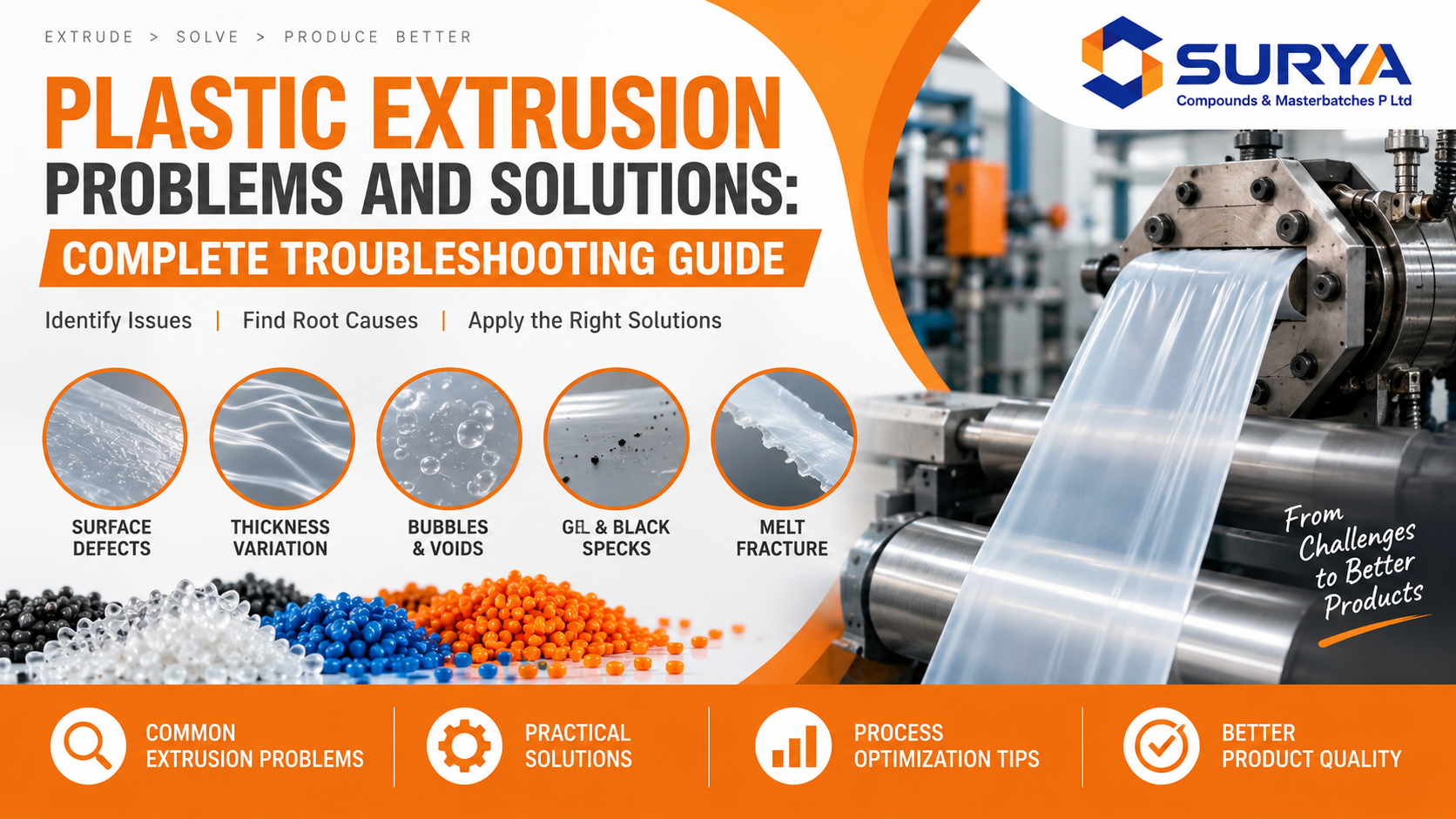
Plastic extrusion is widely used to manufacture films, pipes, sheets, profiles, cables, tubes, coatings, and other plastic products. However, small changes in temperature, pressure, material quality, screw speed, moisture, or masterbatch compatibility can lead to production defects. Understanding plastic extrusion problems and solutions helps manufacturers identify the root cause and maintain consistent product quality.
Common plastic extrusion problems include melt fracture, die lines, surface roughness, bubbles, color streaks, black specks, uneven thickness, poor dispersion, die drool, and unstable output.
Understanding the cause of each defect helps you correct the process faster and reduce scrap.
This guide explains the most common plastic extrusion defects, their causes, and practical solutions for plastic manufacturers and processors.
Quick Answer: What Are the Most Common Plastic Extrusion Problems?
The most common plastic extrusion problems include:
- Melt fracture and sharkskin
- Die lines and surface defects
- Uneven film or product thickness
- Poor masterbatch dispersion
- Color streaking
- Black specks and contamination
- Bubbles and voids
- Die drool
- Excessive die pressure
- Low or unstable output
- Poor melt strength
- Polymer degradation
- Moisture-related defects
- Dimensional variation
The correct solution depends on whether the problem comes from material quality, processing conditions, equipment, die design, moisture, or masterbatch compatibility.
Plastic Extrusion Defects at a Glance
|
Extrusion defect |
Common cause | Practical solution |
|
Melt fracture |
Excessive shear or output rate |
Reduce shear rate and optimize melt temperature |
|
Sharkskin |
High wall shear stress |
Adjust temperature, output, and die conditions |
|
Die lines |
Dirty or damaged die |
Clean and inspect the die |
|
Color streaks |
Poor dispersion or incompatible carrier |
Check masterbatch compatibility and mixing |
|
Black specks |
Degradation or contamination |
Purge, clean equipment, and control temperature |
|
Bubbles |
Moisture or trapped air |
Dry material and check venting |
|
Uneven thickness |
Unstable melt flow or die gap |
Check die, pressure and material flow |
|
Die drool |
Material degradation or additive buildup | Clean die and optimize processing conditions |
|
High pressure |
Restricted flow or excessive viscosity | Check screen pack, die and material |
| Low output | Feeding or melting problems |
Check feed system, screw and temperature |
| Surface roughness | Poor melting or excessive shear |
Optimize temperature and screw conditions |
| Poor melt strength | Wrong polymer grade or degradation |
Review resin grade and processing conditions |
1. Melt Fracture and Sharkskin
Melt fracture is one of the common extrusion defects seen when polymer melt experiences excessive shear stress as it passes through the die.
The extrudate may develop a rough, distorted, or wavy surface. In film extrusion, the defect can appear as a rough or uneven film surface.
Common causes
- Excessive extrusion rate
- High screw speed
- Low melt temperature
- Excessive die shear
- Incorrect die geometry
- Polymer viscosity that is too high
- Poor processing conditions
Solutions
- Reduce screw speed gradually.
- Reduce output rate if the die is overloaded.
- Optimize the melt temperature within the resin supplier’s recommended range.
- Check die gap and die geometry.
- Review the polymer grade and melt flow characteristics.
- Consider a suitable processing aid where the application requires it.
For agricultural film applications, Surya Compounds & Masterbatches offers polymer processing additive solutions designed to help address melt fracture during film extrusion.
2. Die Lines and Surface Defects
Die lines appear as continuous lines or marks along the extruded product. They often become more visible when the product has a smooth or glossy surface.
Common causes
- Contamination inside the die
- Scratches on die lips
- Material buildup
- Damaged die surfaces
- Poor melt filtration
- Degraded polymer
Solutions
- Stop the extrusion line safely.
- Inspect the die lips and flow channels.
- Remove polymer buildup.
- Check the screen pack for contamination.
- Inspect the die for scratches or damage.
- Check whether the raw material contains foreign particles.
Do not assume every die line is caused by the masterbatch. Check the die and melt path before changing the formulation.
3. Poor Masterbatch Dispersion
Poor masterbatch dispersion is a major cause of streaks, specks, uneven colour, and inconsistent appearance in extruded products.
A masterbatch needs to distribute uniformly through the polymer melt. If the carrier resin is incompatible, the dosage is incorrect, or the mixing energy is insufficient, dispersion problems can occur.
Surya Compounds & Masterbatches explains that poor dispersion can result from incompatible carrier resin, incorrect let-down ratio, insufficient mixing, pigment agglomeration, moisture, low processing temperature, or unsuitable screw conditions.
Symptoms of poor dispersion
- Colour streaks
- Colour patches
- Pigment specks
- Uneven shade
- Filter blockage
- Rising melt pressure
- Weak spots in thin films
- Pinholes in film
Solutions
- Match the masterbatch carrier with the base polymer.
- Check the masterbatch dosage.
- Verify the let-down ratio.
- Check melt temperature.
- Improve mixing and shear where appropriate.
- Keep the material dry.
- Check screw and mixing element condition.
- Use a masterbatch with proven dispersion quality.
Read our detailed guide on How to Fix Poor Masterbatch Dispersion in Plastics for a deeper troubleshooting process.
4. Colour Streaking During Extrusion
Colour streaks appear when pigment or colour masterbatch is not distributed evenly throughout the polymer.
This problem is particularly noticeable in films, sheets, pipes, profiles, and other products where surface appearance matters.
Possible causes
- Incorrect masterbatch carrier
- Poor pigment dispersion
- Incorrect dosage
- Insufficient mixing
- Inadequate melt temperature
- Moisture
- Contaminated equipment
How to fix colour streaking
Start with the masterbatch and base resin compatibility.
For example, if your extrusion process uses PE, the masterbatch carrier should be suitable for PE processing. A significant mismatch in flow behaviour or polymer chemistry can affect mixing and dispersion.
Melt flow index is also important when selecting materials. Surya’s guide explains how MFI influences flow behaviour and masterbatch compatibility.
Check:
- Base polymer grade
- Masterbatch carrier
- MFI
- Dosage
- Melt temperature
- Screw speed
- Mixing efficiency
- Material moisture
5. Black Specks in Extruded Plastic
Black specks are common quality problems in plastic extrusion.
They are often caused by carbonized polymer, degraded additives, foreign contamination, material buildup, or residue from a previous production run.
Common causes
- Excessive temperature
- Long residence time
- Polymer degradation
- Die buildup
- Screw or barrel dead spots
- Contaminated raw material
- Poor purging
- Recycled material contamination
- Cross-contamination between colours
Surya Compounds & Masterbatches’ guide on black specks identifies thermal degradation, long residence time, die or screw buildup, contaminated raw materials, cross-contamination, equipment damage, and regrind as common causes.
Solutions
- Check actual melt temperature.
- Avoid unnecessary residence time.
- Purge the machine properly.
- Clean the screw, barrel, and die.
- Check raw material cleanliness.
- Inspect regrind quality.
- Reduce dead spots in the melt path.
- Use heat-stable materials for high-temperature applications.
You can also read: Black Specks in Plastic: Causes and How to Fix Contamination.
6. Bubbles and Voids in Extruded Products
Bubbles indicate that gas or moisture is present in the melt.
This issue is particularly important in film, sheet, pipe, and profile extrusion.
Common causes
- Moisture in raw material
- Wet masterbatch
- Trapped air
- Poor venting
- Volatile contaminants
- Material degradation
Solutions
- Dry moisture-sensitive materials according to the resin supplier’s specification.
- Store polymers and masterbatch in sealed conditions.
- Check hopper and feed-system contamination.
- Inspect the extruder’s venting system.
- Reduce sources of volatile contamination.
- Check whether the processing temperature is causing degradation.
Moisture control is especially important when processing hygroscopic polymers such as PET. Surya’s PET masterbatch guidance highlights drying and storage as important factors in processing.
7. Uneven Thickness
Uneven thickness is a serious issue in film, sheet, pipe and profile extrusion.
For films, thickness variation can affect:
- Mechanical strength
- Appearance
- Sealing
- Barrier performance
- Material consumption
- Downstream processing
Possible causes
- Uneven die gap
- Unstable melt pressure
- Incorrect die alignment
- Non-uniform cooling
- Poor melt distribution
- Inconsistent feed
- Variation in raw material properties
Solutions
- Check die alignment.
- Inspect die lips.
- Monitor melt pressure.
- Check temperature stability.
- Inspect the cooling system.
- Maintain consistent feed rates.
- Check resin and masterbatch consistency.
8. Die Drool
Die drool occurs when material or degraded polymer accumulates around the die lips during extrusion.
It can create surface defects and force production stops for cleaning.
Common causes
- Polymer degradation
- Additive migration
- Excessive temperature
- Long residence time
- Poor material formulation
- Contamination
- Incompatible additives
Solutions
- Optimize processing temperature.
- Reduce excessive residence time.
- Clean the die regularly.
- Check additive compatibility.
- Review the formulation.
- Inspect the screen pack and melt filtration system.
If the problem started after introducing a new masterbatch or additive, compare the production conditions before and after the formulation change.
9. Excessive Extrusion Pressure
High extrusion pressure indicates increased resistance to melt flow.
Common causes
- Blocked screen pack
- Dirty die
- High-viscosity polymer
- Low melt temperature
- Excessive filler loading
- Poor material dispersion
- Restricted flow path
Solutions
- Check and replace the screen pack when required.
- Inspect the die.
- Check melt temperature.
- Review polymer MFI.
- Check filler concentration.
- Inspect masterbatch compatibility.
- Look for contamination or material buildup.
For filler-loaded applications, the quality and dispersion of filler are important. Surya’s filler masterbatches use calcium carbonate or talc in polymer carriers and are designed for applications including blown film, injection moulding and extrusion coating.
10. Low or Unstable Extrusion Output
Production output should remain stable when material, temperature and equipment conditions remain consistent.
Unexpected output variation can indicate problems with:
- Material feeding
- Hopper bridging
- Screw wear
- Temperature control
- Melt pressure
- Resin consistency
- Screen blockage
- Screw speed
Troubleshooting steps
Check the problem in this order:
- Confirm the actual screw speed.
- Check hopper feeding.
- Inspect the feed throat.
- Check melt pressure.
- Inspect the screen pack.
- Verify barrel temperature.
- Check material consistency.
- Inspect screw and barrel wear.
Avoid changing multiple variables at once. Change one parameter, observe the result, and record the effect.
11. Surface Roughness
A rough extrusion surface often indicates poor melt conditions or excessive shear.
Possible causes
- Low melt temperature
- High screw speed
- High shear
- Poor polymer melting
- Contamination
- Die damage
- Incorrect processing aid level
Solutions
- Check melt temperature.
- Reduce screw speed if shear is excessive.
- Inspect the die surface.
- Check polymer grade.
- Verify material cleanliness.
- Review processing-aid requirements.
12. Polymer Degradation During Extrusion
Polymer degradation happens when the material experiences excessive heat, oxidation, shear, or residence time.
The result can include:
- Yellowing
- Brown or black specks
- Odour
- Loss of mechanical properties
- Lower melt strength
- Unstable processing
- Colour variation
How to prevent polymer degradation
- Maintain appropriate processing temperatures.
- Avoid unnecessary residence time.
- Prevent contamination.
- Keep moisture-sensitive materials dry.
- Use appropriate stabilisation.
- Maintain the extruder and die.
- Select materials suitable for the processing conditions.
For applications involving heat history or reprocessed materials, antioxidant masterbatch can help protect polymers from oxidative degradation. Surya offers antioxidant masterbatch solutions for applications including pipes, BOPP, tapes, cables, and reprocessed or filled compounds.
13. Poor Melt Strength
Melt strength determines how well the polymer maintains its shape after leaving the die.
Low melt strength can create problems in:
- Blow film
- Blow moulding
- Pipe extrusion
- Profile extrusion
- Sheet extrusion
Common causes
- Incorrect polymer grade
- Excessively high MFI
- Excessive processing temperature
- Polymer degradation
- Incorrect formulation
MFI is an important material-selection parameter. Extrusion applications often require enough melt strength to maintain the shape of the extrudate, so selecting the material solely on easy flow is not enough.
Plastic Extrusion Troubleshooting: A Practical Method
When you experience an extrusion defect, avoid immediately changing the formulation.
Use a structured troubleshooting process.
Step 1: Identify the exact defect
Record what you see:
- Streaks
- Specks
- Bubbles
- Thickness variation
- Roughness
- Die lines
- Pressure variation
- Colour variation
- Die drool
Step 2: Identify when the defect started
Ask:
- Did you change the polymer?
- Did you change the masterbatch?
- Did you change the dosage?
- Did you change the screw speed?
- Did you change the temperature?
- Did you change the screen pack?
- Did you introduce recycled material?
Step 3: Check the material
Review:
- Polymer grade
- MFI
- Moisture
- Masterbatch compatibility
- Filler loading
- Additive concentration
- Recycled material percentage
Step 4: Check processing conditions
Review:
- Barrel temperature
- Die temperature
- Screw speed
- Melt pressure
- Output rate
- Residence time
- Cooling conditions
Step 5: Check the equipment
Inspect:
- Screw
- Barrel
- Die
- Screen pack
- Feed system
- Venting system
- Cooling system
Step 6: Change one variable at a time
This makes troubleshooting more reliable.
If you change temperature, screw speed, masterbatch dosage and screen pack simultaneously, you will not know which change solved the problem.
How Masterbatch Selection Affects Extrusion Quality
Masterbatch is not only a colour or additive source. Its carrier system, dispersion, MFI, thermal stability and compatibility influence extrusion performance.
A suitable masterbatch should be selected according to:
- Base polymer
- Processing method
- Processing temperature
- Required colour or additive function
- Desired dosage
- MFI compatibility
- Dispersion requirements
- End-use requirements
Surya Compounds & Masterbatches supplies masterbatch and compound solutions across polymers including PVC, LLDPE, LDPE, HDPE, PP, PS, PET, TPU, HIPS, ABS and EVA.
For film extrusion, product selection also depends on the required surface properties. Surya’s slip masterbatch is designed to reduce friction between film layers and between film and metal surfaces.
Anti-block masterbatch is used to reduce film-to-film adhesion and blocking during film production.
For outdoor and agricultural film applications, UV and other additive masterbatches help address performance requirements related to environmental exposure.
Common Extrusion Defects by Application
Film Extrusion
Common problems include:
- Thickness variation
- Melt fracture
- Die lines
- Bubbles
- Blocking
- Poor slip
- Colour streaks
- Poor dispersion
- Pinholes
Surya serves flexible packaging applications including polyethylene films, liners, FIBC, protective films, raffia sacks and other packaging products.
Pipe Extrusion
Common problems include:
- Surface roughness
- Uneven wall thickness
- Die lines
- Colour variation
- Poor dimensional stability
- Melt fracture
Cable Extrusion
Common problems include:
- Surface defects
- Uneven coating
- Colour variation
- Die buildup
- Poor dispersion
- Dimensional inconsistency
Profile Extrusion
Common problems include:
- Warpage
- Uneven dimensions
- Surface roughness
- Color variation
- Die lines
- Poor melt stability
How to Reduce Plastic Extrusion Defects
You can reduce extrusion defects by controlling five major areas:
1. Material
Use consistent polymer grades and maintain proper material storage.
2. Masterbatch
Choose a compatible masterbatch with suitable dispersion, carrier resin, and thermal stability.
3. Processing
Maintain stable temperature, screw speed, pressure, and output.
4. Equipment
Keep the screw, barrel, die, and screen pack clean and properly maintained.
5. Quality Control
Monitor:
- MFI
- Color
- Moisture
- Melt pressure
- Product dimensions
- Dispersion
- Mechanical properties
Consistent testing helps identify changes before they become major production problems.
Why Work With Surya Compounds & Masterbatches?
Plastic extrusion problems often involve several variables at the same time. A masterbatch supplier should therefore understand more than colour selection.
Surya Compounds & Masterbatches has been operating since 1986 and provides masterbatch and compound solutions for multiple polymer types and industries. Its portfolio includes colour masterbatches, additive masterbatches, filler masterbatches, and polymer compounds.
The company serves industries including packaging, agriculture, pipe and tank, wire and cable, automotive, medical, and consumer and household applications.
For extrusion applications, the focus should remain on compatibility, dispersion, processing stability, and the specific requirements of the finished product.
Final Takeaway
Plastic extrusion problems and solutions should always be approached systematically.
When a defect appears, first identify the symptom. Then check the material, masterbatch, processing conditions, and equipment before changing the formulation.
For recurring problems, focus on the root cause rather than repeatedly adjusting machine settings.
A compatible masterbatch, stable polymer grade, controlled processing conditions, and proper equipment maintenance help reduce common extrusion defects and improve product consistency.
If you are facing color streaking, poor dispersion, black specks, melt fracture, die buildup, or another extrusion problem, Surya Compounds & Masterbatches can help evaluate the material and application requirements and identify a suitable masterbatch or compound solution.
Frequently Asked Questions About Plastic Extrusion Problems
What are the most common plastic extrusion problems?
The most common problems include melt fracture, die lines, poor dispersion, colour streaking, black specks, bubbles, uneven thickness, die drool, excessive pressure, unstable output, and polymer degradation.
What causes plastic extrusion defects?
Plastic extrusion defects can result from incorrect temperature, excessive shear, unstable pressure, poor material quality, moisture, contamination, incorrect die conditions, equipment wear, polymer degradation or incompatible masterbatch.
How do you troubleshoot plastic extrusion problems?
Start by identifying the defect. Then check material quality, moisture, masterbatch compatibility, MFI, temperature, screw speed, melt pressure, die condition, and screen pack. Change one variable at a time and record the result.
Why do black specks appear during plastic extrusion?
Black specks often result from polymer degradation, die or screw buildup, contamination, excessive temperature, long residence time or cross-contamination from previous production runs.
What causes color streaks in extruded plastic?
Color streaks are commonly associated with poor masterbatch dispersion, incompatible carrier resin, incorrect dosage, insufficient mixing, moisture, or unsuitable processing conditions.
How does masterbatch affect extrusion?
Masterbatch affects colour or additive distribution, dispersion, flow behaviour and processing consistency. Carrier compatibility, MFI, dosage and thermal stability should match the base polymer and extrusion process.
How do you prevent melt fracture in extrusion?
Review screw speed, extrusion output, melt temperature, die conditions, and polymer grade. A suitable processing aid also helps in applications where melt fracture is a recurring issue.
Why is MFI important in plastic extrusion?
MFI provides an indication of how easily a polymer flows under specified test conditions. Extrusion applications often require a balance between flow and melt strength. MFI also helps evaluate compatibility between the base polymer and masterbatch carrier.
How does moisture affect plastic extrusion?
Moisture can cause bubbles, voids, surface defects, and other processing problems. Hygroscopic materials require appropriate drying and storage before processing.
How can manufacturers reduce extrusion defects?
Use consistent raw materials, select compatible masterbatch, control moisture, maintain stable processing conditions, keep the die and extruder clean, monitor MFI and pressure, and maintain equipment regularly.
