

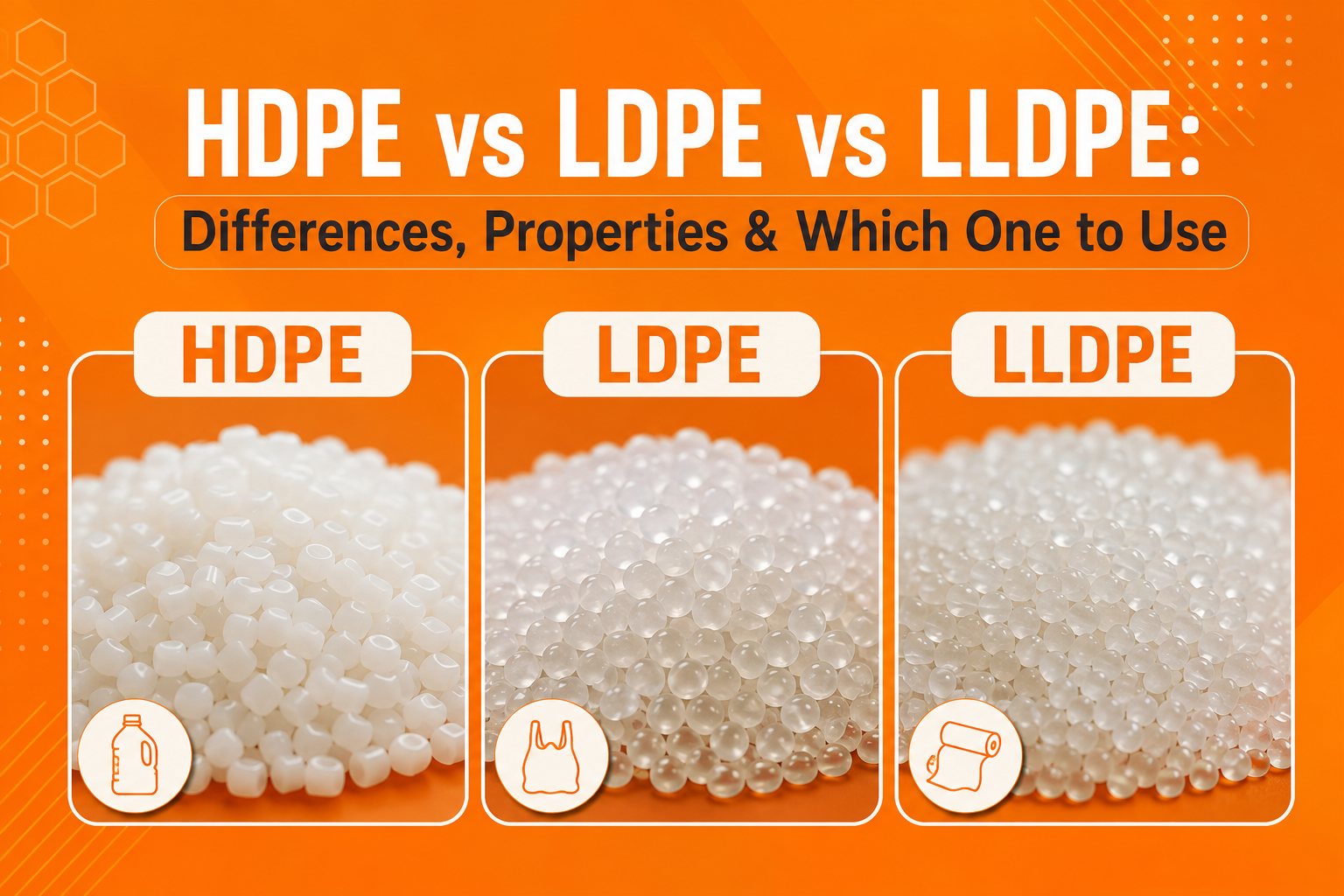
Pick up a milk jug, a grocery bag, and a stretch-wrapped pallet. Three products, three feels—rigid, soft, and stretchy—yet all three are made from the same base polymer: polyethylene. The difference comes down to how the molecules are arranged, and that is exactly what the HDPE vs LDPE vs LLDPE debate is about.
If you’re a manufacturer, product designer, or procurement manager, choosing the wrong grade can lead to brittle parts, torn films, or wasted money. Choose the right one, and you get the strength, flexibility, and cost you actually need.
In this guide, you’ll learn what sets HDPE, LDPE, and LLDPE apart in structure, density, and performance. You’ll see where each grade shines, get a side-by-side comparison table, and finish with a simple way to decide which polyethylene fits your application.
What Is the Difference Between HDPE, LDPE, and LLDPE?
HDPE, LDPE, and LLDPE are three types of polyethylene that differ in molecular branching and density. HDPE has minimal branching, giving it high density, rigidity, and strength. LDPE has heavy long-chain branching, making it soft and flexible. LLDPE has short, uniform branches that add tensile strength and puncture resistance.
All three start from ethylene gas. What changes is the polymerization process and the resulting chain structure. That structure controls how tightly the chains pack together, which decides density, and density drives nearly every physical property you care about.
Think of it like stacking pipes. HDPE chains are straight and pack tightly, so the material is dense and stiff. LDPE chains have long tangled branches that keep them loosely packed, so it stays soft. LLDPE sits in between, with short branches that let chains slide without tangling.
HDPE (High-Density Polyethylene): Strong and Rigid
HDPE has the least branching of the three, so its chains pack tightly into a dense, crystalline structure. Its density typically ranges from 0.941 to 0.965 g/cm³, the highest of the common polyethylene grades.
This gives HDPE excellent tensile strength, stiffness, and chemical resistance. It handles impact well and resists moisture, making it a workhorse for products that must hold their shape and take abuse.
You’ll find HDPE in milk and detergent bottles, water and gas pipes, crates, jerry cans, road barriers, and industrial containers. When a product needs to be rigid, tough, and durable, HDPE is usually the answer.
LDPE (Low-Density Polyethylene): Soft and Flexible
LDPE is the most branched grade, with both short and long chains extending from the backbone. That branching prevents tight packing, so its density sits low at roughly 0.910 to 0.940 g/cm³.
The result is a soft, highly flexible, translucent material with good clarity and excellent chemical resistance to acids and bases. Its weakness is lower tensile strength and poorer puncture resistance compared with the other two.
LDPE dominates flexible packaging: plastic bags, squeeze bottles, cling film, coatings for cartons, and general-purpose film. If you need stretch, softness, and clarity over raw strength, LDPE delivers at low cost.
LLDPE (Linear Low-Density Polyethylene): The Tough Middle Ground
LLDPE is a copolymer—ethylene combined with a short alpha-olefin like butene, hexene, or octene. This creates a linear backbone with short, uniform branches and no long tangled chains. Its density overlaps LDPE at around 0.915 to 0.940 g/cm³.
Because the chains slide past each other without entangling, LLDPE offers noticeably higher tensile strength, puncture resistance, and tear resistance than LDPE at similar density. It also resists surface cracking better.
That toughness makes LLDPE the go-to for stretch film, heavy-duty bags, agricultural film, pond liners, and flexible tubing. Manufacturers often blend it with LDPE to boost film strength without losing flexibility.
HDPE vs LDPE vs LLDPE: Comparison Table
|
Property |
HDPE | LDPE | LLDPE |
|
Density (g/cm³) |
0.941–0.965 | 0.910–0.940 |
0.915–0.940 |
|
Branching |
Minimal | Long + short chains | Short, uniform |
| Flexibility | Low (rigid) | High |
High |
|
Tensile strength |
High | Low | Medium–high |
| Puncture resistance | High | Low |
High |
|
Clarity |
Opaque | Translucent |
Translucent |
| Typical uses | Bottles, pipes, crates | Bags, film, squeeze bottles |
Stretch film, liners, heavy bags |
Which Polyethylene Should You Choose?
Start with the job the part has to do. If it must stay rigid and take a load—bottles, pipes, containers—reach for HDPE. If it must be soft, clear, and cheap for simple packaging, LDPE is your grade.
When you need flexibility plus strength, especially for film that must resist tearing and puncturing, LLDPE wins. Many packaging films use an LLDPE-LDPE blend to balance stretch, strength, and cost.
Keep processing in mind too. LDPE flows easily and is forgiving to run. LLDPE has lower shear sensitivity, so it can be harder to process at the same melt index. Matching the grade to both your product and your machine setup prevents costly surprises on the line.
For color, UV protection, or added properties, the right masterbatch pairs with any of these grades. A well-chosen carrier resin in the masterbatch keeps dispersion consistent across HDPE, LDPE, and LLDPE runs.
Real-World Applications Compared
Seeing where each grade lands in everyday products makes the choice clearer. HDPE handles anything that must stay rigid and carry load — think detergent bottles, milk jugs, water tanks, pipes, and industrial drums. Its stiffness and chemical resistance make it the default for containers and pipework.
LDPE takes over wherever softness and clarity matter more than strength. Bread bags, cling film, squeeze bottles, and carton coatings all lean on its flexibility and low cost. It’s the everyday film plastic you handle without thinking about it.
LLDPE steps in when a film must survive rough handling. Pallet stretch wrap, heavy-duty refuse sacks, agricultural mulch film, and pond liners rely on its tear and puncture resistance. That’s why it so often replaces or reinforces LDPE in demanding film jobs.
Cost and Sustainability Considerations
Cost usually tracks performance. LDPE tends to be the most economical for simple film, while HDPE and LLDPE command a premium where strength is essential. Buying purely on price without matching the grade to the job often backfires through failures or downgrades.
All three are recyclable, which matters as brands push toward circular-economy goals. HDPE (recycling code 2) has well-established recycling streams, and recycled polyethylene grades are widely available. Factoring recyclability and recycled-content options into your material choice supports both cost and sustainability targets.
Conclusion
The choice among HDPE, LDPE, and LLDPE really comes down to three levers: density, strength, and flexibility. HDPE brings rigidity and toughness for bottles, pipes, and containers. LDPE offers softness and clarity for everyday flexible packaging. LLDPE bridges the gap with flexibility plus real strength for demanding films and liners.
Match the grade to your product’s job and your processing setup, and you’ll avoid brittle parts, torn film, and wasted material. For reliable color consistency and enhanced performance, choose high-quality masterbatch solutions from Surya Compounds & Masterbatches that are compatible with your selected polyethylene grade.
Need help selecting the right polyethylene grade or a matching masterbatch for your application? Contact the technical experts at Surya Compounds & Masterbatches for a tailored recommendation that fits your manufacturing requirements.
Frequently Asked Questions
Q: Which is stronger, HDPE or LDPE?
A: HDPE is stronger and more rigid than LDPE. It has higher tensile strength, better impact resistance, and holds its shape under load. LDPE is softer and more flexible, which suits it to bags and film but makes it less suitable for structural or load-bearing parts.
Q: What is the main difference between LDPE and LLDPE?
A: The difference is molecular structure. LDPE has long, tangled branches that make it soft but weaker. LLDPE has short, uniform branches on a linear backbone, giving it higher tensile strength, better puncture resistance, and improved tear resistance at a similar density.
Q: Which polyethylene is best for packaging film?
A: It depends on the film. LDPE offers clarity and softness for light packaging. LLDPE gives strength for stretch film and heavy-duty bags. Many manufacturers blend LLDPE with LDPE to get flexibility and tear resistance in the same film.
Q: What plastic recycling number is LDPE?
A: LDPE is recycling code 4. HDPE is code 2. LLDPE is generally grouped under code 4 with LDPE because of their similar low-density nature, though its properties differ due to the linear structure.
Q: Can HDPE, LDPE, and LLDPE be blended together?
A: Yes. Blending is common, especially LLDPE with LDPE to improve film strength while keeping flexibility. Blend ratios are tuned to balance strength, clarity, processability, and cost for the specific end product.
