

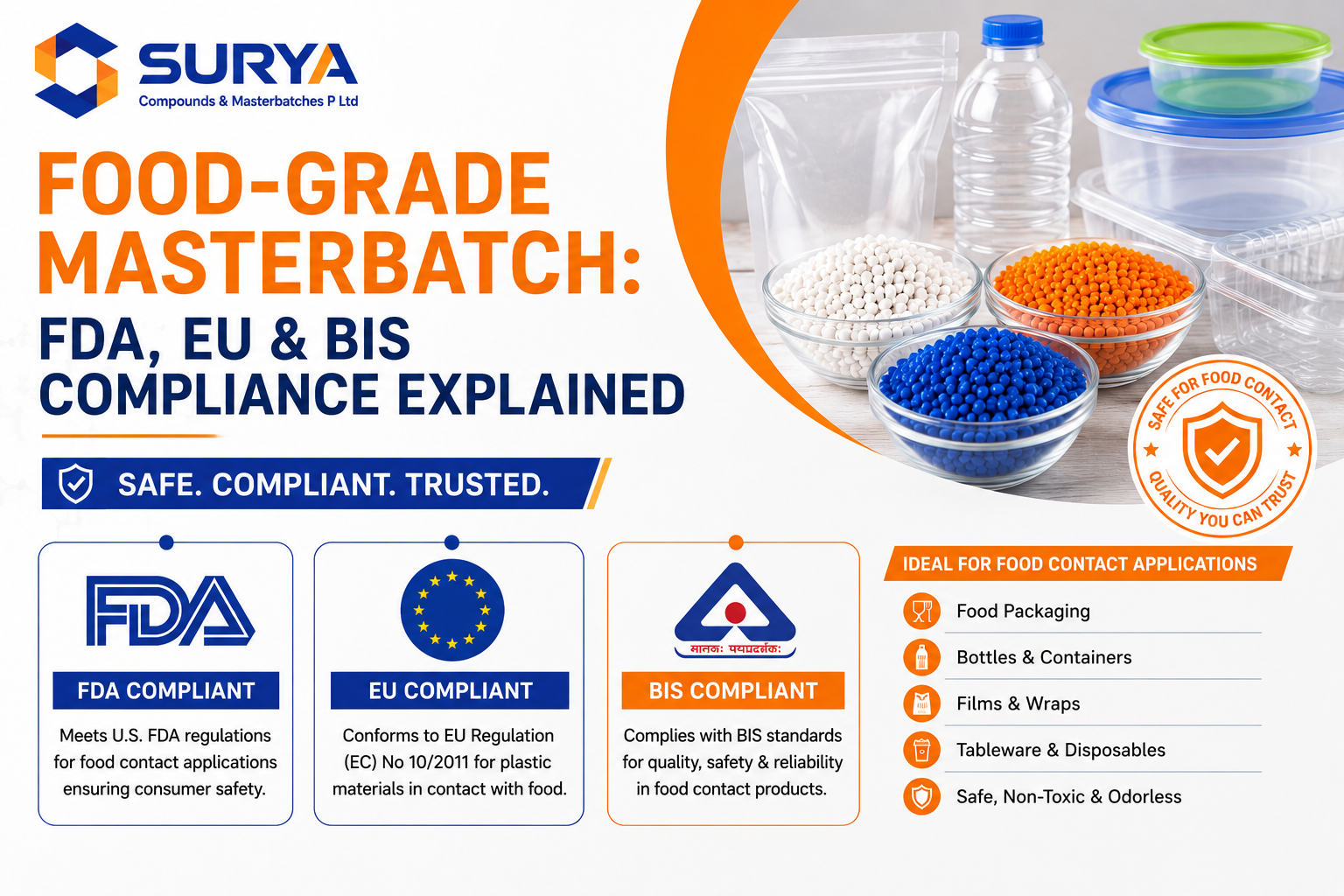
Food-grade masterbatch is a color or additive concentrate made only from ingredients approved for food contact, so it can be used safely in packaging, containers, caps, cutlery, and other items that touch food. For any buyer serving the food and packaging sector, compliance is not a nice-to-have — it is a purchase filter that decides whether a supplier is even considered. This guide explains what makes a masterbatch food-grade, the key standards in the US, EU, and India; how migration testing works; and the documentation you should always request.
| Quick answer: A masterbatch is food-grade when every ingredient—pigment, carrier resin, and additive—is on the relevant food-contact positive list and the finished plastic passes migration limits. The main frameworks are FDA 21 CFR (US), EU 10/2011 (EU), and, in India, BIS standards such as IS 9833 and IS 9845 under FSSAI rules. |
What makes a masterbatch food-grade?
Food-grade status is not a property of the pigment alone — it applies to the whole formulation. Three conditions must all be met:
- Approved pigments and additives. Every colorant and additive must appear on the applicable food-contact positive list. For example, titanium dioxide — the pigment behind white masterbatch — is covered for food-contact plastics under FDA 21 CFR 73.575, subject to purity and usage limits.
- Approved carrier resin. The carrier polymer that delivers the pigment (PE, PP, PET and so on) must itself be cleared for food contact for the intended use and temperature.
- Migration compliance. The finished plastic must not transfer substances into food above the permitted limits when tested with food simulants under realistic conditions.
This is why a single non-compliant colorant can invalidate an entire batch. A masterbatch that uses one pigment not on the positive list makes the whole formulation non-compliant, even if every other ingredient is approved. Food-grade is an all-or-nothing property of the complete recipe.
Where food-grade masterbatch is used
Food-grade masterbatch appears wherever plastic meets food. Typical applications include flexible packaging films, rigid containers and tubs, bottle caps and closures, disposable cups, trays and cutlery, and water and beverage bottles. The demand is growing fast: as regulators tighten migration limits and brand owners face stricter due-diligence expectations, more converters need documented food-grade colour and additive solutions rather than generic ones. For Indian manufacturers who also export, the same part may need to satisfy Indian BIS rules at home and FDA or EU rules abroad, which makes a supplier who can document several frameworks especially valuable. Choosing a properly food-grade masterbatch at the design stage avoids the far larger cost of a recall or a rejected shipment later.
Key food-contact standards
Different markets run independent regulatory systems. The table summarises the ones that matter most for Indian manufacturers and exporters.
|
Region |
Framework | What it covers |
|
United States |
FDA 21 CFR (e.g. 178.3297 colorants; 73.575 TiO₂; 177 polymers) |
Positive lists of approved substances and colorants for food contact |
|
European Union |
EU 10/2011 (under Reg. 1935/2004 & GMP 2023/2006) |
Union positive list plus specific and overall migration limits |
|
India |
BIS: IS 9833, IS 9845 (under FSSAI rules) |
Permitted materials and migration limits for food-contact plastics |
| China (export) | GB 4806 series |
Safety requirements for food-contact plastics and additives |
The frameworks are not interchangeable. A masterbatch that is compliant with the US FDA is not automatically compliant with the EU or with Indian BIS rules, because each system has its own positive lists and its own migration limits. An exporter typically has to demonstrate compliance separately for every target market, which is why suppliers who can document multiple frameworks at once are so valuable.
Migration testing explained
Migration testing measures how much of a substance transfers from the plastic into food, or into a food simulant that stands in for food, under set conditions of time and temperature. It is the practical proof that a formulation is safe in use rather than just on paper.
There are two types. Overall migration is the total of all substances that move into the food simulant, with a commonly used limit of around 10 mg/dm² of contact surface area. Specific migration sets individual limits for particular substances of concern, such as certain heavy metals. Testing should be carried out by an accredited laboratory — in India, one that is NABL or ILAC accredited — using the food simulant and the time-and-temperature conditions that match how the product will actually be used, whether that is cold storage, hot fill or microwave heating.
Documentation buyers should request
Before committing to a food-grade masterbatch, ask for evidence rather than assurances:
- A food-contact / compliance declaration stating exactly which frameworks are met (for example FDA 21 CFR, EU 10/2011, IS 9833 and IS 9845).
- Migration test reports from an accredited lab, for the relevant food simulant and conditions.
- A statement of composition or intended use confirming the ingredients are on the positive list for that application.
- Good Manufacturing Practice (GMP) evidence and full batch traceability, so any issue can be traced back.
How to choose a food-grade masterbatch supplier
- Confirm the exact standards you need for your market — US, EU, India, or several at once.
- Ask for current test reports and declarations, not just a verbal promise that the product is food-grade.
- Check the carrier resin is food-contact approved for your polymer and use case, including temperature exposure such as hot-fill or microwave.
- Verify traceability and GMP so that every batch is documented and repeatable.
- Run your own migration validation on the finished part for critical or high-volume applications.
Conclusion
Choosing the right food-grade masterbatch is essential for maintaining product safety, regulatory compliance, and consistent quality in food-contact plastics. Compliance depends on the complete formulation, including pigments, additives, carrier resin, migration performance, and manufacturing controls.
For manufacturers and exporters, the safest approach is to verify the requirements of each target market and demand current compliance declarations, accredited migration test reports, and traceability documents from the supplier. Surya Compounds & Masterbatches focuses on documented, application-specific masterbatch solutions to help manufacturers meet the quality and compliance requirements of food-contact plastic applications.
Frequently Asked Questions
What is a food-grade masterbatch?
It is a colour or additive concentrate made only from ingredients approved for food contact — approved pigments, additives and carrier resin — so the finished plastic can safely touch food and passes migration limits.
Which standards apply to food-grade masterbatch?
The main frameworks are FDA 21 CFR in the US, EU 10/2011 in the EU, and BIS standards such as IS 9833 and IS 9845 under FSSAI rules in India. China’s GB 4806 series applies for exports there.
What is migration testing?
Migration testing measures how much of a substance moves from the plastic into food or a food simulant under set time and temperature conditions. It checks both overall migration and specific migration against legal limits and should be done by an accredited lab.
Is titanium dioxide allowed in food-contact plastic?
Yes. Titanium dioxide is permitted for food-contact plastics under FDA 21 CFR 73.575, subject to purity and usage limits. It must still meet the migration and documentation requirements of the target market.
Does FDA compliance mean it is EU and BIS compliant too?
No. The frameworks are independent and have different positive lists and limits. A masterbatch may need separate compliance for the US, EU, and India depending on where the product is sold.
