

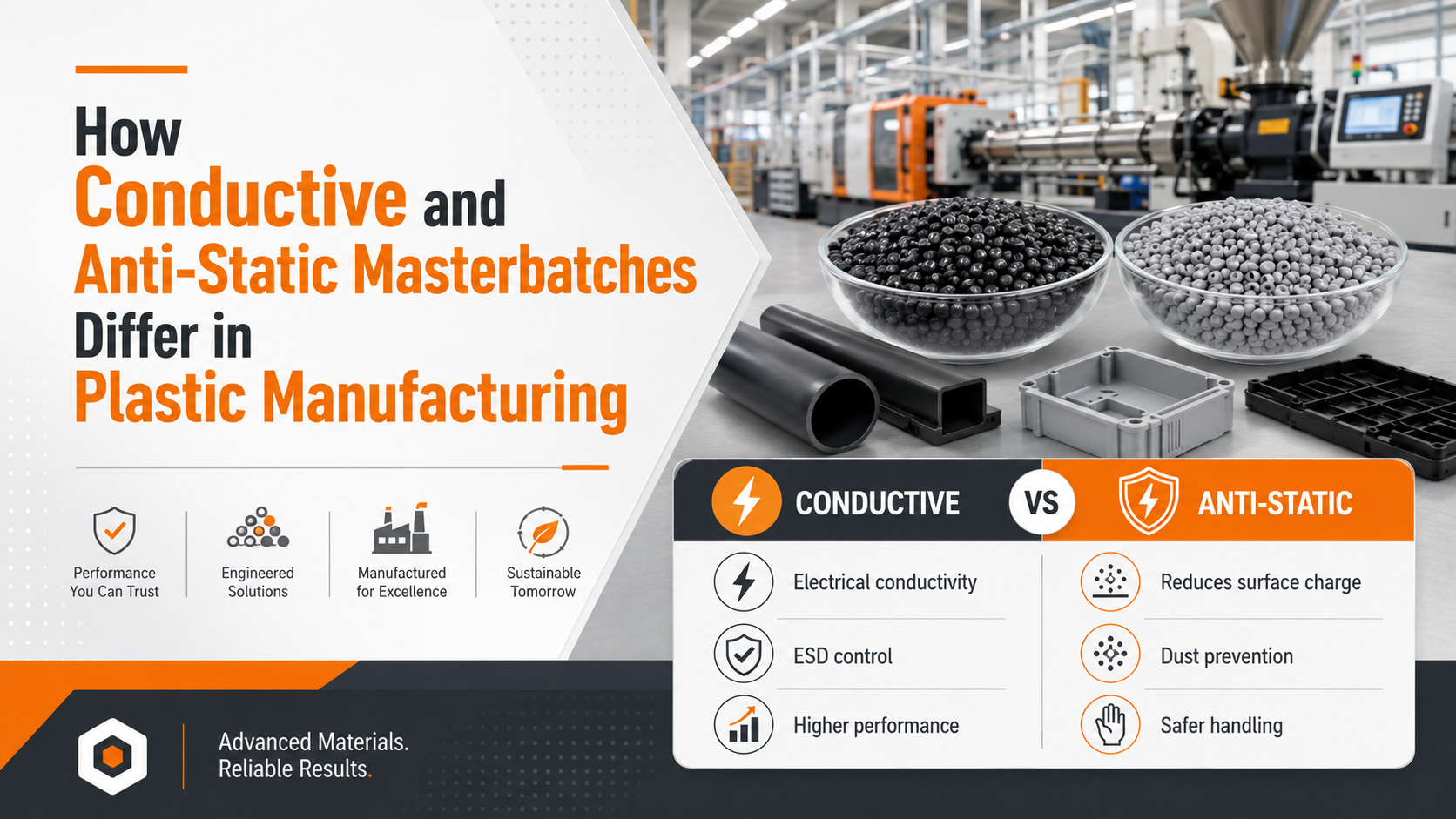
Now and then, plastic makers face a tricky issue—static buildup. It pulls in dirt, messes up electronics, makes materials hard to move around, and sometimes leads to danger near flammable stuff. Because of that, factories turn to special mix-ins designed to reduce charge. These include concentrated blends made to carry current or stop static from forming in the first place.
One way these materials tackle static differs completely from the other, even if that’s their shared goal. Knowing how conductive vs anti static masterbatch sets itself apart from antistatic types matters when matching a solution to your needs.
From electronics packaging to car parts, picking the right masterbatch shapes how well things work – even how safe they become. Industrial containers? Household items? The blend inside matters more than most think.
Static Electricity in Plastics Explained
When plastic rubs against something else, the charge tends to stick right where it builds up. That happens because plastics block the flow of electricity instead of letting it pass. Movement or touch often leaves behind an invisible layer of static cling across their surfaces.
This buildup can lead to several problems:
- Attraction of dust and contaminants
- Damage to electronic components
- Product handling difficulties
- Safety hazards in sensitive environments
- Reduced manufacturing efficiency
Starting fresh each time, makers pick either conductive or anti-static masterbatches based on how much static control a product needs. Yet the choice shifts with every application, quietly shaped by what the material demands.
Conductive Masterbatch Explained?
Electrical conductivity in plastics? That comes from a special additive called conductive masterbatch. This material blends into polymers, letting them carry current. Not every plastic does that naturally, so the addition makes a difference. Think of it like giving plastic new abilities without changing its base form. The result stays useful in everyday applications where static or charge movement matters. Understanding what conductive masterbatch is reveals how it alters plastic behavior to establish reliable electrical paths.
Electrical paths form inside plastic when conductive particles are mixed in. These tiny channels let current move without building up danger. Rather than trapping static energy, the material guides it elsewhere slowly. Movement happens across the structure where contact points link up continuously.
Conductive Masterbatch Key Traits
- Enables electrical conductivity
- Static fades fast when touched by it
- Suitable for high-risk environments
- Provides permanent conductivity
- Static shocks happen less often because the material helps control electric buildup slowly over time instead of letting it snap suddenly
Static control matters most when handling delicate electronics or dangerous substances. A special additive helps prevent buildup by allowing electricity to move through materials easily. This solution often shows up wherever safety cannot afford any spark risks.
Common Applications
- Electronic packaging
- Semiconductor handling trays
- Industrial storage containers
- Automotive components
- Electrical equipment housings
From the start, the material carries its own ability to conduct, so defense stays strong as long as the item lasts.
Understanding Anti Static Masterbatch?
Picture anti static masterbatch not as something that carries charge, but as a way to stop buildup before it happens.
Most plastics hold onto static, but anti-static masterbatch helps prevent that. Rather than forming a channel for current, it works by letting the material pull in tiny amounts of moisture. This shift lowers resistance across the surface. Less friction means less charge builds up over time. The effect shows quickly during processing. Even thin layers can make a noticeable difference. Moisture interaction becomes key instead of relying on conductivity.
Anti Static Masterbatch Key Features
- Reduces static charge buildup
- Helps prevent dust attraction
- Improves product handling
- Enhances surface cleanliness
- Cost-effective solution for many applications
Perfect when you just need a little static protection without making things fully conductive, anti-static masterbatch fits the bill nicely. Though it won’t carry current like metal, it quietly prevents cling and sparks where needed most. Useful across everyday items where total conductivity isn’t the goal, yet nuisance shocks still matter. From packaging to casings, its role stays subtle – just enough disruption to stop static, never pretending to be more.
Common Applications
- Packaging films
- Consumer product packaging
- Household plastic products
- Industrial wrapping materials
- Storage containers
What it does most is cut down on static problems without changing how the plastic feels or holds up.
Conductive Versus Anti Static Masterbatch How They Differ
Even so, these two materials handle static electricity but perform in quite distinct ways across uses. Yet their functions vary noticeably depending on the setting applied. Analyzing the dynamic of conductive vs anti static masterbatch helps highlight these primary functional shifts:
1. Static Control Method
- Conductive Masterbatch: Electrical charges move easily because the conductive masterbatch guides them across the substance. Safety improves since built-up energy finds a way out without risk.
- Anti Static Masterbatch: Static buildup fades when anti-static masterbatch mixes into plastic, yet the material stays non-conductive. Though it limits charge formation, electricity still can’t flow through the polymer. Surface sparks drop off even though no conductive network forms inside. The additive calms electrostatic effects without turning the plastic into a conductor. Charges struggle to gather, however free electrons remain absent throughout.
2. Level of Protection
- Conductive Masterbatch: Offering stronger safeguards, it works well where delicate circuits are used or conditions turn risky. Built tough when surroundings demand more care than usual.
- Anti Static Masterbatch: While it doesn’t fully block static, this option handles everyday needs well. Most people find it works just fine for wrapping items or basic storage uses.
3. Durability of Performance
- Conductive Masterbatch: Even after years of use, the material still carries current just as well since its makeup includes conduction from the start. What lies inside keeps working without change.
- Anti-static Masterbatch: How well it works can shift when the surroundings change. Over months of use, results might differ too.
4. Cost Considerations
- Conductive Masterbatch: Spending more is common because of unique conducting materials along with better overall function.
- Anti-static masterbatch: A budget-friendly option shows up where simple static management is needed. Cost drops when only fundamental control matters. Where basics rule, cheaper setups step in. Simple needs bring simpler fixes into play. Lower expense fits tasks without complex demands.
5. Application Areas
Out in factories where precision matters most, conductive setups built on what is conductive masterbatch technology show often. Meanwhile, packaging lines and products people use every day lean heavily on anti-static versions instead.
Choosing a Masterbatch
Selecting between conductive and anti-static masterbatch depends on several factors.
Consider These Questions
- Does the application involve sensitive electronic components?
- Could static electricity cause serious problems?
- How much stillness needs managing?
- What are the environmental conditions?
- How well should the finished product work?
Most times, when you need total removal of static charge, people go for conductive masterbatch. To just lower static cling or keep dust away, an anti-static version might do the job instead.
Industries Using Static Control Solutions
From construction to packaging, tailored color additives quietly boost how well materials hold up under stress. A single batch tweak can mean fewer breakdowns during heavy use. Think medical gear – its resilience often ties back to precise pigment mixes. Even car parts depend on these blends to resist heat damage. Without such custom formulas, everyday items might fail when needed most.
| Industry Sector |
Primary Risk / Challenge |
Material Solution Applied |
|
Electronics |
Static shocks can damage delicate electronics. |
Workers often rely on conductive supplies when moving gear. Protection begins the moment hands touch a circuit board. |
|
Packaging |
Contamination and slow production line speeds. |
Static control keeps items clean while boosting how fast they move through packaging lines. |
|
Automotive |
Unwanted charge buildup across high-heat zones. |
From dashboards to fuel systems, parts made with these materials handle unwanted charge buildup without fail. |
|
Industrial Manufacturing |
Sudden sparks and unexpected machinery hiccups. |
Workplace safety gets a boost when static is managed well. Production stays steady through various manufacturing steps. |
Product Quality Why It Matters
Because how well these materials work ties directly to their makeup, uniformity, stability during production, picking a reliable source matters more than most realize. Without tight control at every stage, even strong designs can fall short.
Reliable masterbatch products should offer:
- Consistent performance
- High-quality raw materials
- Uniform dispersion
- Reliable processing behavior
- Application-specific customization
A strong track record in manufacturing often leads to smoother outcomes across all production needs. When experience guides the process, each step tends to follow a clearer path.
Manufacturers Pick Suryam
Nowhere else quite matches what happens when performance meets consistency – Suryam steps in where materials need more than just color. Instead of chasing trends, they build partnerships through precision-made masterbatches. Not every supplier holds up under industrial pressure; this one does. Where others shift focus, Suryam stays rooted in quality that works behind the scenes. Masterbatch isn’t flashy, yet it carries weight – their versions carry even more.
What Makes Suryam Different?
- Advanced Manufacturing Expertise: Out of changing demands in plastic production, Suryam builds custom masterbatches. These answers grow from what factories now face every day.
- Consistent Product Quality: Precision manufacturing, along with tight quality checks, keeps performance steady in many different uses.
- Customized Solutions: Not every field needs the same defense against static. Depending on what’s needed, Suryam builds custom blends that match exact demands.
- Focus on Innovation: Improvement never stops at Suryam, where updated formulas shape how goods are made. Because of shifting markets, changes in production keep pace—customers find it easier to remain relevant when methods evolve. Progress shows up quietly, built into each step forward.
Conclusion
Electrical behavior shapes how each additive works—conductive versions deliver lasting pathways for current, whereas resistance control defines the role of anti-static types. One locks in a steady flow across materials; moisture interaction often drives the effect seen with the other. Performance goals decide which path fits best, depending on what kind of discharge risk matters most.
Whatever field you work in will shape what kind of material fits best. If it is about shielding gadgets or keeping packages free from clinging particles, picking the right additive mix makes a real difference down the line. How well things perform often ties back to that decision early on.
From small details to big results, Surya compounds & masterbatches builds trust through steady improvements and real-world answers for makers everywhere. Its materials fight static and carry current yet stay tough when conditions shift. Performance stays strong, not by accident, but by design, shaped around how things actually work. Across fields like packaging, automotive, or electronics, one thing holds: consistency matters most. What changes is how it’s reached—each solution fits the need, not the trend. Reliability comes without flash, just focused science behind every batch sent out.
