

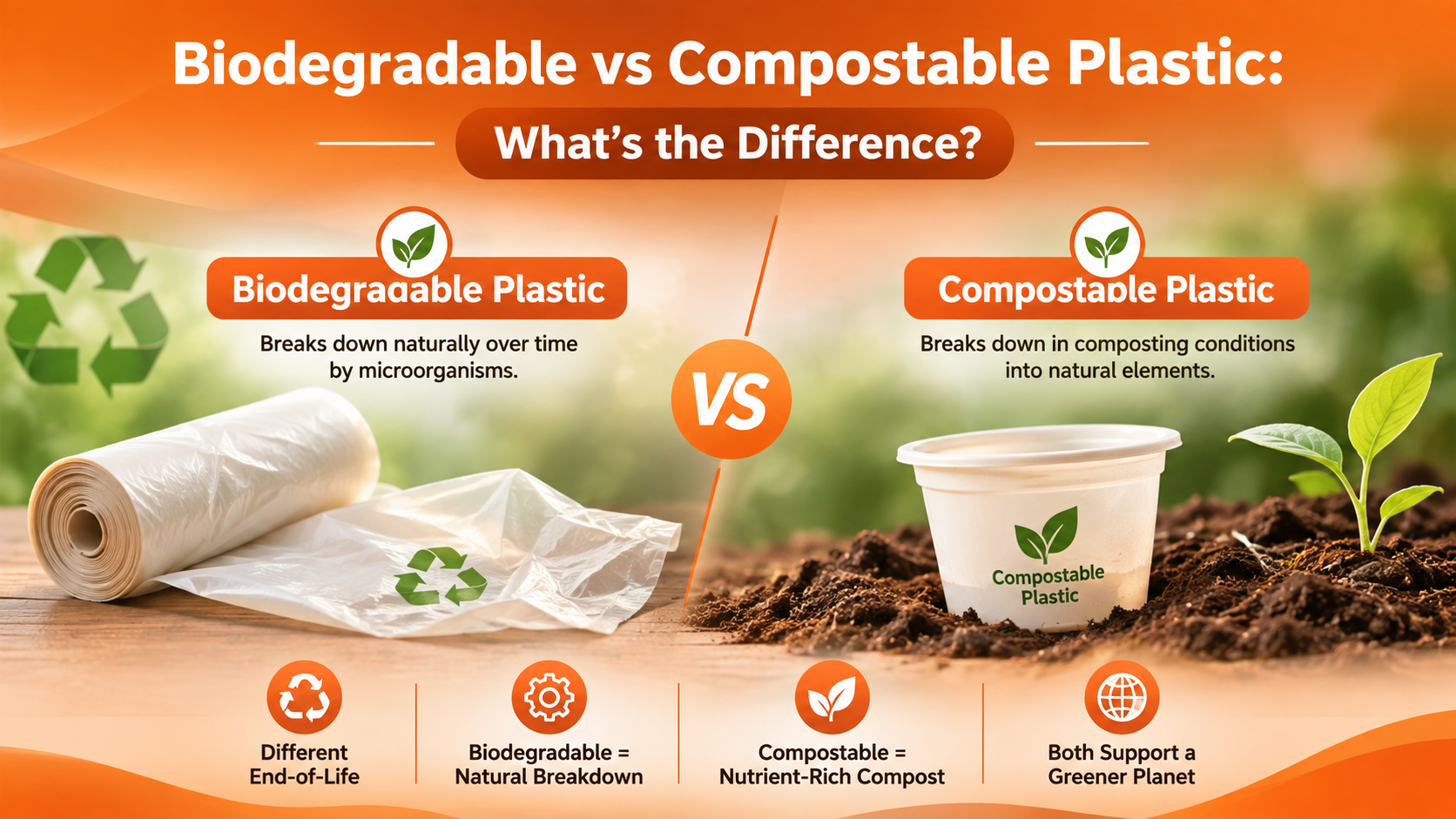
“Biodegradable” and “compostable” get printed on packaging as if they mean the same thing. They don’t. One promises the material will eventually break down; the other promises it breaks down into safe, soil-friendly matter under defined conditions. Mixing them up can mislead customers and even land brands in regulatory trouble.
For manufacturers, buyers, and product designers, the biodegradable vs compostable plastic distinction matters because it changes claims you can legally make, how the product should be disposed of, and which material you should specify.
In this guide, you’ll learn what each term actually means, how the two differ in conditions and end results, where oxo-biodegradable plastic fits, and a clear way to decide which one suits your product and market.
What Is the Difference Between Biodegradable and Compostable Plastic?
Biodegradable plastic breaks down into water, carbon dioxide, and biomass through microbial action, but with no guaranteed timeframe or conditions. Compostable plastic also breaks down biologically, but within a set time under specific composting conditions and leaves no toxic residue, meeting standards like EN 13432 or ASTM D6400.
In short, all compostable plastics are biodegradable, but not all biodegradable plastics are compostable. The key differences are time, conditions, and the safety of what’s left behind.
Biodegradable is a broad, loosely defined claim. A material might biodegrade in months or in decades, in soil, landfill, or industrial settings — the label alone doesn’t say. Compostable is the stricter, certified subset with measurable requirements.
How Biodegradable Plastic Works
Biodegradable plastic is designed to be broken down by microorganisms — bacteria, fungi, and algae — into simpler natural substances. The end products are typically water, carbon dioxide (or methane), and biomass.
The catch is that “biodegradable” carries no standard timeframe or environment. One product may need industrial conditions; another may partially degrade in soil. Without a certified standard behind the claim, the term tells you the direction of travel, not the destination.
This vagueness is why many regions now scrutinise unqualified “biodegradable” labels. A claim that sounds green can be meaningless if the material only degrades under conditions that rarely exist in real disposal.
How Compostable Plastic Works
Compostable plastic is a stricter category. To be certified compostable, a material must break down within a defined period under specific composting conditions and turn into compost that supports plant growth without leaving toxic residue.
Certification standards such as EN 13432 (Europe) and ASTM D6400 (US) set the requirements: a set degradation timeframe, disintegration into small fragments, and no harmful residues like heavy metals. Most certified compostable plastics need industrial composting — controlled heat, moisture, and microbes.
That last point trips people up. “Home compostable” is a separate, harder certification. A plastic labelled compostable for industrial facilities may not break down properly in a backyard bin, so disposal guidance matters as much as the material.
Where Does Oxo-Biodegradable Plastic Fit?
Oxo-biodegradable plastic is conventional plastic with additives that speed up fragmentation when exposed to heat, light, and oxygen. The plastic first breaks into smaller pieces, which are then intended to biodegrade through microbial action.
It’s used where standard plastics need a faster breakdown pathway without switching to a fully bio-based resin. Oxo-biodegradable masterbatch can be added to conventional polymers during processing, making it a practical route for existing product lines.
Keep in mind that oxo-biodegradable and compostable are not the same. Oxo-biodegradable plastic is not certified compostable and shouldn’t be labelled as such. Match the claim to the actual certification the material holds.
Biodegradable vs Compostable: Comparison Table
|
Feature |
Biodegradable Plastic | Compostable Plastic |
|
Breaks down via |
Microbial action |
Microbial action |
|
Timeframe |
Not defined |
Defined (per standard) |
|
Conditions |
Unspecified |
Specific (often industrial) |
|
End result |
Water, CO₂, biomass |
Safe compost, no toxic residue |
|
Certification |
Often none |
EN 13432 / ASTM D6400 |
| Residue | May vary |
Must be non-toxic |
Which One Should You Choose?
Start with your claim and your market. If you need a certified environmental claim — for retail packaging or a regulated market — compostable plastic backed by EN 13432 or ASTM D6400 gives you defensible ground.
If your goal is faster fragmentation of conventional plastic in existing production, oxo-biodegradable additives offer a lower-cost, drop-in route. Just be honest in labelling: call it oxo-biodegradable, not compostable.
Also weigh disposal reality. Compostable plastics need the right composting facility to deliver on their promise. If that infrastructure isn’t available to your customers, the environmental benefit may not materialise. Match material, claim, and real-world disposal for a credible, compliant product.
Common Types of Biodegradable and Compostable Plastics
It helps to know the materials behind the labels. PLA (polylactic acid), made from plant starch, is one of the most common certified compostable plastics, used in cups, cutlery, and packaging. It usually needs industrial composting to break down properly.
PHA (polyhydroxyalkanoates) is produced by microorganisms and can biodegrade in a wider range of environments, including some marine settings. PBAT is a flexible polymer often blended with PLA to add toughness in compostable film.
On the biodegradable-but-not-compostable side sit oxo-biodegradable products — conventional polymers with pro-degradant additives. Knowing which family your material belongs to keeps your labelling accurate and your claims defensible.
Why the Difference Matters for Your Brand
Getting these terms right isn’t just technical hygiene — it protects your brand. Regulators in many regions now crack down on vague or misleading environmental claims, and an unqualified “biodegradable” label can invite scrutiny or penalties.
Customers are also more informed and more sceptical. Overstating a material’s green credentials risks accusations of greenwashing, which can damage trust faster than having no eco-claim at all.
The safe path is precision: state exactly what the material is certified to do, under what conditions, and how to dispose of it. Clear, honest labelling backed by real certification turns your sustainability effort into a genuine selling point rather than a liability.
Conclusion
The biodegradable vs. compostable plastic difference comes down to three things: time, conditions, and what’s left behind. Biodegradable is a broad, often uncertified claim. Compostable is the certified, measurable subset that turns into safe compost under defined conditions.
Oxo-biodegradable sits apart again — a faster-fragmenting route for conventional plastic, but not a compostable one. Choose based on the claim you can legally make, the disposal infrastructure your customers have, and your cost targets.
Exploring greener packaging options or oxo-biodegradable additives for your product line? Get in touch with the technical team at Surya Compounds & Masterbatches to find a solution that matches your claims and your process.
Frequently Asked Questions
Q: Is biodegradable plastic the same as compostable plastic?
A: No. Compostable plastic is a certified subset of biodegradable plastic. It breaks down within a defined time under specific conditions and leaves no toxic residue. Biodegradable plastic simply breaks down eventually, with no guaranteed timeframe, conditions, or end-product safety.
Q: How long does biodegradable plastic take to decompose?
A: There’s no fixed answer, because “biodegradable” has no standard timeframe. Depending on the material and conditions, it can take months to many years. Certified compostable plastics, by contrast, must degrade within a set period defined by standards like EN 13432 or ASTM D6400.
Q: Is oxo-biodegradable plastic compostable?
A: No. Oxo-biodegradable plastic uses additives to fragment conventional plastic faster, but it is not certified compostable. It should not be labelled compostable. If you need a compostable claim, use a material certified to a recognized composting standard instead.
Q: What standards certify compostable plastic?
A: The main standards are EN 13432 in Europe and ASTM D6400 in the United States. They require the plastic to disintegrate and biodegrade within a set time, under defined composting conditions, and leave compost free of toxic residues such as heavy metals.
Q: Do compostable plastics break down in a home compost bin?
A: Not always. Many certified compostable plastics need industrial composting with controlled heat and moisture. “Home compostable” is a separate, stricter certification. Always check which certification a product holds and provide clear disposal guidance to customers.
