

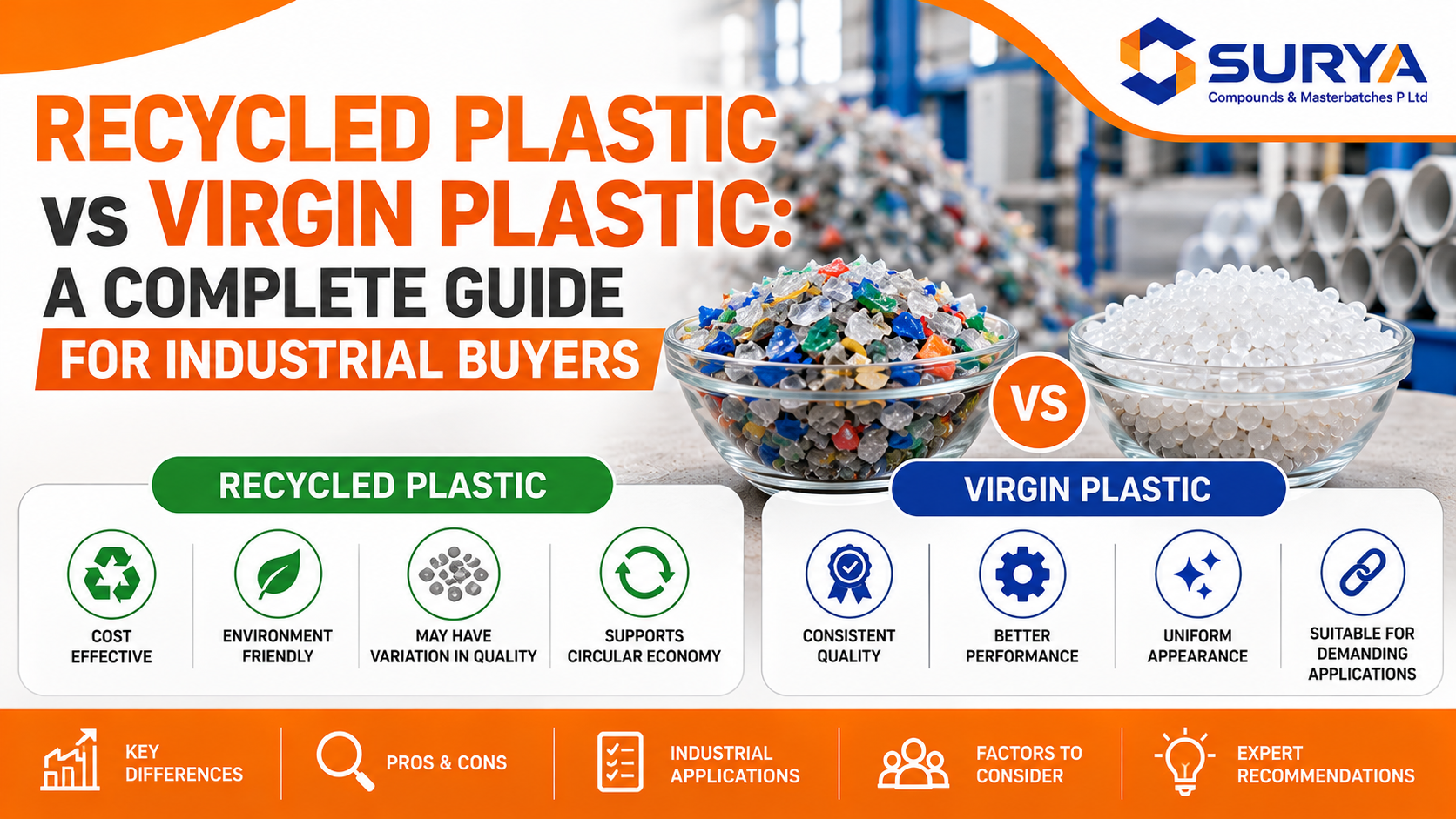
Choosing between recycled plastic vs virgin plastic is a consequential material-selection decision. It can influence mechanical performance, manufacturing efficiency, product quality, supply reliability, and total cost. Virgin polymers originate from newly manufactured feedstock; recycled polymers are recovered from prior manufacturing or use and reprocessed. Neither origin alone establishes fitness for an industrial application.
For buyers comparing virgin vs recycled plastic, the useful question is which specified compound consistently meets the intended component’s functional, processing, commercial, and compliance requirements. This guide covers the technical trade-offs and the questions to ask before purchasing.
What Are Virgin and Recycled Plastics?
Virgin polymers
Virgin polymers are made from newly produced polymer feedstock. Common grades include polypropylene (PP), polythene (PE), acrylonitrile butadiene styrene (ABS), polyamide (PA), and polycarbonate (PC). Each family includes grades with different molecular weights, additives, reinforcements, flow characteristics, and end uses. Virgin grades commonly provide controlled starting composition and documented properties, but they are not universally superior to every recycled formulation.
Recycled polymers: PIR and PCR
Post-industrial recycled (PIR) feedstock comes from production scrap, offcuts, start-up material, or rejected components before consumer use. Segregated PIR from a known process can have relatively traceable composition, although handling and previous processing still matter.
Post-consumer recycled (PCR) feedstock comes from products recovered after use, such as containers, packaging, and discarded components. Collection streams can contain diverse polymers, colours, additives, residues, and contaminants, making sorting and qualification especially important.
What are recycled polymer compounds?
Recycled polymer compounds are formulated materials containing recycled resin and, when needed, virgin resin, mineral fillers, reinforcements, stabilisers, compatibilizers, impact modifiers, colourants, or other additives. Compounding can target a desired balance of stiffness, impact resistance, flow, appearance, and stability. An additive that improves one property can compromise another: for example, some filler packages increase stiffness while reducing elongation or toughness.
Recycled Plastic vs Virgin Plastic: Comparison at a Glance
| Factor | Virgin plastic | Recycled plastic compound |
|
Feedstock |
Newly produced polymer | Recovered PIR or PCR polymer |
|
Composition |
Controlled by the producer’s grade specification | Depends on collection, sorting, feedstock controls, and formulation |
| Mechanical properties | Grade- and formulation-dependent | Also depends on degradation and previous processing history |
|
Batch consistency |
Usually supported by established grade tolerances |
Can be controlled but may require broader incoming and batch testing |
|
Melt-flow behaviour |
Grade-specific |
Influenced by feedstock mixture, degradation, and additives |
|
Contamination exposure |
Generally less recovered stream contamination |
May include foreign polymers, particles, residues, or incompatible additives |
|
Appearance |
Controlled colours and optical grades may be offered. | Feedstock colours and particles can restrict some finishes |
| Cost | Depends on grade and market. |
Depends on recovery, cleaning, formulation, testing, and market |
| Application | Wide range, subject to grade qualification |
Wide range when application requirements are validated |
These are tendencies, not universal performance rankings. Compare specific grades tested under equivalent conditions.
Mechanical Performance
1. Tensile strength, stiffness, and elongation
Tensile properties depend on base polymer chemistry, molecular weight and its distribution, fillers, reinforcement, additives, processing conditions, and the moulded specimen. Reprocessing can change molecular structure, but the effect varies by polymer. A filled recycled PP may be stiffer than unfilled virgin PP while having lower elongation at break. Examine modulus, yield strength, elongation, and failure mode together—not one strength figure in isolation.
2. Impact resistance
Impact resistance is important for industrial housings, containers, covers, and material-handling products. Foreign polymers, poor dispersion, degradation, or brittle fillers may reduce toughness; an appropriate impact-modifier package may improve it. Compare notched impact results only with matching methods, specimen conditioning, and temperatures. Room-temperature results cannot automatically predict cold-service behaviour.
3. Durability and long-term loading
Initial tensile and impact properties do not establish service life. Relevant durability requirements may include creep, fatigue, chemical resistance, environmental stress cracking, UV exposure, vibration, and repeated handling. A part under sustained load or exposed to outdoor conditions may need accelerated ageing and representative functional testing, irrespective of recycled content.
4. Thermal behaviour
Repeated melt exposure, moisture, oxygen, and residence time can alter some polymer chains and therefore viscosity, stability, and mechanical behaviour. Other formulations can undergo branching or crosslinking. Stabilizers and controlled processing may reduce some risks. Separate processing stability, heat resistance under load, and long-term thermal ageing when writing specifications.
Batch Consistency and Compound Specifications
Recycled feedstock may vary in polymer composition, colour, additives, contaminants, and prior thermal history. Virgin batches can also vary within agreed tolerances. The relevant purchasing criterion is whether a supplier can maintain a defined acceptance window, not simply whether the input is recycled.
Ask for a named compound grade, a technical data sheet, test conditions, critical-property ranges, lot identification, documented change control, and—where available—a batch-specific certificate of analysis. A typical data sheet value is not necessarily a contractual limit. Agree in advance how nonconforming lots will be handled.
Processing Behaviour in Injection Moulding and Extrusion
1. Melt flow rate and viscosity
Melt flow rate (MFR or MFI) indicates extrusion flow under a standardized load and temperature. It is useful for screening and quality control, but does not fully describe viscosity at actual processing shear rates. Recycled feedstock mixing and molecular-weight changes can alter MFR. Compare values only under the same test temperature and load; evaluate full processing behaviour in production trials.
2. Injection moulding
Flow variability can affect filling pressure, weld lines, shrinkage, surface finish, dimensions, and cycle stability. Some recycled compounds may exhibit black specks or inconsistent appearance if feedstock and filtration are inadequate. Evaluate the candidate in the intended mould and machine, with defined acceptance criteria for weight, dimensions, appearance, and mechanical performance.
3. Extrusion
Extrusion trials should monitor output, melt pressure, filter-screen loading, die build-up, melt uniformity, dimensional variation, and surface appearance. Particles or incompatible polymer fractions can complicate filtration or affect finish. Carefully formulated recycled materials may still be suitable for various sheets, profiles, and other products after qualification.
4. Temperatures, drying, and handling
No single processing temperature applies to all recycled polymers. Follow grade-specific guidance and account for drying requirements. Hygroscopic polymers such as many polyamides and polyesters need suitable moisture control to avoid moisture-related processing damage. Storage, residual volatiles, and previous handling should also be considered.
Contamination Risks and Controls
Recovered streams can contain unintended PE/PP mixtures, metals, paper, adhesive, dust, dirt, pigments, moisture, organic residues, or degraded particles. Some polymer combinations are immiscible and can compromise mechanical behaviour; intentionally engineered blends with suitable compatibilization are a different case from uncontrolled contamination.
Potential controls include feedstock segregation, polymer identification, washing, drying, metal separation, melt filtration, controlled compounding, batch inspection, and traceability. No single control detects or eliminates every contaminant. For highly regulated or sensitive applications, require the specific chemical, purity, and end-use evidence that the application demands.
Cost: Compare the Total Manufacturing Outcome
Recycled material is not necessarily cheaper than virgin material. Prices depend on resin family, feedstock access, sorting and cleaning, additive formulation, quality level, market conditions, lead time, and documented requirements.
| Cost item | What buyers should evaluate |
| Purchase price | Price per delivered kilogram for the specified grade |
| Process efficiency | Cycle time, output, pressure, energy, and line stability |
| Yield | Scrap, rework, rejection rates, and usable parts |
| Testing | Qualification, incoming inspection, ongoing verification |
| Maintenance | Filter changes, tooling wear, cleaning, and downtime |
| Supply | Lead times, repeatability, interruptions, and inventory |
| Quality losses | Claims, replacement, and potential field failures |
Total cost per accepted part = (material + processing + testing + quality-related costs) ÷ accepted parts.
For example, a lower-priced material that causes more rejects and interruptions may cost more per accepted component than a higher-priced material. Establish the answer with comparable quotes and actual trial data, not assumed price or performance advantages.
Testing and Quality Requirements
| Property | Common test methods | Purpose |
| Tensile properties | ASTM D638; ISO 527 series | Strength, stiffness, elongation |
| Melt flow | ASTM D1238; ISO 1133 series | Flow screening and batch comparison |
| Impact | ASTM D256 / ISO 180 (Izod); ISO 179 (Charpy) | Impact behaviour |
| Flexural | ASTM D790; ISO 178 | Bending behaviour |
| Density | ASTM D792; ISO 1183 series | Composition and consistency screening |
| Heat deflection | ASTM D648; ISO 75 series | Deformation under load at temperature |
| Vicat softening | ASTM D1525; ISO 306 | Softening under specified conditions |
| Thermal transitions | DSC / ISO 11357 series | Melting and crystallization behaviour |
| Mass loss and composition clues | TGA / ISO 11358 series | Thermal mass-loss behaviour |
| Polymer identification | FTIR and other suitable analyses | Identification of polymer fractions |
Select methods according to the actual grade, part geometry, requirements, and applicable standard. Results from different specimens, conditions, or methods are not directly interchangeable. A technical data sheet normally provides typical or specified properties, whereas a batch report documents results or conformity for a particular lot. Ask which values are guaranteed and which are indicative.
An industrial housing, for example, may require screw-boss strength, assembly testing, dimensional stability, chemical exposure, and temperature cycling beyond laboratory tensile coupons. Final-part validation under representative service conditions remains essential before any direct material substitution.
Industrial Application Suitability
Potential uses for qualified recycled compounds
- Non-critical moulded parts: selected covers, storage products, enclosures, and accessories, after appearance and mechanical qualification.
- Material-handling products: selected bins, trays, and crates, after testing stacking, impact, temperature, and repeated handling.
- Profiles and sheets: selected extruded industrial products, after dimensional, surface, and processing validation.
- Automotive non-safety components: only where applicable customer specifications, ageing, odour/emissions, appearance, and mechanical requirements are met.
- Specified recycled-content products: only with documented permitted PIR/PCR categories, content accounting, and satisfactory functional performance.
Where virgin or specially qualified formulations may be preferable
Food-contact, medical, safety-critical automotive, electrical, highly appearance-sensitive, and high-temperature engineering uses often demand extra purity, traceability, regulatory, ageing, or safety evidence. Virgin resin may simplify some qualification pathways, but virgin content itself is not proof of compliance. Recycled grades should be considered only when the applicable rules permit them and required documentation and product testing support their use.
Practical Decision Matrix for Industrial Buyers
| Criterion | Virgin-polymer consideration | Recycled-compound consideration | Buyer action |
| Performance | Defined by grade and additives | Also affected by feedstock and history | Compare full property profiles |
| Consistency | Established tolerances may be available | Requires effective source and lot control | Agree acceptance ranges |
| Processing | Grade-specific processing guidance | May need additional optimization | Trial on production equipment |
| Contamination | Generally fewer recovered-stream risks | Additional foreign-material risks | Review segregation and filtration |
| Cost | Grade and market dependent | Recovery and QA dependent | Calculate cost per accepted part |
| Appearance | More controlled choices may be available | Feedstock colour/particles can matter | Approve production samples |
| Compliance | Still requires appropriate qualification | May require added recycled-source controls | Verify all application-specific rules |
| Supply | Producer and market dependent | Feedstock and compounder dependent | Check lot continuity and change control |
Decision sequence: Define the component’s operating conditions; set measurable property and documentation requirements; shortlist particular grades; run laboratory and manufacturing validation; then compare cost per accepted component and supply reliability.
Supplier Evaluation Checklist
1. Composition and sourcing
- What base polymer and exact compound grade are supplied?
- Is the material virgin, PIR, PCR, or a blend, and how is its declared content verified?
- Which fillers, modifiers, and additives are relevant to the application?
- How are feedstock and formulation changes communicated?
2. Mechanical and thermal data
- Is a current technical data sheet available with methods and test conditions?
- Are tensile, flexural, impact, MFR, and thermal data suitable for the application?
- Are values typical, specification limits, or batch-specific results?
- What ageing, creep, or chemical-resistance evidence is available if needed?
3. Processing and Quality
- What drying, storage, processing, and handling guidance applies?
- How are contamination, incoming feedstock, and batch variation controlled?
- Are lot identifiers, traceability, and certificates of analysis available?
- How are nonconforming batches and customer complaints managed?
- Can the material be trialled under the intended production conditions?
4. Commercial and Regulatory
- What are the order quantities, lead times, pricing terms, and supply continuity arrangements?
- What are the agreed acceptance and rejection criteria?
- Is the required application-specific regulatory or customer documentation available?
- Has the finished part been qualified for its actual operating environment?
Frequently Asked Questions
1. Is recycled plastic weaker than virgin plastic?
Not always. Degradation or contamination may reduce certain properties, while an appropriately formulated recycled compound may meet a defined strength or toughness requirement. Compare actual grades and test conditions.
2. Can recycled plastic directly replace virgin plastic in injection moulding?
Do not assume so. Confirm flow, dimensions, shrinkage, appearance, impact, other relevant properties, and finished-part performance through trials and qualification.
3. Is recycled plastic always cheaper?
No. Feedstock quality, sorting, stabilizers, testing, yield, and processing costs determine the economics. Compare total manufacturing cost per accepted part.
4. What is the difference between PIR and PCR plastic?
PIR comes from industrial production waste before end-user use; PCR comes from products recovered after use. Source control and contamination challenges differ, but neither label guarantees quality.
5. Does recycling change melt flow index?
It can. Molecular-weight changes, feedstock mixtures, and additives can change MFR. Only compare measurements made under matching load and temperature, and validate actual processing.
6. Which tests should industrial buyers request?
At minimum, select tests based on use: commonly tensile, impact, melt flow, density, and thermal properties. Add chemical, creep, ageing, contamination, and finished-part tests when relevant.
7. Can recycled polymer compounds be used in automotive parts?
They may suit selected parts when customer specifications and mechanical, thermal, appearance, odour/emissions, and traceability requirements are demonstrated. Safety-critical uses need particularly rigorous qualification.
8. Can recycled and virgin polymers be blended?
Yes, when compatibility, formulation, processing, and performance are verified. No universal recycled-content blending ratio is suitable for all polymers or applications.
9. How can a manufacturer improve recycled-compound consistency?
Use controlled sourcing, segregation, material identification, cleaning or filtration where appropriate, stable formulation, batch testing, and agreed property limits.
10. Are recycled compounds suitable for high-performance applications?
Some specially qualified formulations may be. The decision requires application-specific data and often long-term performance validation, not a blanket judgement based on recycled content.
11. Do virgin polymers automatically meet food-contact or medical requirements?
No. Material composition, intended-use conditions, applicable rules, and documented qualification govern suitability for regulated uses.
12. What should matter most when selecting a compound supplier?
Prioritize verifiable specifications, consistency, traceability, suitable test evidence, production compatibility, quality support, and reliable supply arrangements.
Conclusion: Selecting the Right Industrial Polymer Compound
The recycled plastic vs virgin plastic decision is best made against a measurable specification. Compare mechanical and thermal performance, processing stability, contamination controls, traceability, application compliance, and total manufacturing cost. A compound’s origin does not eliminate the need for testing.
Surya Compounds & Masterbatches is a relevant point of contact for discussions about industrial polymer-compound requirements. To evaluate possible options, begin with the intended polymer family, processing method, performance targets, quality expectations, and application constraints.
Contact Surya Compounds & Masterbatches to discuss your material requirements and the specifications and qualification information needed for an informed industrial purchasing decision.
