
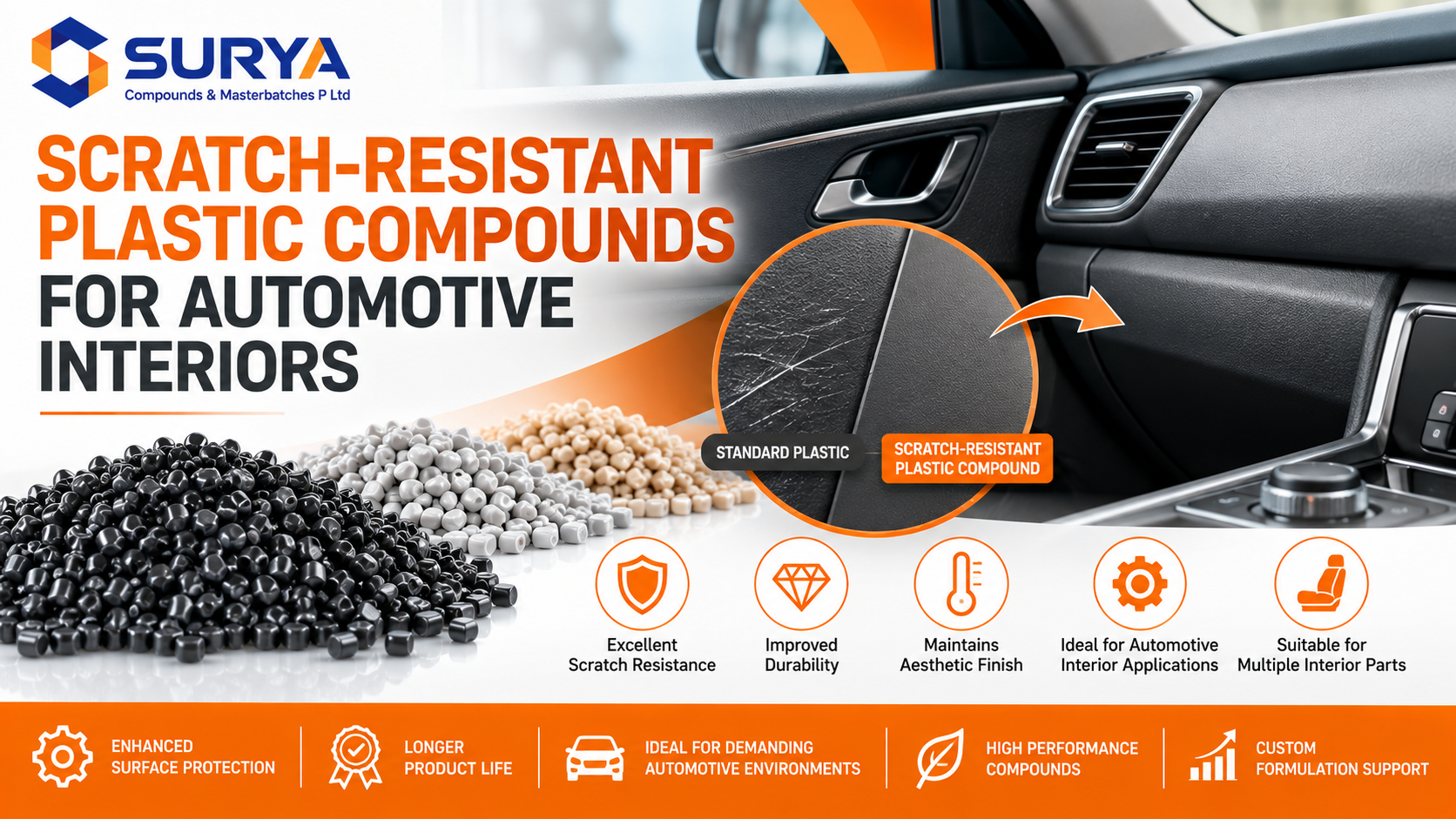
Automotive interior plastics must retain an acceptable surface appearance despite contact with keys, bags, footwear, cleaning cloths, fingernails and everyday handling. Instrument panels, door trims, consoles and pillar covers are especially exposed. Choosing scratch resistant plastic compounds therefore requires more than a hard polymer: resin chemistry, fillers, modifiers, pigments, texture, moulding conditions and the way damage is measured all contribute to the result.
For automotive manufacturers, the central aim is to reduce damaging surface deformation and objectionable visible marks while maintaining impact strength, stiffness, dimensional stability, processability, appearance and cost targets. This guide explains how to evaluate a scratch resistant PP compound and alternative automotive interior materials without assuming any single formulation will pass every original equipment manufacturer (OEM) specification.
Quick Summary
Scratch-resistant plastic compounds are formulated to reduce visible scratching, scuffing, and surface whitening on automotive interior components such as dashboards, door trims, and centre consoles.
A scratch-resistant PP compound may combine polypropylene or TPO with optimised fillers, impact modifiers, surface additives, pigments, and textures. Performance depends on the formulation, moulding conditions, and intended application.
Automotive manufacturers should evaluate scratch resistance using relevant methods such as ASTM D7027 or ISO 19252, while also validating mechanical properties, durability, appearance, and OEM requirements.
Understanding Scratch Resistance and Mar Resistance
Scratching usually involves localised mechanical contact that creates a groove, displaced material, cracking or permanent deformation. Marring often refers to superficial scuffing or fine contact damage that changes surface gloss, colour or texture. These terms overlap in everyday usage, but a part can resist deep grooves while still showing highly visible light marks.
Damage visibility depends on the depth and shape of a mark, the contrast between damaged and undamaged regions, pigment and filler dispersion, surface gloss, texture, viewing angle and illumination. On dark interior trim, a shallow light-coloured scratch may be more objectionable than a deeper mark that produces little contrast. Scratch whitening is particularly important for many coloured or mineral-filled PP formulations.
Key distinction: Mechanical scratch depth, critical scratch load, coefficient of friction and visual rating are different endpoints. An improvement in one does not guarantee an improvement in the others.
Suitable Polymers for Automotive Interior Components
Polypropylene and thermoplastic polyolefins
PP and PP-based thermoplastic polyolefins (TPOs) are common candidates for moulded interior trim because they can offer a useful balance of density, stiffness, chemical resistance, mouldability and cost. Talc-filled PP may improve stiffness and dimensional behaviour, but exposed or poorly dispersed mineral particles and the resulting deformation behaviour may contribute to scratch whitening. A scratch resistant PP compound typically requires optimisation of the resin, impact-modifier system, mineral grade and loading, additives, pigmentation and surface structure together.
ABS and PC/ABS
ABS and PC/ABS blends may be considered for interior housings, decorative parts and components with defined appearance, impact or thermal requirements. Their surface response varies by grade, rubber morphology, pigment system, texture and any coating. They should not automatically be described as scratch-proof or always superior to PP. Compare actual grades using the specified test, surface and moulding conditions.
Other engineering thermoplastics
Selected PA, PC, PMMA and other engineering polymers may be relevant to particular interior components, especially when stiffness, transparency, heat resistance or dimensional requirements govern the decision. Transparent or high-gloss parts can require specialised hard-coat systems, because optical appearance and surface damage visibility may be more demanding than for textured trim.
How Formulation Improves Automotive Plastic Scratch Resistance
1. Silicone-based and other surface-modifying additives
Some silicone-based additives and masterbatches are designed to change surface friction and reduce visible scratching or scuffing in PP/TPO compounds. The effect depends on additive chemistry, carrier compatibility, dosage, dispersion, and ageing. Migration or surface accumulation can cause bloom, tack, appearance changes, altered paint/adhesive bonding or other downstream issues. Verify performance after heat ageing, cleaning, UV exposure and assembly—not only immediately after moulding.
2. Lubricants, slip agents and processing aids
Selected lubricants and slip agents can change contact friction and surface response. Lower friction is not synonymous with higher scratch resistance under every load and texture. Some additives may affect gloss, odour, emissions, surface feel, paintability or long-term stability. Supplier guidance and qualification testing are essential.
3. Mineral fillers and reinforcement
Talc and other mineral fillers may help achieve stiffness and shrinkage targets, but filler type, particle size, loading, orientation, dispersion and matrix adhesion influence surface marking. Changing filler level to improve one property can reduce impact toughness, elongation or surface quality. The best formulation is a balanced system, not simply the highest filler content.
4. Elastomer and impact-modifier systems
Elastomer-modified PP/TPO compounds can improve impact performance, but modifier type and concentration alter hardness, deformation, surface recovery and scratch appearance. A softer material may deform differently under a stylus than a harder grade. Evaluate scratch, low-temperature impact, stiffness and dimensional behaviour together.
5. Pigments, colour and stabilisers
Pigment selection and dispersion affect both appearance and how a scratch contrasts with the surrounding surface. Light and dark colours can behave differently under the same mechanical damage. Heat and light stabilisers are relevant to long-term colour and surface integrity but should not be treated as automatic anti-scratch additives.
Surface Finish and Tool Texture
Surface design is as important as material chemistry. Fine or coarse grain, low gloss, matte finish, and pattern direction can change how marks appear. A selected texture may visually mask certain contact marks, yet another texture may concentrate contact stresses or produce obvious gloss changes. Textured is not automatically scratch resistant.
Moulded-in colour (MIC) compounds avoid a separate paint layer, but place greater importance on inherent surface durability and pigment consistency. Coatings or hard coats can provide an alternative for certain high-gloss or decorative components; they introduce additional adhesion, abrasion, weathering, chemical resistance, manufacturing and repair considerations.
Test on the intended production texture. Flat, polished plaques and grained final parts can rank materials differently. Specify colour, grain, gloss target, finish and inspection lighting before approving a formulation.
Moulding Conditions That Affect Surface Quality
1. Melt and mould temperatures
Use a validated temperature window for the chosen compound. Temperatures influence filling, crystallisation, surface replication, residual stresses and additive behaviour. Excessive heat or residence time can degrade some formulations; inadequate temperatures can impair flow or texture reproduction. No universal setting improves every grade.
2. Injection speed, packing and gate design
Filling velocity, packing pressure, gate location, weld-line formation and flow orientation affect gloss, surface pattern, shrinkage and stress distribution. High-shear regions near gates may behave differently from the rest of the component. Optimize processing for the actual tool, material and appearance requirements.
3. Cooling, ejection and handling
Uneven cooling and early ejection can increase distortion or leave a surface susceptible to handling marks. Tool cleanliness, release practices, robotic grippers, conveyors, part stacking, protective packaging and assembly fixtures also affect final appearance. Some defects attributed to an inadequate resin originate from handling after moulding.
4. Moisture, contamination and dispersion
Where the polymer or additive system requires it, drying and storage controls are important. Poor additive dispersion or foreign particles can create localized surface defects. Record actual machine settings during each trial so improvements can be reproduced.
Testing Scratch and Mar Resistance
Scratch evaluation should combine instrumented mechanical measurements with visual acceptance criteria. Relevant methods include:
|
Test or assessment |
What it can establish |
Key controls |
|
ASTM D7027 instrumented scratch |
Scratch response under controlled stylus loading; mechanical and visual damage indicators | Tip geometry, load, speed, conditioning, texture |
|
ISO 19252 scratch properties |
Comparative scratch mapping or critical normal-load behaviour under defined conditions |
Specimen preparation, load history, speed and surface |
|
OEM-specific scratch protocol |
Whether a material or part meets an automaker’s prescribed method and limit |
Exact OEM revision, tip, load and acceptance rule |
|
Optical imaging/profilometry |
Scratch width, depth, residual groove and damage morphology |
Imaging setup, measurement location, recovery time |
|
Colour/gloss difference |
Visibility, whitening or surface sheen change |
Lighting, colour, grain and instrument geometry |
|
Repeated rub/scuff assessment |
Sensitivity to repeated contact and handling |
Counterface, repetitions, force and cleaning history |
| Ageing followed by scratch testing | Durability of the surface response after service-like exposure |
Heat, UV, humidity, chemicals and recovery conditions |
ASTM D7027 discusses scratch whitening and notes that viscoelastic recovery can change residual damage; ISO 19252:2025 specifies a controlled method for determining scratch properties. OEM methods such as VW PV 3952 may apply to a specific customer programme, but their requirements and acceptance thresholds must be obtained from the governing specification. Do not interchange numerical results from different tips, loads, methods, textures or ageing protocols.
Build a reproducible test plan
- Obtain the exact customer/OEM test method and required acceptance level.
- Define colour, gloss, texture, thickness, conditioning and moulding history.
- Compare multiple plaques and, where necessary, final parts from several batches.
- Record scratch load, speed, stylus, direction relative to grain, temperature and humidity.
- Measure both visible damage and physical groove characteristics where relevant.
- Repeat after heat/UV/chemical ageing and representative cleaning or handling.
- Confirm impact, stiffness, heat, dimensional, odour/emission and other part requirements are still satisfied.
Material Selection Table for Automotive Interior Applications
|
Candidate |
Potential advantage | Scratch or mar consideration | Typical evaluation priority |
|
Unfilled PP |
Useful base for lower-density moulded trim | Surface softness and visible marking vary by grade | Scratch, stiffness, dimensional control |
| Talc-filled PP | Improved stiffness and dimensional potential | Talc grade, dispersion and surface whitening require attention |
Scratch visibility, impact, shrinkage |
|
Modified PP/TPO |
Tunable toughness and surface behaviour | Modifier and additive balance can affect hardness and marking |
Scratch, low-temperature impact, ageing |
|
Scratch-modified PP compound |
Formulated friction/surface response | Additive migration, gloss and bonding must be checked |
Initial and aged scratch, VOC/odour, finish |
|
ABS |
Moulded appearance and impact options | Scratch performance depends on grade and texture |
Finish, scratch, heat, impact |
|
PC/ABS |
Useful impact and thermal property combinations | Visual damage can remain an issue; coating may be considered |
Scratch, temperature, chemical resistance |
| Coated or hard-coated substrate | Can protect selected decorative surfaces | Added coating cost, adhesion, ageing and repair considerations |
Abrasion, adhesion, scratch, appearance |
These are material families, not ranked products or guaranteed specifications. Qualification must use actual commercial grades and production-representative parts.
Practical Automotive Examples
Example 1: Textured dashboard panel with whitening marks
Problem: A dark talc-filled PP panel meets stiffness targets but shows pale stylus marks on a grained surface. Evaluation: Compare filler particle characteristics and loading, compatible surface-modifying additives, pigments and texture variants. Test whitening threshold and residual groove after conditioning and ageing, while checking impact and dimensional performance. Decision: Select only a formulation that meets the entire part specification; no particular additive or dosage should be assumed successful in advance.
Example 2: Centre-console trim with repeated scuffing
Problem: Keys and everyday contact create fine mar marks that become visible under oblique light. Evaluation: Compare moulded-in colour PP/TPO, ABS and a relevant coated option under the same repeated-contact protocol. Record gloss change, colour difference, maintenance/cleaning effects and total manufacturing cost. Decision: Choose on measured appearance durability and integration requirements, not initial hardness alone.
Example 3: Door trim passes a plaque test but fails in production
Problem: Flat trial plaques look acceptable while actual textured parts show inconsistent marks near gates. Evaluation: Map fill patterns, local mould temperature, packing, gate shear, texture replication, additive distribution and handling damage. Repeat tests on production parts from multiple locations and lots. Decision: Investigate moulding/process causes before changing resin formulation.
Performance Trade-offs and Commercial Decisions
An anti-scratch change can influence other important properties:
- Scratch vs impact: Higher stiffness or hardness does not ensure adequate cold-impact behaviour.
- Scratch vs gloss and touch: Surface modifiers and textures can affect perceived quality and feel.
- Scratch vs paint or adhesive bonding: Migratory components may interfere with subsequent finishing or assembly.
- Scratch vs long-term appearance: Heat/UV exposure and cleaning may change additive distribution or colour.
- Scratch vs mouldability: Fillers and modifiers can influence flow, weld lines, cooling and dimensional stability.
- Scratch vs cost: Additive, tooling, coating, scrap, testing, and warranty-related costs belong in the total-cost calculation.
Compare cost per accepted, specification-compliant component, accounting for material price, cycle time, yield, rework, tooling, surface finishing, and validation—not just compound price per kilogram.
Evaluation Checklist for Automotive Manufacturers
Product definition
- Which interior part and contact/cleaning conditions are involved?
- Is the defect deep scratching, light marring, whitening or gloss change?
- What are the intended colour, grain, gloss and visible-surface requirements?
- Which OEM specification, revision and acceptance limit applies?
Compound and formulation
- What are the polymer family, exact grade, filler type/loading and impact requirements?
- Are anti-scratch additives compatible with the base polymer and other masterbatches?
- Are migration, bloom, paint/adhesive bonding, odour and emissions assessed?
- Are heat, light and chemical stability adequate for the vehicle interior?
Production and quality
- Are trials run on production-representative moulds and textures?
- Are temperature, injection, packing, cooling and handling settings documented?
- Have several locations, batches and parts been inspected?
- Do surface tests remain satisfactory after relevant ageing and cleaning?
- Do impact, stiffness, dimensional, flame-related and other OEM requirements remain satisfied?
- Are supplier data, change controls and lot traceability available?
Commercial approval
- Is the cost per accepted finished component competitive?
- Are material availability, repeatability and customer approval documented?
- Has final-part validation been completed before changing an approved material?
Frequently Asked Questions
1. What are scratch-resistant plastic compounds?
They are polymer formulations developed to reduce physical scratch damage, visible marring, or both under defined test conditions. Performance depends on base polymer, additives, filler system, surface finish, and processing. No plastic should be assumed scratch-proof.
2. Which plastic is best for automotive interior scratch resistance?
There is no universal winner. Modified PP/TPO, ABS, PC/ABS and coated systems may be candidates. Select a grade based on the component’s surface, OEM test, ageing, mechanical and processing requirements.
3. How can a scratch-resistant PP compound be improved?
Evaluate PP grade, talc characteristics, impact modification, compatible silicone or other surface additives, colour dispersion, texture and moulding settings as a connected formulation system. Test the resulting compound rather than assuming any ingredient always improves performance.
4. Does more talc increase scratch resistance?
Not necessarily. Talc can change stiffness and dimensional behaviour while also affecting whitening and groove formation. Particle size, dispersion, loading, and interaction with the PP matrix matter.
5. Do silicone additives make PP scratch-proof?
No. Selected additives can reduce friction or improve certain scratch/mar outcomes, but benefits depend on formulation and test conditions. Migration, ageing, appearance, and downstream bonding must be checked.
6. What is scratch whitening in automotive plastics?
It is a lightened or pale appearance along a damaged region, often caused by local deformation, scattering or microstructural changes. The visual contrast can matter more to customers than groove depth alone.
7. Does a textured surface always hide scratches?
No. Texture can change mark visibility and contact mechanics; some patterns mask light marks while others make gloss differences more obvious. Test the real texture and viewing conditions.
8. Which standard is used for plastic scratch testing?
ASTM D7027 and ISO 19252 cover instrumented scratch evaluation. Specific automotive programmes may require an OEM method such as VW PV 3952. The controlling customer specification determines the actual pass/fail criteria.
9. How do moulding conditions affect scratch resistance?
Temperature, filling, packing, texture replication, cooling, gate design and part handling can alter appearance and local material structure. Test production parts as well as plaques.
10. Is mar resistance the same as abrasion resistance?
No. Fine scuffing, a single stylus scratch and repeated abrasive wear represent different damage mechanisms. A material may perform well in one test and poorly in another.
11. Can an anti-scratch masterbatch affect paintability?
It can, depending on the additive package and surface behaviour. Evaluate coating adhesion, bonding, surface defects and ageing wherever further finishing or assembly is required.
12. Can a new scratch-resistant grade replace an approved interior compound directly?
Not without the required customer and application qualification. Confirm mechanical, thermal, dimensional, appearance, emissions, processing and long-term requirements before substitution.
Conclusion:
Improving automotive plastic scratch resistance requires coordinated decisions about resin, fillers, modifiers, anti-scratch additives, pigmentation, texture, moulding and handling. The most useful measure of success is not a general claim of high scratch resistance but documented performance under the exact test and appearance requirements of the finished automotive part.
For teams evaluating scratch-resistant plastic compounds, a sound process starts with the failure mode, fixes a test protocol, compares formulated candidates, validates the production part, and checks every performance trade-off before approval.
Surya Compounds & Masterbatches is a relevant brand for industrial polymer-compound discussions. Automotive manufacturers and purchasing teams can contact Surya Compounds & Masterbatches with their polymer family, part design, specified scratch test, appearance targets, moulding method, and other qualification criteria to discuss material requirements and evaluation options. No particular product grade, test result, or capability is implied without company verification.
