

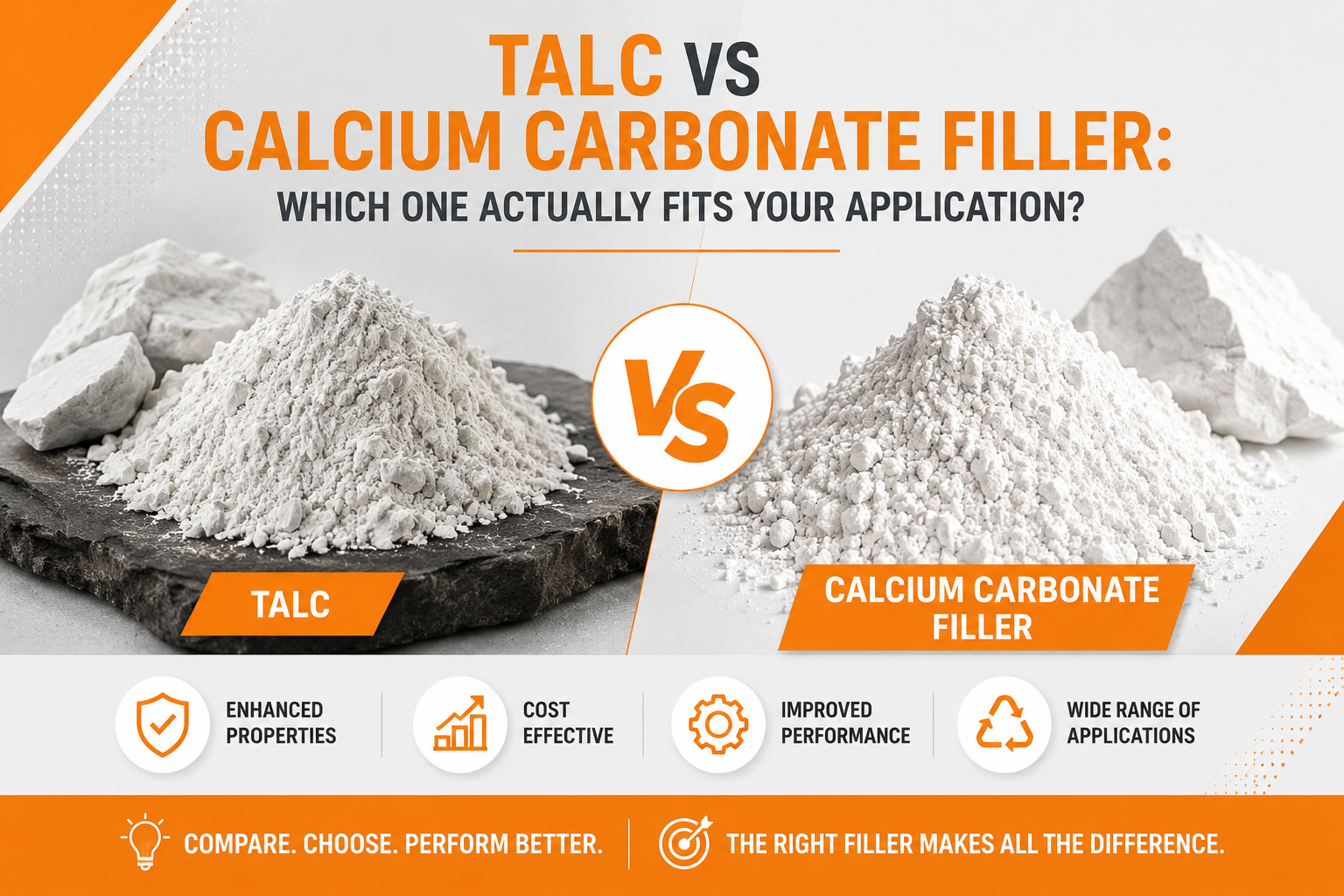
A compounder in Ahmedabad once swapped calcium carbonate for talc in a polypropylene automotive part to cut cost, without adjusting anything else in the formulation. The stiffness dropped, the part flexed where it shouldn’t have, and the whole batch got rejected at inspection.
The two fillers aren’t interchangeable, even though buyers often treat them that way on a spreadsheet.
The talc vs calcium carbonate filler decision comes up constantly in plastic compounding, because both are cheap, widely available mineral fillers used to bulk out polymer, cut resin cost, and tune mechanical properties. But they behave very differently once they’re inside a melt, and picking the wrong one for the job creates exactly the kind of failure that Ahmedabad batch ran into.
What Talc Filler in Plastics Actually Does
Talc is a hydrous magnesium silicate with a distinctive plate-like, layered particle structure. That shape is the whole story with talc — it’s why the material behaves the way it does inside a polymer matrix.
Because talc particles are flat and stack like sheets, they reinforce stiffness and heat resistance far more than round particles ever could. Polypropylene compounds loaded with talc show noticeably higher flexural modulus and better dimensional stability under heat, which is exactly why automotive interior parts — dashboards, door panels, bumper components — lean on talc-filled PP so heavily.
Talc also improves scratch resistance and reduces mold shrinkage, both of which matter for parts with tight dimensional tolerances.
What Calcium Carbonate Filler for Plastics Brings to the Table
Calcium carbonate, usually ground limestone or precipitated CaCO3, has a rounder, more granular particle shape compared to talc’s flat plates. That geometry difference changes almost everything about how it performs.
CaCO3 is primarily a cost-reduction and processing-aid filler. It’s cheaper than talc in most markets, disperses easily, and doesn’t hurt impact strength the way high talc loadings sometimes can. Pipe compounds, packaging films, and injection-molded housings that need decent impact resistance without much added stiffness often use calcium carbonate instead.
It also tends to give better surface gloss in the final part, since round particles don’t create the same surface texture that plate-like talc particles can under certain conditions.
Side-by-Side: Talc vs Calcium Carbonate Filler
|
Property |
Talc | Calcium Carbonate |
|---|---|---|
|
Particle shape |
Plate-like, layered | Rounded, granular |
|
Stiffness contribution |
High |
Moderate |
| Impact strength effect | Can reduce at high loading |
Minimal reduction |
| Heat distortion resistance | Improves significantly |
Slight improvement |
|
Cost |
Higher than CaCO3 |
Generally lower |
|
Surface finish |
Can affect gloss |
Better gloss retention |
| Typical use case | Automotive, appliances |
Pipes, packaging, general molding |
Mineral Fillers for Plastics: Why the Choice Isn’t Just About Price
Buyers who default to “whichever filler is cheaper this month” miss the bigger picture. The filler choice directly shapes the mechanical profile of the final part.
Talc-heavy formulations trade some impact strength for stiffness and heat resistance — a fair trade for a dashboard component sitting in direct sun, a poor trade for a part that needs to flex without cracking in cold weather.
Calcium carbonate formulations trade some stiffness for cost savings and better impact performance — ideal for high-volume, lower-stress parts like packaging containers, less ideal for anything that needs to hold its shape under sustained heat.
Loading percentage matters just as much as filler type. A 10% talc loading behaves nothing like a 30% loading — the higher end starts trading away toughness for stiffness fast, and processors need to test at the actual production loading, not extrapolate from a lower-percentage sample.
Step-by-Step: Choosing Between Talc and Calcium Carbonate
Step 1 — Define the mechanical priority. Does the part need maximum stiffness and heat resistance, or does it need to survive impact without stiffening too much?
Step 2 — Check the operating temperature range. Parts exposed to sustained heat generally benefit more from talc’s heat distortion resistance.
Step 3 — Consider the surface finish requirement. If gloss or a smooth cosmetic surface matters, calcium carbonate usually performs better at equivalent loading.
Step 4 — Test at the target loading percentage, not a rough estimate. Small changes in loading shift the property balance more than people expect.
Step 5 — Factor in cost per part, not just cost per kilo. A cheaper filler that increases scrap rate from cracking or warping isn’t actually saving money.
Step 6 — Run impact and flex tests on the actual molded part, since lab plaque data doesn’t always translate directly to a complex geometry.
Tips and Common Mistakes
The biggest mistake is treating this as a straight swap. Switching from calcium carbonate to talc — or the reverse — without re-tuning the loading percentage and possibly the impact modifier package almost guarantees a property shift nobody planned for.
Another common mistake: ignoring particle size distribution. Two “talc” fillers from different suppliers can have very different average particle sizes, and finer particles disperse differently than coarser ones, changing both mechanical performance and processing behavior.
Assuming higher filler loading is always better is a mistake too. Beyond a certain percentage — usually somewhere around 30-40% depending on the polymer — both fillers start hurting toughness and processability more than they help stiffness or cost.
And skipping supplier-to-supplier validation. Not all calcium carbonate is coated the same way, and uncoated versus stearate-coated CaCO3 behaves quite differently in terms of dispersion and moisture sensitivity.
Getting the Formulation Right
Surya Compounds & Masterbatches works with processors to formulate talc and calcium carbonate-filled compounds around the actual mechanical requirement rather than defaulting to whichever filler is cheaper that quarter. That kind of formulation-first approach — matching filler type, particle size, and loading to the part’s real job — is usually what prevents the kind of mid-run rejection that comes from treating two very different mineral fillers for plastics as interchangeable.
FAQs
1. Is talc or calcium carbonate better for plastic filler?
Neither is universally better. Talc improves stiffness and heat resistance, while calcium carbonate is more cost-effective and preserves impact strength better at equivalent loading.
2. Can I replace calcium carbonate with talc in an existing formulation?
Not directly. Switching fillers changes stiffness, impact strength, and processing behavior, so the formulation needs re-testing at the target loading before switching.
3. Which filler is cheaper, talc or calcium carbonate?
Calcium carbonate is generally cheaper than talc in most markets, which is why it’s common in high-volume, cost-sensitive applications.
4. Does talc filler reduce impact strength in plastics?
At higher loading percentages, talc can reduce impact strength because its plate-like structure increases stiffness at the expense of toughness.
5. What applications commonly use talc-filled plastic compounds?
Automotive interior parts, appliance housings, and components needing heat resistance and dimensional stability commonly use talc-filled compounds.
