

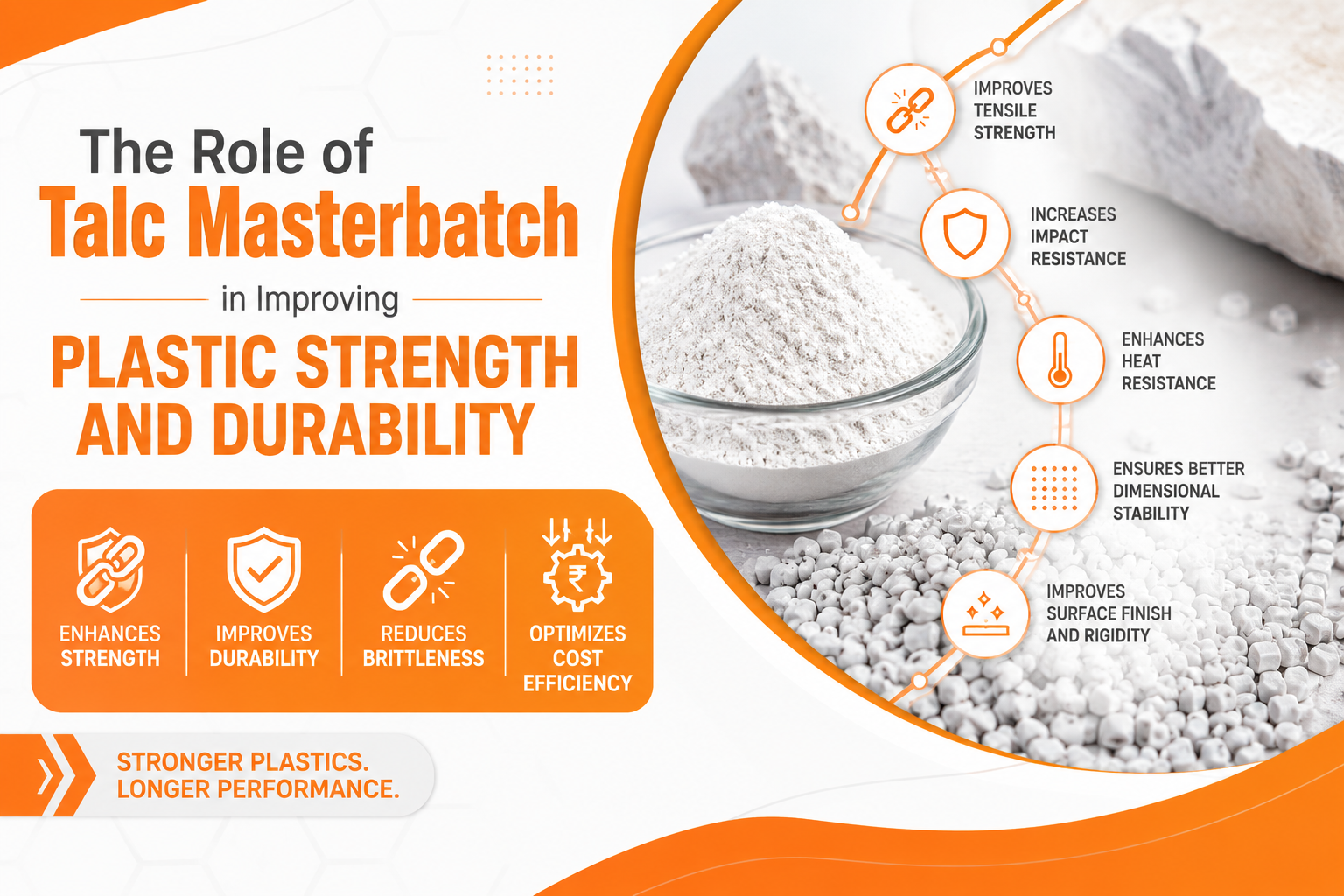
Plastic manufacturers continuously seek materials that improve product performance while maintaining production efficiency and cost control. Industries such as automotive, packaging, household goods, appliances, and industrial manufacturing require plastic products that can withstand mechanical stress, temperature fluctuations, and long-term usage without compromising structural integrity.
One of the most effective solutions used in modern plastic compounding is Talc Masterbatch. This mineral-filled additive is widely incorporated into polypropylene and other polymer systems to improve stiffness, dimensional stability, heat resistance, and overall durability. By combining finely processed talc minerals with compatible resin carriers, manufacturers can produce stronger and more reliable plastic components across various applications.
As demand grows for lightweight yet durable plastic products, talc-based masterbatch has become an essential material for manufacturers looking to enhance performance while optimizing raw material utilization.
What is Talc Masterbatch?
Talc Masterbatch is a concentrated blend of ultrafine talc powder dispersed within a polymer carrier resin, typically polypropylene (PP) or polyethylene (PE). It is designed to improve the physical and mechanical properties of plastic products during processing and end-use applications.
Unlike loose mineral fillers, talc filler masterbatch offers uniform dispersion throughout the polymer matrix. This ensures consistent performance, improved processability, and better product quality during injection molding, blow molding, extrusion, and thermoforming operations.
The plate-like structure of talc particles acts as a reinforcing agent within the polymer, helping manufacturers achieve higher rigidity, improved dimensional accuracy, and better thermal stability.
Key Properties of Talc Based Masterbatch
The popularity of talc based masterbatch comes from its ability to enhance multiple plastic properties simultaneously.
Important performance characteristics include:
- Higher stiffness and rigidity
- Improved dimensional stability
- Better heat resistance
- Reduced shrinkage during molding
- Enhanced surface hardness
- Improved creep resistance
- Better scratch resistance
- Increased structural strength
- Improved processing efficiency
- Consistent product quality
These properties make talc-reinforced compounds suitable for demanding industrial and commercial applications.
How Talc Masterbatch Improves Plastic Strength
Enhanced Stiffness and Rigidity
One of the primary benefits of Talc Masterbatch is its ability to increase the stiffness of plastic materials.
Talc particles create a reinforcing network within the polymer structure, limiting molecular movement and improving resistance to deformation. This allows manufacturers to produce thinner yet stronger plastic components without sacrificing structural performance.
Applications such as automotive interior parts, appliance housings, furniture components, and industrial products particularly benefit from increased rigidity.
Better Dimensional Stability
Plastic components often experience shrinkage during cooling and molding processes. Excessive shrinkage can result in warping, dimensional inaccuracies, and product defects.
Talc filler masterbatch helps control shrinkage by stabilizing the polymer structure. This leads to improved dimensional accuracy and consistent product geometry.
For precision-molded parts, dimensional stability is essential for maintaining product quality and assembly performance.
Improved Load-Bearing Capacity
Plastic products used in industrial and automotive applications must withstand continuous mechanical stress. Talc-reinforced compounds increase load-bearing performance by improving the material’s resistance to bending and deformation.
This makes talc additive masterbatch a preferred solution for products that require long-term structural reliability.
Improving Durability Through Talc Reinforcement
Durability extends beyond initial strength. Plastic products must continue performing under environmental and mechanical stress throughout their service life.
Heat Resistance
Talc naturally possesses excellent thermal stability. When incorporated into polymer systems, it improves heat deflection temperature and helps plastic components maintain their shape under elevated temperatures.
This makes talc-filled compounds suitable for:
- Automotive components
- Electrical housings
- Kitchenware products
- Appliance parts
- Industrial equipment
Surface Hardness and Scratch Resistance
Many plastic products experience continuous wear during daily use. Talc reinforcement improves surface hardness, helping products resist scratches, abrasions, and surface damage.
Applications such as consumer goods, storage containers, automotive trims, and industrial parts benefit from enhanced wear resistance.
Long-Term Performance Stability
The mineral structure of talc helps improve creep resistance, reducing deformation under continuous loads. This ensures that plastic products maintain their shape and performance over extended periods.
Processing Advantages of Talc Additive Masterbatch
In addition to improving physical properties, talc additive masterbatch offers significant manufacturing benefits.
Faster Production Cycles
Talc improves heat transfer characteristics within plastic materials, allowing faster cooling during molding operations.
Benefits include:
- Reduced cycle times
- Higher production output
- Improved manufacturing efficiency
- Lower operating costs
Improved Process Stability
Uniform dispersion helps maintain consistent melt flow characteristics during processing.
Manufacturers often experience:
- Better machine performance
- Reduced processing defects
- Improved product consistency
- Lower rejection rates
Optimized Material Costs
By improving mechanical properties and product efficiency, manufacturers can often optimize material usage while maintaining required performance standards.
Talc Masterbatch vs Calcium Carbonate Masterbatch
Both talc and calcium carbonate are widely used mineral fillers in plastic manufacturing. However, they serve different purposes.
| Property | Talc Masterbatch | Calcium Carbonate Masterbatch |
| Stiffness | Higher | Moderate |
| Heat Resistance | Better | Standard |
| Dimensional Stability | Excellent | Good |
| Shrinkage Control | Superior | Moderate |
| Surface Hardness | Improved | Standard |
| Cost Reduction | Moderate | Higher |
| Automotive Applications | Preferred | Limited |
For applications requiring structural strength and thermal performance, Talc Masterbatch is often the preferred solution.
Applications of Talc Filler Masterbatch
The versatility of talc filler masterbatch allows it to be used across multiple industries.
Automotive Industry
Common applications include:
- Dashboard components
- Door trims
- Interior panels
- Pillar covers
- Engine covers
Packaging Industry
Used in:
- Rigid packaging containers
- Caps and closures
- Food storage products
- Industrial packaging components
Household Products
Common applications include:
- Furniture components
- Storage containers
- Home appliances
- Consumer goods
Industrial Applications
Used in:
- Equipment housings
- Electrical enclosures
- Construction products
- Engineering plastic components
How to Choose the Right Talc Masterbatch Manufacturer
Choosing a reliable talc masterbatch manufacturer is critical for achieving consistent product quality and manufacturing performance.
Important considerations include:
- Manufacturing expertise
- Advanced compounding technology
- Consistent particle dispersion
- Quality control standards
- Technical support capabilities
- Customized formulation options
- Reliable supply chain management
A trusted supplier helps manufacturers achieve better productivity, lower rejection rates, and improved product performance.
Why Choose Surya Compounds & Masterbatches?
Surya Compounds & Masterbatches is a trusted talc masterbatch manufacturer providing advanced plastic compounding solutions for diverse industrial applications.
The company focuses on:
- Consistent product quality
- Advanced manufacturing technology
- Customized formulations
- Technical expertise
- Reliable supply support
- Application-specific solutions
With a commitment to innovation and quality, Surya Compounds & Masterbatches helps manufacturers improve plastic strength, durability, and production efficiency.
Conclusion
Talc Masterbatch plays an important role in improving the mechanical and thermal performance of plastic products. From enhanced stiffness and dimensional stability to better heat resistance and long-term durability, it offers significant advantages across automotive, packaging, consumer goods, and industrial applications.
As manufacturers continue focusing on performance, efficiency, and product quality, talc based masterbatch remains one of the most effective solutions for reinforcing polymer systems.
Partnering with an experienced talc masterbatch manufacturer such as Surya Compounds & Masterbatches helps businesses achieve consistent quality, reliable performance, and long-term manufacturing success.
