

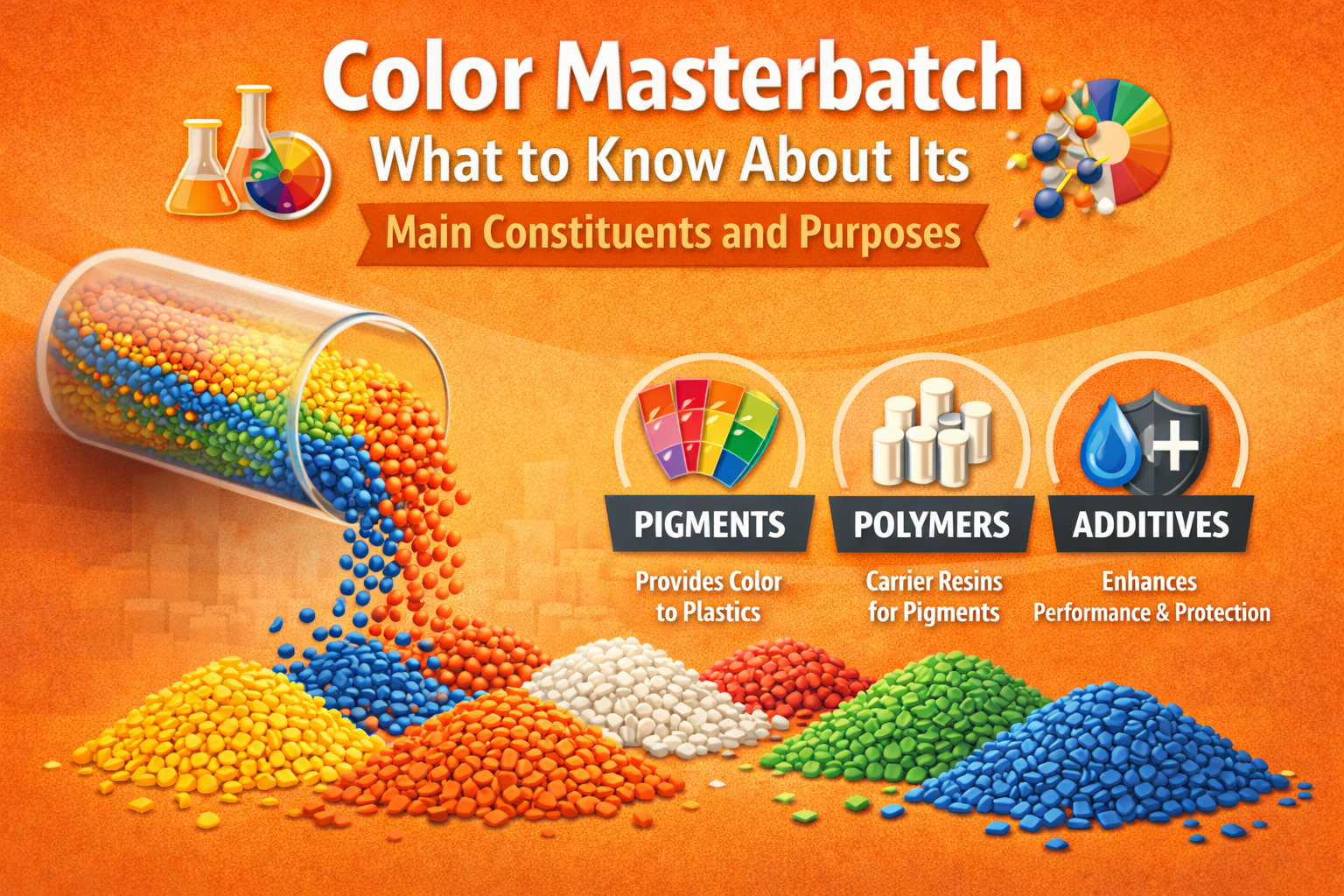
In the world of plastics and polymers, achieving vibrant, consistent, and durable color is not just a matter of aesthetics but also functionality. Color masterbatch plays a crucial role in meeting this demand. Whether it is in packaging, automotive components, textiles, household goods, or electrical applications, the masterbatch color determines the product’s appeal, usability, and brand value.
One of the leading names in the industry, Surya Masterbatches (Suryamb), has been revolutionizing the use of colour masterbatch by offering high-quality formulations that meet industry standards and customer requirements. In this comprehensive guide, we will explore the main constituents of color masterbatch, its purposes, the manufacturing process, and the role played by Suryamb as a reliable colour masterbatch manufacturer.
1. Introduction to Colour Masterbatch

A colour masterbatch is a concentrated mixture of pigments or dyes and additives encapsulated during a heat process into a carrier resin, which is then cooled and cut into granular shapes. These granules are later mixed with natural polymers during the plastic manufacturing process to impart the desired color.
Instead of directly adding raw pigments, which can result in uneven color dispersion, masterbatch color ensures uniform distribution, stability, and superior aesthetics in the final product.
At Suryamb, every colour masterbatch is engineered with precision to ensure vivid shades, long-lasting durability, and excellent processability.
2. Main Constituents of Colour Masterbatch
The main constituents of colour masterbatch are carefully balanced to achieve consistent performance. Let’s break them down:
2.1 Pigments or Dyes
- The primary component that gives color.
- Pigments provide opacity, while dyes provide transparency.
- Types include organic, inorganic, fluorescent, pearlescent, and metallic pigments.
- Example: Titanium dioxide for white, carbon black for black, phthalocyanine pigments for blues and greens.
2.2 Carrier Resin
- The medium in which pigments are dispersed.
- Usually the same as the base polymer to ensure compatibility.
- Common carrier resins: Polyethylene (PE), Polypropylene (PP), Polystyrene (PS), PET, and Nylon.
2.3 Additives
- Enhance the performance and functionality of the masterbatch.
- Examples include UV stabilizers, antioxidants, flame retardants, antistatic agents, and processing aids.
2.4 Dispersing Agents
- Ensure pigments are evenly distributed within the resin.
- Prevent clumping and improve color consistency.
At Surya Masterbatches (Suryamb), formulations are optimized for excellent pigment dispersion, high thermal stability, and long-term performance.
3. Purposes of Colour Masterbatch
The use of masterbatch color is not just about adding visual appeal. It serves multiple industrial purposes:
3.1 Aesthetic Appeal
- Provides products with vibrant, uniform, and long-lasting colors.
- Enhances brand recognition through consistent shades.
3.2 Protection
- UV stabilizers in color masterbatch protect plastic products from sunlight degradation.
- Prevents discoloration, brittleness, and weakening of polymers.
3.3 Functionality
- Certain pigments improve heat resistance, opacity, or conductivity.
- Example: Carbon black not only provides color but also enhances UV resistance.
3.4 Cost Efficiency
- Concentrated form reduces waste and provides precise coloring.
- Minimizes the need for excess pigment use.
3.5 Customization
- Enables production of customized shades to meet customer-specific needs.
- Suryamb specializes in delivering tailored colour masterbatch solutions.
4. Colour Masterbatch Manufacturing Process
The colour masterbatch manufacturing process is a highly technical one, ensuring pigments are evenly dispersed in carrier resins. The steps generally include:
4.1 Selection of Pigments and Additives
- Based on customer requirements, application type, and processing conditions.
4.2 Weighing and Mixing
- Pigments, carrier resins, dispersing agents, and additives are weighed and pre-mixed.
4.3 Compounding
- The mixture is melted and compounded using high-shear twin-screw extruders.
- Ensures pigments are finely dispersed in the resin.
4.4 Cooling
- The molten mixture is cooled rapidly to prevent pigment degradation.
4.5 Pelletizing
- The cooled mass is cut into uniform granules, known as masterbatch pellets.
4.6 Quality Testing
- Each batch undergoes rigorous testing for dispersion quality, thermal stability, color strength, and shade accuracy.
At Suryamb, advanced compounding technology ensures high dispersion quality, consistency, and premium performance across applications.
5. Types of Colour Masterbatch
Colour masterbatch is available in various forms, catering to different requirements:
5.1 Standard Colour Masterbatch
- Widely used for consumer goods, packaging, and household products.
5.2 White Masterbatch
- Based on titanium dioxide pigment.
- Offers brightness, opacity, and high covering power.
5.3 Black Masterbatch
- Uses carbon black.
- Provides UV protection, opacity, and strength.
5.4 Custom Colour Masterbatch
- Tailored shades developed to meet customer-specific branding requirements.
- Suryamb offers custom solutions with precise shade matching.
6. Applications of Colour Masterbatch
Colour masterbatch is indispensable across industries. Some major applications include:
6.1 Packaging Industry
- Used in bottles, films, containers, and bags.
- Provides both aesthetics and protection.
6.2 Automotive Industry
- Adds durability and UV resistance to vehicle interiors and exteriors.
6.3 Textile Industry
- Used in fibers and yarns for clothing and furnishings.
6.4 Electrical and Electronics
- Provides insulation, flame retardancy, and consistent coloring.
6.5 Consumer Goods
- Used in toys, kitchenware, and household items for appealing colors.
6.6 Agriculture
- Films, pipes, and nets made with UV-stabilized masterbatch improve longevity.
Surya Masterbatches (Suryamb) supplies to all these sectors with high-quality, durable, and customizable masterbatch color solutions.
7. Advantages of Using Colour Masterbatch
Using masterbatch instead of raw pigments offers several benefits:
- Consistent quality and shade reproducibility.
- Cleaner processing with less dust and contamination.
- Improved dispersion of pigments.
- Easy handling and storage of granules.
- Cost savings through reduced pigment usage.
- Environmental benefits by minimizing waste.
Suryamb ensures its masterbatches provide maximum performance, cost-effectiveness, and sustainability.
8. Quality Control at Surya Masterbatches (Suryamb)
Quality is at the heart of Suryamb’s colour masterbatch manufacturing process. Some of the strict quality checks include:
- Melt Flow Index (MFI) testing – to ensure processing compatibility.
- Color consistency checks – using spectrophotometers.
- Dispersion testing – to verify uniform pigment distribution.
- UV stability testing – to ensure long-term outdoor performance.
- Thermal stability testing – to prevent degradation during processing.
9. Environmental and Sustainability Aspects
Modern industries demand eco-friendly solutions. Suryamb emphasizes:
- Use of non-toxic, eco-friendly pigments.
- Development of biodegradable and recyclable masterbatches.
- Minimization of carbon footprint through efficient production processes.
This positions Surya Masterbatches (Suryamb) as a responsible and forward-looking colour masterbatch manufacturer.
10. Future of Colour Masterbatch
The demand for masterbatch color is expected to grow with increasing plastic consumption in packaging, automotive, electronics, and healthcare. Future trends include:
- Smart masterbatches with antimicrobial, fragrance, or conductive properties.
- Nano-pigment technology for improved dispersion.
- Sustainable alternatives aligned with circular economy principles.
- AI-driven color matching for precise and fast customization.
With innovation at its core, Suryamb is investing in next-generation technologies to remain ahead in the industry.
11. Why Choose Surya Masterbatches?
When selecting a colour masterbatch manufacturer, the choice matters. Suryamb stands out for:
- Wide range of products – from standard colors to custom shades.
- Advanced manufacturing facilities – ensuring consistent quality.
- Customized solutions – tailored for specific industries and applications.
- Strong R&D focus – for continuous innovation.
- Commitment to sustainability – eco-friendly and recyclable solutions.
- Global standards compliance – meeting international benchmarks for safety and quality.
12. Conclusion
A colour masterbatch is much more than just a coloring agent—it is a critical component in plastics manufacturing, ensuring durability, protection, and cost-effectiveness. Understanding its main constituents (pigments, carrier resins, additives, dispersants) and its purposes provides clarity on why industries rely so heavily on this solution.
As a leading colour masterbatch manufacturer, Surya Compounds & Masterbatches (Suryamb) has established itself as a trusted partner for businesses worldwide. With its high-quality products, advanced manufacturing process, customized solutions, and sustainability initiatives, Suryamb ensures that industries not only achieve the desired aesthetic appeal but also long-term functionality and performance.
In a world increasingly dependent on plastics, the role of colour masterbatch continues to expand, and with innovators like Suryamb, the future looks brighter, more colorful, and sustainable.
