

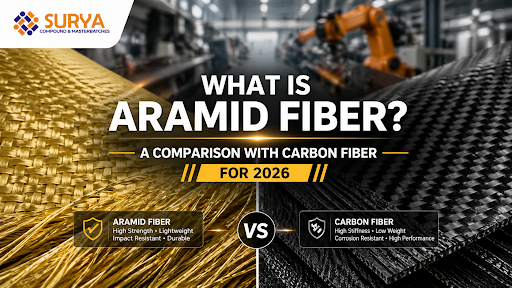
In the high-stakes world of advanced materials, two giants dominate the landscape: aramid fiber and carbon fiber. Both are engineered marvels that have replaced traditional metals in everything from aerospace to law enforcement. However, despite their similar “high-tech” reputation, they are fundamentally different in personality and performance.
Choosing between them isn’t about finding which is “better”—it’s about understanding which one survives the specific environment you are throwing it into. Let’s break down the aramid fiber vs carbon fiber debate to help you decide which material belongs in your next project.
What is Aramid Fiber?
If you’ve ever heard of Kevlar, you already know aramid. To answer what aramid fiber is, think of it as a synthetic organic polymer known as an aromatic polyamide. It is essentially a high-performance plastic that has been spun into incredibly strong fibers.
Aramid is best known for its “toughness.” Unlike other fibers that might snap under a sudden impact, aramid absorbs energy. This makes it the undisputed king of impact resistance and ballistic protection. It is also inherently flame-resistant and does not melt or ignite under normal conditions.
The Comparison: Aramid Fiber vs Carbon Fiber
To understand the core differences, we have to look at how they behave under stress.
| Feature | Aramid Fiber | Carbon Fiber |
| Primary Strength | Impact & Abrasion Resistance | Tensile Strength & Rigidity |
| Weight | Very Light | Extremely Light |
| Flexibility | High (Ductile) | Low (Brittle) |
| Conductivity | Non-conductive (Insulator) | Highly Conductive |
| Best For | Ballistics, Gloves, Tires | Racing Cars, Bikes, Aerospace |
Key Differences in Performance
1. Rigidity vs. Flexibility
Carbon fiber is incredibly stiff. When you need a structure that won’t bend even a millimeter—like a drone frame or a professional racing bike—carbon fiber is the choice. Aramid, on the other hand, is flexible. It can be woven into clothing or used in tires because it can withstand constant vibration and bending without breaking.
2. Impact Survival
This is where the aramid fiber vs carbon fiber battle gets interesting. If you hit carbon fiber with a hammer, it will likely shatter like glass. If you hit aramid fiber with a hammer, it will simply dent or absorb the blow. This is why bulletproof vests are made of aramid, not carbon.
3. Conductivity and Interference
Carbon fiber conducts electricity, which can be a nightmare for electronic housings as it can interfere with Wi-Fi or radio signals. Aramid is a natural insulator. It is “transparent” to radio waves, making it ideal for radomes or protective covers for sensitive sensors.
4. Heat and Chemical Resistance
Both materials handle heat well, but aramid is the star in fire-prone environments. It can withstand extreme temperatures without losing its structural integrity. However, it is sensitive to UV light (it can degrade if left in the sun for long periods), whereas carbon fiber is virtually immune to UV rays.
Real-World Applications
- Aramid Fiber: Body armor, cut-resistant gloves, fire-fighter suits, high-pressure hoses, and jet engine containment rings.
- Carbon Fiber: Formula 1 chassis, high-end sporting goods (golf clubs, tennis rackets), aircraft wings, and structural reinforcements for buildings.
The Human Side of Material Science
In 2026, we are no longer just looking for the “strongest” material; we are looking for the most sustainable and efficient one. The choice between aramid fiber and carbon fiber often comes down to the human experience—protecting a life in the field versus shaving seconds off a lap time on the track.
While the fibers themselves are the stars, the chemistry that holds them together or gives them their final color and finish is just as vital. Even the most advanced fiber can fail if the plastic matrix surrounding it isn’t properly reinforced or stabilized.
This is where technical expertise becomes the bridge between a raw material and a finished product. At the intersection of polymer science and industrial application, Suryamb stands as a leader. As specialists in Surya compounds & masterbatches, they provide the essential chemical building blocks that enhance the performance of advanced polymers. Whether you are working with high-performance plastics or complex composites, we ensure your materials are optimized for the toughest challenges. When your project demands precision, trust the innovation behind it.
ALSO READ: Masterbatch Manufacturing Process
