

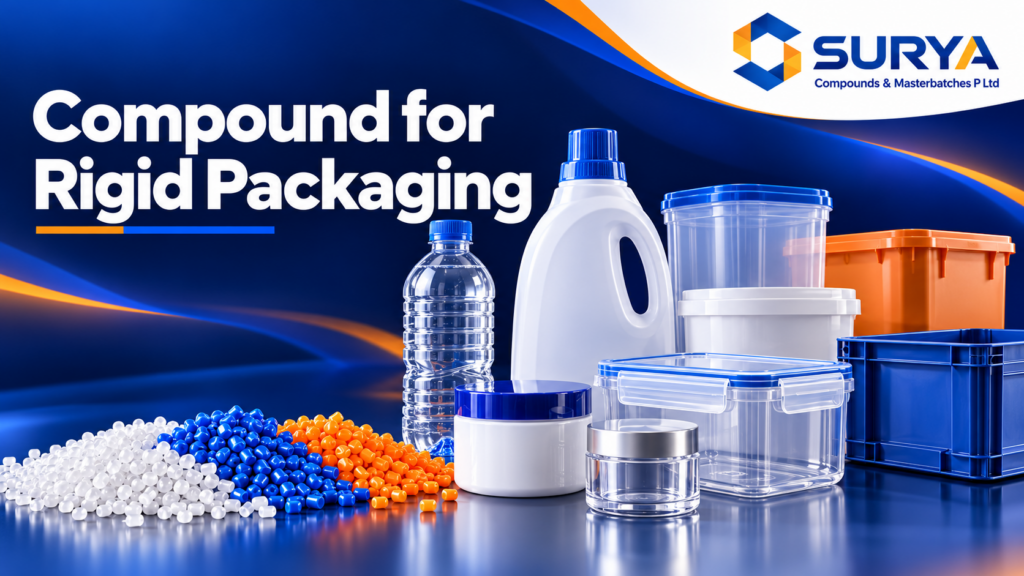
Compound for Rigid Packaging
Rigid packaging requires materials that hold their shape and protect products during filling, storage, transport, and use. A Compound for Rigid Packaging is formulated to deliver the mechanical, thermal, appearance, and processing properties needed for containers and components such as bottles, caps, tubs, trays, jars, and closures. Common packaging polymers include PET, HDPE, PP, and other application-specific plastics. The best choice depends on the product, forming process, and required performance.
What Is a Compound for Rigid Packaging?
A compound for rigid packaging is a tailored polymer formulation used to manufacture rigid plastic packaging. It can combine a base resin with additives, modifiers, fillers, colorants, or other ingredients to meet specific processing and performance requirements. Manufacturers select rigid packaging compounds based on the manufacturing method, such as injection moulding, blow moulding, extrusion, or thermoforming.
Why Is a Rigid Packaging Compound Important?
Rigid containers need strength, dimensional stability, impact resistance, and consistent processing. A suitable compound helps the finished package retain its shape and perform reliably during handling and distribution. Material selection also affects appearance, weight, cycle time, closure performance, and compatibility with the packaged product. Industry references cover rigid plastic container materials, container dimensions, lids, and bottle manufacturing practices, showing the importance of controlled material and component specifications.
Applications of Compound for Rigid Packaging
Rigid packaging compounds are used across food and beverage, personal care, household, healthcare, industrial, and consumer applications. They support products that require a defined shape and higher structural rigidity than flexible films.
- PET bottles and containers
- HDPE bottles and containers
- PP caps, closures, tubs, and containers
- Injection-moulded packaging components
- Thermoformed trays and rigid packs
- Industrial containers and protective packaging
Key Properties of a Compound for Rigid Packaging
A rigid packaging formulation should be matched to the product and process. Key properties include impact strength, stiffness, tensile strength, dimensional stability, heat resistance, chemical resistance, surface appearance, color consistency, and processability. For bottles and containers, product compatibility and storage performance also matter. Industry test methods address bottle properties such as dimensions, acetaldehyde in PET bottles, and compatibility with packaged products. citeturn0search2turn0search9turn0search14
How to Select a Compound for Rigid Packaging
Follow a practical material-selection process before moving to commercial production.
- Step 1: Define the container, closure, tray, or component.
- Step 2: Select the base resin based on strength, stiffness, temperature, and chemical requirements.
- Step 3: Match the formulation to injection molding, blow molding, extrusion, or thermoforming.
- Step 4: Set targets for impact, dimensions, appearance, weight, and cycle time.
- Step 5: Check product compatibility and applicable regulatory requirements.
- Step 6: Validate the compound through laboratory, mold, and production trials.
Benefits of Using the Right Compound for Rigid Packaging
- Consistent molding and forming
- Better dimensional stability
- Improved impact and load performance
- Reliable container and closure quality
- Controlled color and surface appearance
- Potential for lightweighting when the formulation and design allow it
Best Practices for Rigid Packaging Compounds
Keep resin quality and processing conditions stable. Control moisture where the polymer requires drying. Monitor melt temperature, mold conditions, cycle time, cooling, and part dimensions. For recycled content, verify the material’s consistency and suitability for the intended application. Packaging design is also moving toward material efficiency and lightweighting, so compound selection should support the required performance without unnecessary material use. citeturn0search4
Key Material and Application Comparison
Requirement | Typical Material Options | What to Check | Packaging Benefit |
Structural strength | Stiffness, impact, tensile strength | Shape retention | |
Dimensional control | Application-specific resin systems | Shrinkage and dimensional stability | Consistent parts |
Processing | Injection/blow-moulding/thermoforming grades | Melt flow and cycle behaviour | Stable production |
Product compatibility | PET / HDPE / PP and tailored formulations | Chemical and storage compatibility | Longer package performance |
Best Practices for Better Packaging Compounds
- Define the end-use first. Film, pouch, bag, bottle, cap, tub, and tray applications need different performance targets.
- Match the compound to the base resin and processing method. Check compatibility before full-scale production.
- Control moisture and contamination. Clean raw materials and stable processing conditions improve consistency.
- Test key properties before approval. Typical checks include melt flow, tensile strength, impact, seal performance, appearance, and dimensional stability.
- Use controlled addition rates for additives, colors, and functional modifiers. Validate the final formulation through production trials.
- Review food-contact, regulatory, recycled-content, and sustainability requirements for the intended market before commercialisation.
Common Mistakes to Avoid
- Choosing a compound only on price without checking application performance.
- Using the same formulation across different polymers or processing conditions.
- Ignoring sealability, stiffness, impact, or barrier needs during material selection.
- Skipping trial runs and relying only on laboratory assumptions.
- Changing raw materials without rechecking process stability and final-product performance.
Why Choose Surya Compounds & Masterbatches?
Surya Compounds & Masterbatches focuses on polymer compounds and masterbatch solutions for demanding plastic applications. A packaging compound should deliver consistent processing, predictable properties, and suitability for the final product. Surya Compounds & Masterbatches can support material selection around resin compatibility, processing requirements, appearance, and application performance.
Talk to Surya Compounds & Masterbatches about your packaging application, resin, processing method, and required performance. Share your specifications to discuss a suitable compound solution for your production needs.
FAQ
Which polymers are common in rigid packaging?
PET, HDPE, and PP are widely used. The correct polymer depends on the packaging format, processing method, product compatibility, and performance requirements.
What properties matter most in rigid packaging compounds?
Key properties include stiffness, impact strength, dimensional stability, heat resistance, chemical resistance, appearance, and processability.
How do I select a rigid packaging compound?
Define the package and process first, then match the resin and formulation to mechanical, thermal, dimensional, appearance, and regulatory requirements.
Can rigid packaging compounds support lightweight packaging?
Yes. A suitable formulation combined with optimized package design can support material reduction while maintaining required performance. The result must be validated through testing.
Why partner with Surya Compounds & Masterbatches for your material needs?
Surya Compounds & Masterbatches offers consistent quality, customized solutions, and expert technical support. Its Compound for Rigid Packaging solutions help manufacturers meet their specific material and application requirements.