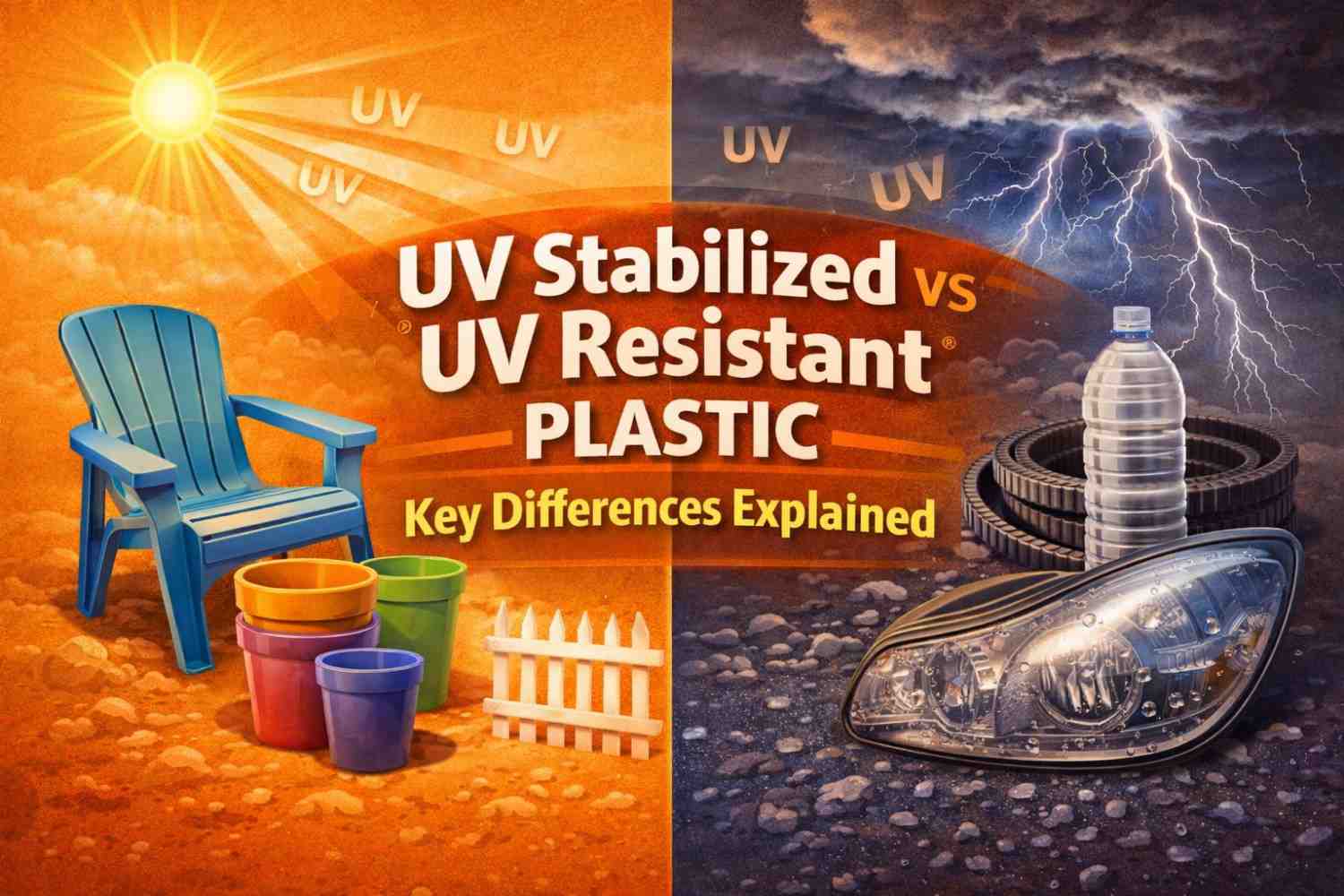
If you work with plastic materials, you’re a manufacturer, product designer, or procurement manager—you’ve definitely come across these two terms: UV stabilized and UV resistant. This common comparison of UV Stabilized vs UV Resistant often creates confusion in real-world applications.
They sound similar. They’re often used interchangeably. But they mean very different things. And picking the wrong one? It can cost you in product failures, customer complaints, and wasted material.
In this blog, we break down exactly what each term means, how they differ, when to use which, and what to look for when sourcing the right UV-protected plastic for your application.
What Happens When Plastic Is Exposed to UV Light?
Before we compare the two terms, let’s understand the problem they both solve.
Sunlight contains ultraviolet (UV) radiation. When plastic is exposed to UV rays, it triggers a chemical process called photo-oxidation. This causes:
- Color fading—your bright red product turns pink, then chalky white
- Chalking—a powdery residue forms on the surface
- Embrittlement—the plastic becomes stiff and cracks under stress
- Loss of tensile strength—the material simply breaks faster
- Surface degradation—gloss is lost, the product looks old and cheap
This is a massive problem for plastic products used outdoors — agriculture films, automotive parts, garden furniture, construction materials, water tanks, roofing sheets, pipes, and more.
The good news: both UV stabilization and UV resistance are solutions to this problem. They just work differently.
What Does UV Resistant Mean?
UV-resistant plastic refers to a material that is inherently less reactive to UV light due to its chemical composition or molecular structure.
Think of it this way — some polymers are naturally tougher against UV because their backbone structure doesn’t absorb UV radiation as easily. They resist degradation without needing much additive support.
Common uv resistant polymers include:
- Polytetrafluoroethylene (PTFE / Teflon) — outstanding UV resistance due to its strong C-F bonds
- Polycarbonate (PC) — good UV resistance, but still needs surface coatings for long-term outdoor use
- Acrylic (PMMA) — naturally UV resistant, maintains clarity outdoors
- High-Density Polyethylene (HDPE) — moderate natural resistance, commonly used in outdoor pipes and tanks
- Polypropylene (PP) — moderate UV resistance in its natural form
When a manufacturer says a product is made from uv resistant plastic material, they usually mean the base polymer itself has a reasonable tolerance to sunlight. But here’s the catch — “resistant” doesn’t mean “immune.” Left outdoors for years without additives, even UV-resistant plastics will degrade.
What Does UV Stabilized Mean?
UV-stabilized plastic takes protection further. It means additives have been intentionally compounded into the plastic to slow or prevent UV-induced degradation.
A UV stabilizer for plastic works by absorbing, scattering, or neutralising UV energy before it damages the polymer chains. These additives don’t change the base polymer — they act as a chemical shield.
There are four main types of UV stabilizers used in plastic:
1. UV Absorbers (UVA)
These absorb UV radiation and convert it into harmless heat. Common UVAs include benzophenones and benzotriazoles. They’re effective but deplete over time.
2. Hindered Amine Light Stabilizers (HALS)
HALS are the gold standard in UV stabilization. They don’t absorb UV directly — instead, they neutralise the free radicals that UV radiation generates. HALS are highly efficient, last longer, and are used in products like agricultural films, automotive exteriors, and outdoor furniture.
3. Quenchers
These deactivate excited states in polymer molecules, preventing chain degradation. Less common but effective in certain polymer systems.
4. Peroxide Decomposers
These break down hydroperoxides formed during photo-oxidation, slowing the degradation chain reaction.
When you specify uv resistant for plastic in a product brief, you often get a generically resistant material. But when you specify UV stabilized, you’re asking for targeted chemical protection built into the compound — a much stronger guarantee of outdoor performance.
UV Stabilized vs UV Resistant: Side-by-Side Comparison
|
Feature |
UV Resistant | UV Stabilized |
|
How it works |
Inherent polymer structure |
Chemical additives in compound |
|
Level of protection |
Moderate |
High to Very High |
|
Durability outdoors |
1–3 years (without additives) |
3–10+ years (depending on formulation) |
|
Colour retention |
Moderate |
Excellent |
|
Cost |
Lower (no additives needed) |
Slightly higher (additive cost) |
|
Customisability |
Limited |
High — can be tailored per application |
|
Best for |
Indoor/partially sheltered use |
Long-term outdoor exposure |
| Examples | HDPE water tanks, basic PP containers |
Agriculture films, automotive parts, roofing |
The bottom line: UV resistant is a property. UV stabilized is an engineered solution.
If your product will face continuous outdoor exposure — especially in India, where UV intensity is significantly higher than in Europe — UV stabilized compounds are almost always the right choice.
Why UV Protection Matters More in India
India’s geographic position means it receives high UV index values almost year-round. Cities like Rajasthan, Gujarat, Tamil Nadu, and Maharashtra regularly see UV index levels of 10–12 during summer months — classified as “Very High” to “Extreme.”
This is critical context for Indian manufacturers and product designers. A product formulated for mild European UV conditions may fail within months of outdoor use in India.
Industries most affected in India include:
- Agriculture — mulch films, greenhouse covers, drip irrigation pipes
- Construction — roofing sheets, pipes, conduits, geomembranes
- Automotive — bumpers, dashboards, exterior trims
- Packaging — outdoor storage containers, crates, pallets
- Infrastructure — cable insulation, telecom ducts, water supply pipes
In all these applications, the difference between UV resistant and UV stabilized can literally determine whether your product lasts 1 year or 10 years in the field.
How to Choose the Right UV Protection for Your Application
Use this quick decision guide:
Choose UV Resistant material if:
- Your product is used indoors or in partially sheltered environments
- Exposure to sunlight is occasional, not constant
- Budget is tight and performance expectations are moderate
- The product lifecycle is short (1–2 years)
Choose UV Stabilized material if:
- Your product is used outdoors continuously
- You need colour, gloss, and structural integrity to last 3–10+ years
- You’re operating in high UV environments (most of India)
- Your customers have quality expectations and warranty commitments
- You’re in agriculture, construction, automotive, or infrastructure
What to Look for in a UV Stabilizer Compound
Not all UV stabilizers are created equal. When sourcing or specifying a UV stabilized compound, check for:
- HALS concentration — higher HALS loading = longer protection life
- Compatibility with base polymer — not every stabilizer works with every plastic
- Thermal stability — the stabilizer should survive the processing temperatures of extrusion or injection moulding
- Regulatory compliance — especially for food-contact or agricultural use
- Colour neutrality — some stabilizers cause yellowing; quality compounds are colour-stable
- UV durability testing data — ask for accelerated weathering test results (QUV, Xenon Arc)
A reliable compound manufacturer will provide all of this upfront, with formulations tailored to your specific polymer and application.
Surya Compounds & Masterbatches: Engineered UV Solutions for Indian Industry
When it comes to UV stabilized compounds and masterbatches in India, Surya Compounds & Masterbatches is a name that Indian manufacturers trust.
With deep expertise in polymer science and a strong understanding of India’s unique UV environment, Surya Compounds & Masterbatches develops high-performance UV stabilizer masterbatches and compounds for a wide range of industries — agriculture, construction, automotive, and packaging.
What sets them apart:
- Custom-formulated UV masterbatches for specific polymers and applications
- HALS-based and UV absorber-based solutions for different performance requirements
- Proven performance in Indian climate conditions — tested against India’s high UV index environments
- Technical support for product developers and procurement teams
- Consistent quality output aligned with industry and export standards
Whether you need a UV masterbatch for an LDPE greenhouse film in Punjab or a UV stabilized PP compound for roofing sheets in Gujarat, Surya Compounds & Masterbatches has the formulation expertise to match your requirements.
Common Myths About UV Protection in Plastics — Debunked
Myth 1: “Dark colours don’t need UV stabilizers.” False. While carbon black (used in black plastics) does provide significant UV shielding, it doesn’t eliminate the need for UV stabilizers in demanding outdoor applications. And for coloured or natural plastics, no colour alone provides adequate UV protection.
Myth 2: “UV resistant means the plastic will last forever outdoors.” Wrong. UV resistant describes relative resistance — not immunity. Without UV stabilizers, even resistant polymers degrade under continuous Indian sun exposure.
Myth 3: “All UV masterbatches are the same.” They’re not. HALS-based and UV absorber-based solutions have different strengths, lifespans, and compatibility profiles. Using the wrong stabilizer in the wrong polymer can give you a false sense of security.
Myth 4: “UV stabilizers are only needed for agriculture films.” No. UV degradation affects automotive parts, construction materials, pipes, cables, outdoor furniture, and more. Any plastic with outdoor exposure needs proper UV protection.
Read More: Polypropylene vs PVC: Which One Should You Choose?
Conclusion: Stop Guessing, Start Specifying
The choice between UV stabilized vs UV resistant isn’t complicated once you understand the fundamentals.
UV-resistant gives you a starting point — a polymer that doesn’t fall apart the moment it sees sunlight. UV stabilized gives you a guarantee — engineered, tested, long-term outdoor performance.
For most serious outdoor applications in India, UV stabilized is not optional. It’s essential.
If you’re a manufacturer, product designer, or procurement head looking to specify the right UV protection for your plastic products, start by partnering with compound experts who understand your environment.
Get in touch with Surya Compounds & Masterbatches to discuss your UV protection requirements and get a formulation that’s built for India’s climate.
FAQs
1. What is the difference between UV stabilized and UV resistant plastic?
UV resistant refers to a plastic’s natural tolerance to UV radiation based on its polymer structure. UV stabilized means the plastic has been compounded with specific chemical additives — like HALS or UV absorbers — to actively slow down UV-induced degradation. UV stabilized offers a higher and more reliable level of protection.
2. Which is better for outdoor use in India — UV stabilized or UV resistant?
For outdoor use in India, UV stabilized plastic is always the better choice. India receives very high UV index levels year-round, especially in states like Rajasthan, Gujarat, and Tamil Nadu. UV stabilized compounds are specifically engineered to withstand this level of solar exposure over multiple years.
3. What polymers are naturally UV resistant?
Naturally UV resistant polymers include PTFE (Teflon), acrylic (PMMA), polycarbonate (PC), and to a moderate degree, HDPE and PP. However, even these materials benefit significantly from UV stabilizer additives when used in continuous outdoor applications.
4. What is a UV stabilizer masterbatch?
A UV stabilizer masterbatch is a concentrated mixture of UV stabilizing additives — usually HALS, UV absorbers, or both — dispersed in a carrier resin. It’s added to plastic during processing (extrusion, injection moulding) to impart UV protection without changing the base polymer’s core properties.
5. How long does UV stabilized plastic last outdoors?
With the right UV stabilizer formulation, plastic products can last anywhere from 3 to 10+ years outdoors without significant loss of colour, gloss, or mechanical strength. The exact lifespan depends on the stabilizer type, loading level, base polymer, and environmental exposure.
6. Do UV stabilizers affect the colour of plastic?
Quality UV stabilizers — especially HALS-based masterbatches — are designed to be colour neutral and should not affect your product’s colour. Some lower-grade UV absorbers can cause slight yellowing over time. Always verify colour stability with your compound supplier before production.
7. Is UV resistant the same as UV proof?
No. UV resistant means the material has a degree of tolerance to UV radiation — not complete immunity. No plastic is truly UV proof. UV stabilized materials come closer to long-term UV protection but still have finite lifespans that depend on formulation quality and exposure conditions.
8. Where can I source UV stabilizer masterbatches in India?
Surya Compounds & Masterbatches is a trusted manufacturer of UV stabilizer masterbatches and compounds in India. They offer custom-formulated solutions for polymers like PP, HDPE, LDPE, and PVC across agriculture, construction, automotive, and packaging industries.
