

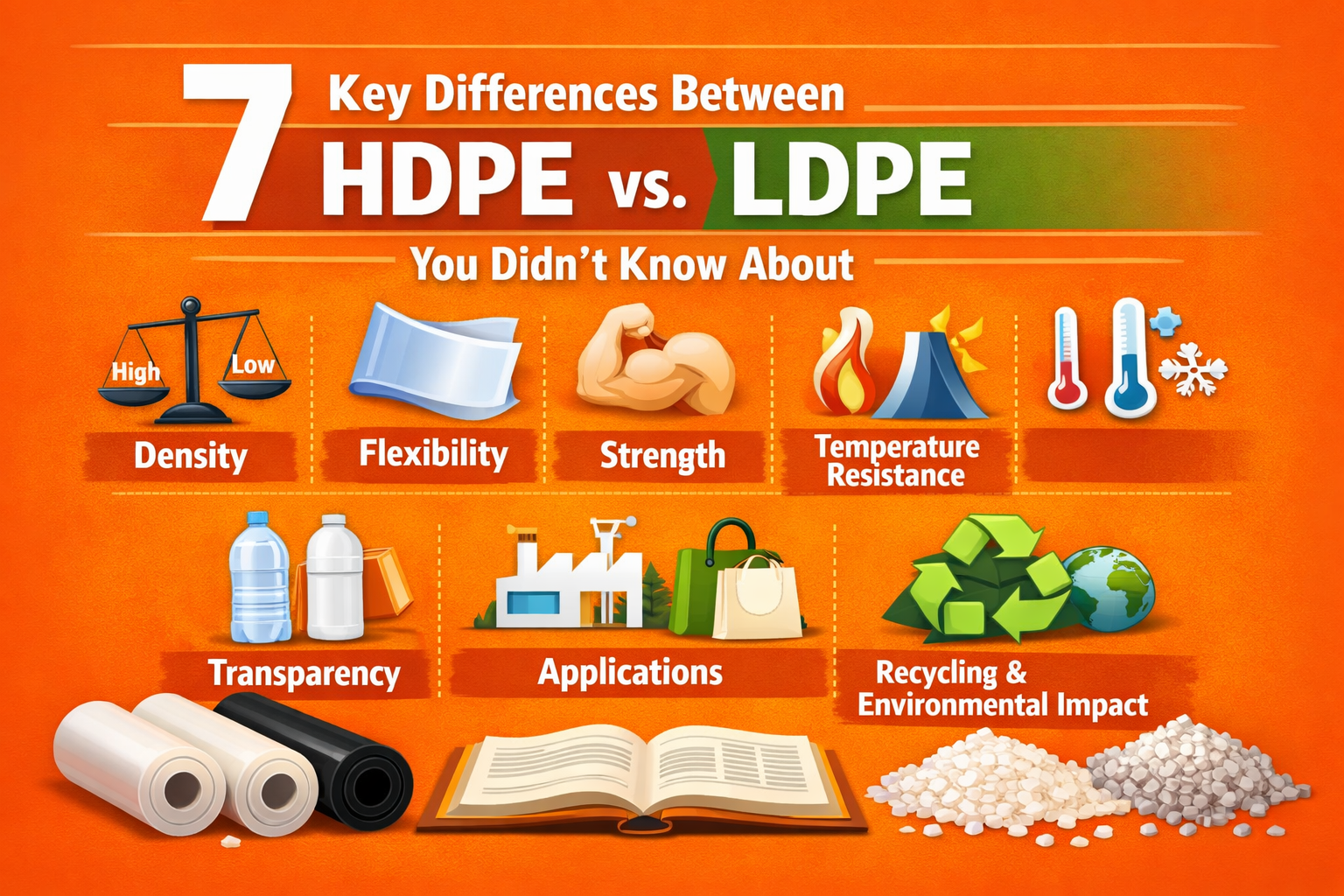
Polyethylene is the world’s most widely used plastic, with Low-Density Polyethylene (LDPE) and High-Density Polyethylene (HDPE) as its main forms. While both are versatile and recyclable, they have distinct properties influencing their ideal applications—especially in packaging, film, piping, and more. Here’s everything you need to know about the LDPE vs HDPE comparison, ldpe film vs hdpe film, and why Surya masterbatches matter.
1. Molecular Structure & Density Differences
- LDPE has a highly branched polymer chain, with short- and long-chain branches disrupting tight molecular packing. This configuration gives it a density of approx. 0.910–0.940 g/cm³.
- HDPE features a mostly linear structure with minimal branching, enabling tight molecular packing and a higher density (≥0.941 g/cm³) .
High density gives HDPE greater strength and stiffness; LDPE’s branching makes it more flexible and transparent.
2. Mechanical Properties & Strength
- Tensile Strength: LDPE ~1,400 psi (≈9.6 MPa); HDPE approx. 4,000 psi (~28 MPa) .
- Impact Resistance: LDPE excels in impact toughness; HDPE is stiffer but more prone to cracking under sudden stress .
- Elasticity: LDPE can stretch ~500% before rupture; HDPE elongates up to ~600 psi (~4%)—resulting in more rigid behavior .
Choose LDPE for flexibility; HDPE for structural rigidity and load-bearing applications.
3. Thermal Performance & Operating Temperatures
- Melting Point: LDPE ~115 °C (239 °F); HDPE ~135 °C (275 °F) .
- Operating Conditions: Both handle moderate temperatures, but HDPE suits higher-temperature or outdoor applications better due to its greater heat tolerance.
LDPE is ideal for applications needing heat sealing flexibility; HDPE is better for structural stability under varying temperatures.
4. Flexibility vs Rigidity
- LDPE is highly flexible and soft, making it a staple in film, packaging, heat seals, and tubing
- HDPE is semi-rigid to rigid, ideal for containers, pipes, and industrial equipment..
For stretchy, pliable products, LDPE is preferred. For strong, shape-retaining items, HDPE performs better.
5. Film Characteristics and Packaging Uses
- LDPE film is transparent, heat-sealable, and flexible—perfect for grocery bags and protective wraps .
- HDPE film is opaque or translucent, more durable, moisture- and UV-resistant—used in industrial liners and outdoor packaging.
In packing, LDPE is favored for flexibility and clarity; HDPE is robust for rugged protection.
6. Chemical Resistance & UV Stability
- Chemical Resistance: Both plastics resist most chemicals; HDPE slightly edges out for harsh or outdoor environments .
- UV Resistance: HDPE naturally resists UV better; LDPE degrades faster in sunlight—often requiring UV-stabilizing additives .
For outdoor uses, HDPE is a superior choice; LDPE requires extra stabilization for sun exposure.
7. Environmental Sustainability & Recycling

- Recyclability: Both are recyclable (#2 and #4 codes), but LDPE is less frequently processed, with only ~5.7% recycled in some regions..
- Environmental Footprint: HDPE is preferred in recycling streams; LDPE is more flexible to repurpose but still lags behind .
Material selection influences recycling outcomes—HDPE leads in practical recyclability; LDPE calls for better recovery systems.
8. Typical Applications of LDPE vs HDPE
| Application Domain | LDPE Use Cases | HDPE Use Cases |
| Packaging & Film | Grocery bags, shrink wrap, flexible film | Stiff liners, containers, heavy-duty bags |
| Tubing | Flexible fluid tubing, wire insulation | Rigid piping, geomembranes |
| Consumer Goods | Squeeze bottles, lids | Rigid bottles, jerrycans, toys |
| Industrial | Protective wrap, caps for pipes | Chemical tanks, structural components |
| Outdoor & UV Applications | Limited outdoor use | Playground equipment, pipes, garden products |
LDPE thrives in low-stress, flexible roles; HDPE dominates in load-bearing or outdoor-critical applications.
9. Enhancing Performance with Surya Masterbatches
Surya masterbatches provide colorants and functional additives that improve both LDPE and HDPE:
- Color Masterbatches: Offer consistent pigmentation and branding across materials.
- UV/Stabilizer Masterbatches: Extend lifespan of LDPE outdoor films; enhance HDPE outdoor product durability.
- Barrier Additives: Boost chemical and moisture resistance for both polymers.
- Flame-Retardant Additives: Essential for industrial and construction uses.
These customizable compounds help manufacturers tailor functionality to application needs—whether packaging, piping, or outdoor products.
10. Choosing LDPE or HDPE: What Matters?
Decision factors include:
- Performance Requirements: Need flexibility or stiffness?
- Environment: Indoor vs outdoor, heat vs cold, UV exposure?
- Processing Method: Films vs blown/extruded forms.
- Cost & Sustainability: Choice impacts recyclability and lifecycle footprint.
- Additive Needs: Consider Surya masterbatches for customization.
Each project must weigh these qualities against intended use and production processes.
11. Reducing Environmental Impact
- Design for Recycling: Choose HDPE when recyclability matters most.
- Use Recycled Resin: HDPE performs well with recycled content; LDPE benefit albeit with caution.
- Optimized Masterbatch Use: Surya adds only necessary functional additives, reducing waste.
Thoughtful material design in packaging and film can significantly lower plastic’s environmental footprint.
12. The Future of LDPE & HDPE
Innovations like:
- LLDPE Blends: Combine LDPE flexibility with added strength for film performance .
- Bi-layer & Multi-layer Films: Use HDPE and LDPE films together for combined properties.
- Enhanced Recyclability: Closed-loop HDPE streams; chemical recycling technologies.
- Smart Additives: Surya is advancing UV, antimicrobial, and biodegradable masterbatches.
These advances aim to blend performance with sustainability.
13. Summary Table
| Feature | LDPE | HDPE |
| Density | 0.910–0.940 g/cm³ | ≥0.941 g/cm³ |
| Tensile Strength | ~9.6 MPa | ~28 MPa |
| Melting Point | ~115 °C | ~135 °C |
| Flexibility | Very flexible | Semi-rigid to rigid |
| Transparency | Transparent | Opaque/translucent |
| UV Resistance | Low | High |
| Chemical Resistance | Good | Excellent |
| Recyclability | Recyclable (#4) but limited | Easily recycled (#2) |
| Typical Use | Films, bags, squeeze products | Containers, pipes, outdoor items |
| Additive Enhancement | Needs UV stabilizers | Common UV / color additives |
14. Conclusion: LDPE vs HDPE – Your Best Picks
- Opt for LDPE when you need flexibility, clarity, and heat-sealable film for packaging or protective wrap.
- Choose HDPE for strength, UV resistance, and recyclability in containers, piping, structural components.
- Enhance both with Surya masterbatches to gain color fidelity, UV resistance, barrier protection, or flame retardancy.
- Design choices impact product performance, cost, and environmental footprint—select accordingly.
Further Assistance
Want help choosing the right polyethylene or integrating Surya Compounds & masterbatches in your products? I can provide application-specific advice, cost comparisons, or sustainable packaging solutions.
