

Somewhere in a small injection molding unit, someone once set the barrel temperature by copying a neighboring machine’s settings. The parts came out brittle, warped, and full of surface streaks. The ABS melting point wasn’t the problem on paper — the actual processing window was.
That gap between what a datasheet says and what happens on the shop floor trips up more processors than anyone likes to admit.
ABS, short for Acrylonitrile Butadiene Styrene, doesn’t melt like a pure crystalline plastic with one sharp temperature. It’s amorphous, which means it softens gradually across a range rather than switching from solid to liquid at a single point. That distinction matters enormously once you’re the one setting barrel temperatures.
So What Is the ABS Melting Point, Exactly?
Technically, ABS doesn’t have a true melting point at all — because it lacks the ordered crystal structure that gives crystalline plastics a defined melt temperature. What it has instead is a glass transition temperature, roughly 105°C, above which the material softens and becomes moldable.
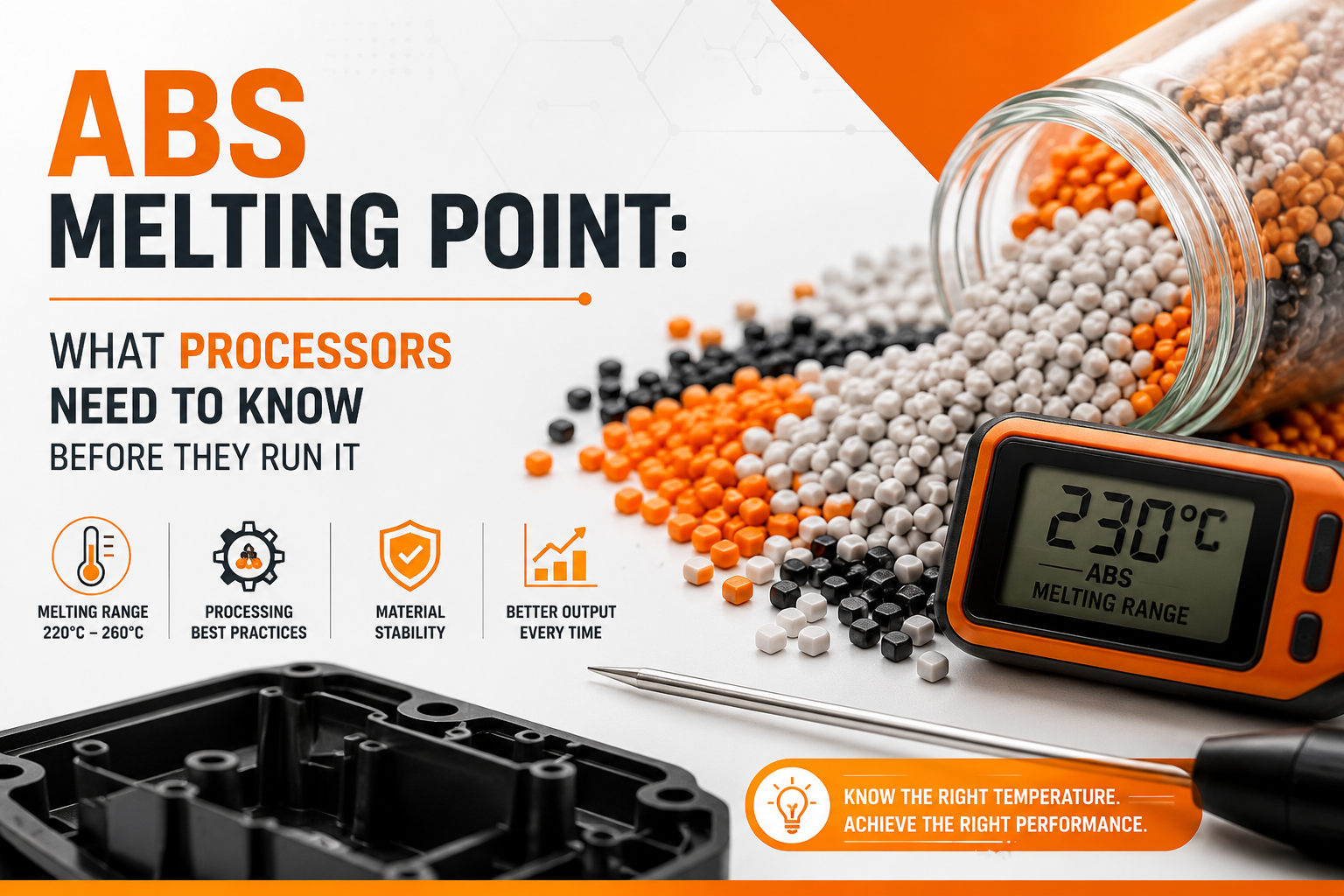
For practical purposes, though, the industry still uses the term “ABS melting point,” and it generally refers to the temperature range where ABS becomes fluid enough to process — typically between 200°C and 260°C.
This is the ABS plastic melting point range most processing guides quote, and it’s the number that actually matters when you’re loading a recipe into a molding machine.
ABS Melting Temperature vs Processing Temperature — They’re Not the Same Thing
Here’s where confusion creeps in. The melting temperature refers to where the resin becomes flowable inside the barrel. The ABS processing temperature is broader — it covers barrel zones, nozzle temperature, and mold temperature together, and each of those needs its own setting.
A typical processing profile looks like this:
|
Zone |
Temperature Range |
|---|---|
|
Rear barrel zone |
200°C – 220°C |
|
Middle barrel zone |
220°C – 240°C |
| Front barrel zone |
230°C – 250°C |
| Nozzle |
230°C – 250°C |
| Mold temperature |
50°C – 80°C |
Push any zone too far past 260°C and ABS starts to degrade. The acrylonitrile component breaks down first, releasing gas and leaving yellowish streaks or a burnt smell in the part. Go too low, and the melt won’t flow evenly, leaving short shots or weld lines that weaken the finished piece.
Why the Melting Point of ABS Plastic Shifts Between Grades
Not all ABS is created equal, and this is the part most generic guides skip over.
Standard injection molding grade ABS processes comfortably in the 220–250°C range. But flame-retardant ABS, glass-filled ABS, and high-impact ABS all carry different additive packages that shift the ideal window slightly.
Flame-retardant grades often need slightly lower processing temperatures to avoid triggering the retardant additive prematurely. Glass-filled grades usually need it a bit higher, since the fiber content increases melt viscosity and resists flow. High-impact grades, loaded with more rubber phase, tend to be more heat-sensitive and degrade faster if the barrel runs hot for too long.
This is exactly why Surya Compounds & Masterbatches builds custom ABS compounds around the actual application rather than handing every customer the same generic processing sheet. A compound engineered for an automotive dashboard clip behaves differently in the barrel than one meant for a toy housing, even though both are technically “ABS.”
Step-by-Step: Setting Up ABS Processing Temperature Correctly
Step 1 — Check the technical data sheet for the specific grade, not a generic ABS reference. Additive packages shift the safe window.
Step 2 — Dry the resin first. ABS absorbs moisture from the air, and moisture in the melt causes splay marks and weakens the part. Dry at 80–90°C for 2–4 hours before running.
Step 3 — Set barrel zones in a rising profile, cooler at the rear, hottest near the nozzle, so the resin melts progressively rather than all at once.
Step 4 — Start conservative and adjust upward. Begin near the lower end of the recommended range and increase only if the melt isn’t flowing cleanly.
Step 5 — Watch the mold temperature. Too cold a mold causes surface flow lines; too hot slows down cycle time and can cause warping on ejection.
Step 6 — Inspect the first shots. Streaking, brittleness, or a burnt odor all point to temperatures running too high somewhere in the profile.
Tips and Common Mistakes
Processors switching from PP or PE lines to ABS often carry over old habits that don’t translate.
One common mistake: assuming a single “ABS melting point” number applies across every grade and supplier. It doesn’t. Even two ABS pellets that look identical can carry different rubber-phase ratios that change their heat sensitivity.
Another mistake — running the nozzle too hot to “fix” flow problems. That usually just accelerates degradation instead of solving the underlying issue, which is often moisture or an incorrect screw speed.
A smaller but costly mistake: skipping resin drying because “it looks dry.” ABS pellets can hold enough surface moisture to cause visible defects without looking wet at all.
And one that’s easy to overlook—not accounting for regrind. Reprocessed ABS has already been through one thermal cycle, so it degrades faster on a second pass if the temperature profile isn’t adjusted downward slightly.
Getting the Grade Right From the Start
A lot of the melting point confusion disappears once the compound itself is engineered for the application rather than pulled off a generic shelf. Surya Compounds & Masterbatches works with processors to fine-tune ABS compounds—impact modifiers, flame retardants, colorants — so the resulting processing window is predictable rather than something the operator has to guess at on day one.
Getting the ABS melting temperature right isn’t really about memorizing one number. It’s about understanding that ABS behaves as a range, and that range shifts depending on grade, additive load, and machine setup.
FAQs
1. What is the melting point of ABS plastic?
ABS is amorphous and doesn’t have a sharp melting point. It softens and becomes processable between roughly 200°C and 260°C, with a glass transition around 105°C.
2. What temperature should I set for ABS injection molding?
Most standard ABS grades process well with barrel zones between 220°C and 250°C and mold temperatures around 50–80°C, though this varies by grade.
3. Why does my ABS part look burnt or discolored?
Discoloration usually means the processing temperature ran too high somewhere in the barrel or nozzle, causing the acrylonitrile component to degrade.
4. Does ABS need to be dried before processing?
Yes. ABS absorbs moisture from the air, and processing it wet causes surface defects like splay marks and reduces mechanical strength.
5. Is the ABS processing temperature the same for every grade?
No. Flame-retardant, glass-filled, and high-impact ABS grades each shift the ideal temperature window slightly because of their different additive packages.
