

A textile mill in Surat once ran three shades of the same yarn before the color finally matched the sample card. The culprit wasn’t the dye. It was an inconsistent polyester masterbatch that shifted tone every time the humidity changed.
That’s the kind of problem a good polyester masterbatch is supposed to prevent, not cause.
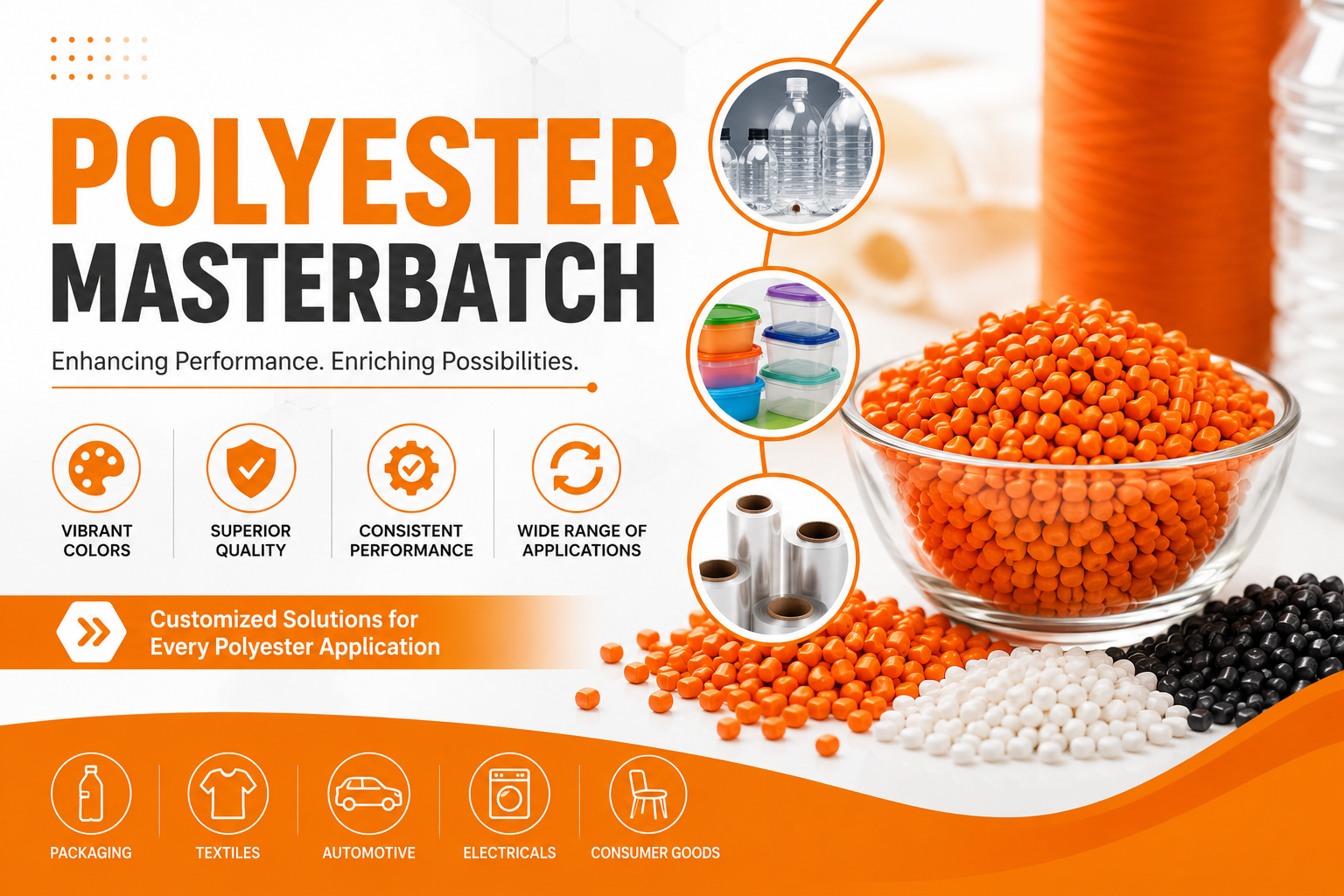
Polyester masterbatch is a concentrated mix of pigments or additives carried in a polyester resin base. Manufacturers add it to virgin PET or polyester polymer during extrusion, spinning, or molding to bring color, strength, or a specific function to the final product. Unlike loose pigment powder, which is messy and hard to dose accurately, masterbatch comes as small pellets that blend cleanly into the base resin.
Surya Compounds & Masterbatches has been supplying polyester masterbatch to fiber and film producers for years, and the recurring theme in almost every client conversation is the same: consistency matters more than the sales pitch.
What Goes Into a Polyester Masterbatch Material
The base carrier resin has to match the polymer it’s going into — that’s non-negotiable. A polyester plastic masterbatch built on a PET carrier disperses far better in PET fiber or PET film than one built on polypropylene, even if the pigment load looks identical on paper.
Inside that carrier sits the actual functional load:
Pigments for color, UV stabilizers for outdoor durability, anti-static agents for fiber processing, flame retardants for technical textiles, and optical brighteners for whites that actually look white instead of grey-ish.
The ratio between carrier and additive typically runs anywhere from 20% to 60% loading, depending on what the end application needs. Higher loading means processors can use less masterbatch per kilogram of polymer, which often works out cheaper in the long run — though it does demand tighter quality control from the manufacturer.
Polyester Masterbatch Properties That Actually Matter on the Floor
Ask ten processors what they care about, and you’ll get some version of the same five answers.
Dispersion quality comes first. Poorly dispersed pigment shows up as specks, streaks, or uneven color across a roll of fabric — exactly the mismatch that ruined that Surat order.
Thermal stability is next. Polyester processing runs hot, often above 260°C for spinning. A masterbatch that degrades or off-gases at that temperature will discolor the melt and clog spinnerets.
Moisture content sounds minor until it isn’t. PET is hygroscopic, meaning it absorbs water from the air. Masterbatch pellets need proper drying and packaging, or moisture trapped inside causes hydrolysis during melting — which weakens the fiber and can snap it mid-spin.
Melt flow compatibility with the base resin prevents viscosity mismatches that create weak spots in the final product.
Consistency batch to batch — this is the one that separates a reliable supplier from a risky one. A pigment that reads correctly on a spectrophotometer in batch one but drifts by even a few Delta-E units in batch five will show up as visible shade variation on the loom.
| Property | Why It Matters | Typical Target Range |
|---|---|---|
|
Carrier resin match |
Ensures clean melt blending | Same polymer family as base |
|
Pigment loading |
Controls cost and color strength | 20%–60% |
| Moisture content | Prevents hydrolysis during melt |
Below 0.02% |
|
Melting/thermal stability |
Avoids degradation at spinning temp |
Stable above 260°C |
| Dispersion | Prevents specks and streaks |
Fine, uniform particle spread |
Polyester Masterbatch Applications Across Industries
Fiber and filament production is the biggest consumer of polyester masterbatch by volume. Spun-dyed polyester yarn — colored during extrusion rather than dyed afterward — uses far less water and energy than conventional dyeing, which is part of why brands chasing sustainability targets have leaned into it.
Packaging film is another major user. PET bottles, food trays, and barrier films rely on masterbatch not just for color but for UV protection and clarity control.
Automotive interiors use polyester masterbatch loaded with flame retardants and heat stabilizers since dashboard and seat components sit in direct sunlight for years without fading or cracking.
Nonwoven fabrics—the kind used in hygiene products, geotextiles, and filtration media—depend on masterbatch for both color and functional additives like anti-microbial agents.
Then there’s the smaller but growing segment: technical textiles for sportswear, where moisture-wicking and anti-static properties get built in at the masterbatch stage rather than added as a finishing treatment later.
Polyester Masterbatch Uses: A Step-by-Step Look at Processing
Step 1 — Resin selection. Match the masterbatch carrier to the base polymer exactly. Mismatched carriers cause poor dispersion even with perfect pigment quality.
Step 2 — Drying. Dry both the base resin and masterbatch pellets separately before blending, typically at 150–170°C for several hours, to strip out residual moisture.
Step 3 — Dosing. Meter the masterbatch into the extruder using a gravimetric or volumetric feeder. Manual dosing invites the exact inconsistency that ruins color matching.
Step 4 — Melt blending. Run the extruder at the temperature profile the masterbatch manufacturer recommends. Going too hot risks degradation; too cool risks poor dispersion.
Step 5 — Spinning or forming. Whether it’s fiber spinning, film casting, or injection molding, keep line speed steady. Fluctuations change shear, and shear changes how well pigment particles spread through the melt.
Step 6 — Quality check. Pull samples regularly and check color consistency, tensile strength, and surface appearance against the reference standard.
Tips and Common Mistakes
Processors who’ve been burned once tend to repeat the same three lessons.
Don’t skip the drying step to save time. It’s the single biggest cause of hydrolytic degradation in polyester processing, and it’s completely preventable.
Don’t switch masterbatch suppliers mid-run without re-validating the color match. Even “identical” formulations from two vendors rarely behave the same on the line.
Don’t assume higher pigment loading always saves money. Beyond a certain concentration, dispersion quality drops, and processors end up compensating with slower line speeds — which erases the cost benefit.
A mistake worth calling out specifically: storing masterbatch pellets in open bags near humid production floors. It seems harmless. It isn’t. Moisture pickup happens faster than most people expect, especially during monsoon months in Indian manufacturing hubs.
Why the Supplier Relationship Matters as Much as the Formula
Surya Compounds & Masterbatches works directly with processors to match carrier resin, pigment loading, and additive packages to the specific application—fiber, film, or molded part—rather than pushing one generic formulation across every customer. That kind of technical back-and-forth, adjusting a formulation after seeing actual line data, is where a lot of color and consistency problems get solved before they become a returned shipment.
Good polyester masterbatch isn’t just a colorant. It’s a functional input that determines whether a production run goes smoothly or gets scrapped halfway through.
FAQs
1. What is polyester masterbatch used for?
It’s used to add color, UV resistance, flame retardancy, or other functional properties to polyester fiber, film, and molded products during processing, instead of dyeing or treating the finished item separately.
2. How is polyester masterbatch different from regular pigment powder?
Masterbatch carries the pigment inside a resin pellet matched to the base polymer, which disperses more evenly and doses more accurately than loose powder.
3. What causes color inconsistency in polyester masterbatch?
Poor dispersion, batch-to-batch pigment variation, and incorrect dosing during extrusion are the most common causes of shade mismatch.
4. Can polyester masterbatch be used in PET bottle production?
Yes. PET bottle and packaging manufacturers use polyester masterbatch for coloring, UV protection, and clarity control in food and beverage packaging.
5. Why is moisture control important for polyester masterbatch?
Polyester is hygroscopic. Trapped moisture causes hydrolysis during melt processing, which weakens the final fiber or film and can lead to processing breaks.
