

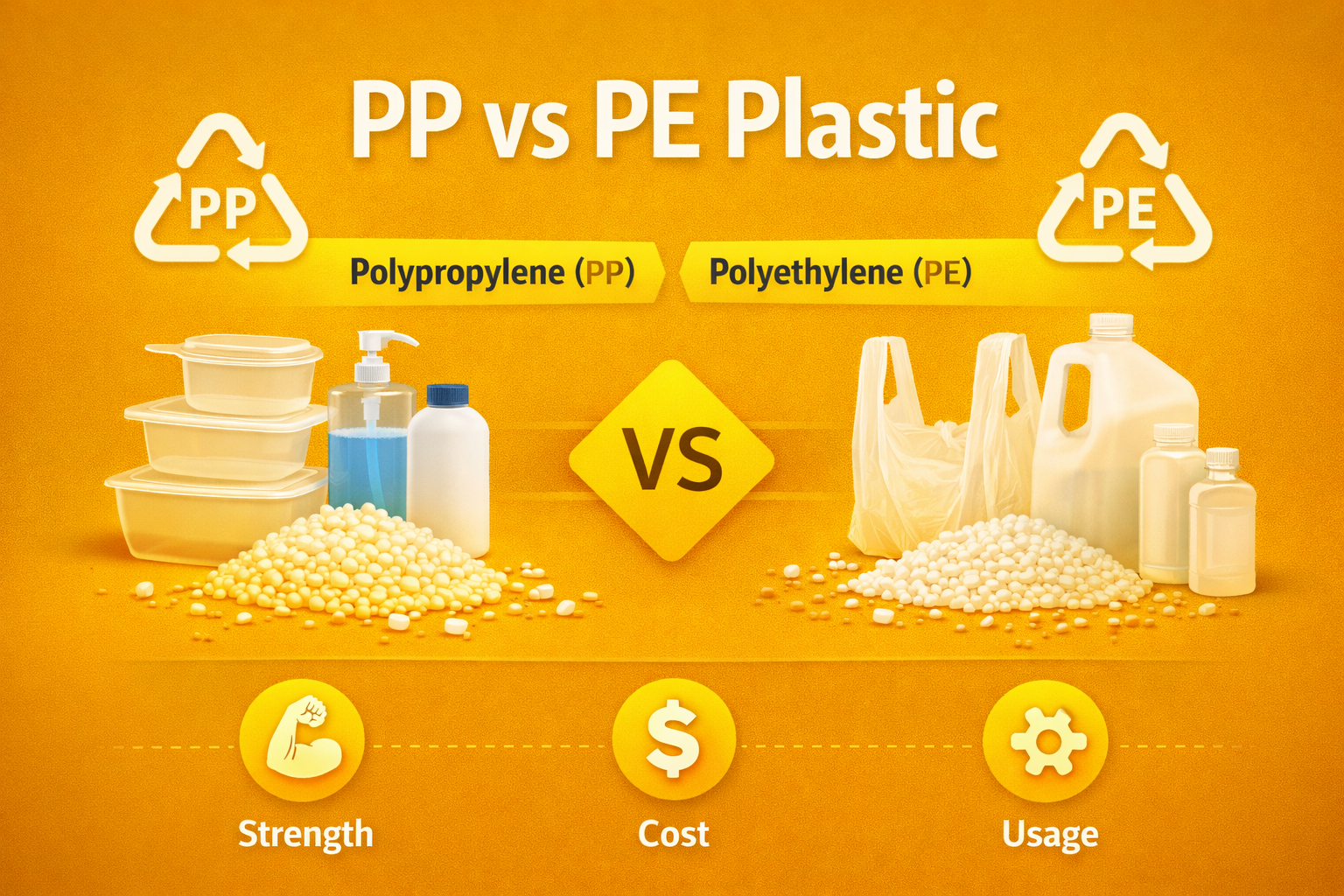
Modern manufacturing, packaging, and everyday goods heavily rely on the role of plastics. Thermoplastics, which are widely used, include polypropylene and polyethylene. The choice between PP and PE plastics is one that demands consideration of several factors because each one exhibits its own set of properties. PE has several advantages over PP, including good resistance to moisture, chemical and abrasion resistance, high strength and toughness, and lower cost.
Polypropylene and polyethylene plastics are two types used in the packaging industry.
PP vs. PE plastic has distinct characteristics. Understanding these differences in the properties of the plastics will enable you to select the best material suited for your product packaging needs and make decisions about product functionality, durability, and cost.
What Is PP Plastic?
A type of plastic that melts when heated—polypropylene—is useful across many manufacturing methods. Its flexibility shows up clearly during shaping under heat. Different industries rely on how it reacts to temperature changes. Performance stays strong even after repeated use. Processing it does not require rare equipment. The material adapts easily to new forms. What stands out is its resistance to wear over time
Key Properties Of PP Plastic
- Stiffness stands out in these materials, their strength right alongside. What you get is resilience under pressure, shaped by how they’re built.
- Resistant to many chemicals, including acids as well as alkaline substances.
- Fatigue doesn’t wear it down easily.
- Unlike polyethylene, this polymer melts at a higher temperature.
- Lightweight and durable
When subjected to stress, Polypropylene retains its form and exhibits satisfactory performance in products requiring strength and thermal stability.
PP Material Uses
Polysulfide is a good general-purpose material with properties that are intermediate between those of rubber and those of thermosets.
Common Uses of PP Material
- Food containers and packaging
- Automotive interior components
- Medical devices and laboratory equipment
- Household items such as plastic storage containers and other plastic items are made from this plastic.
- Industrial components like pipes and fittings
Parts manufactured by Powder Metallurgy are particularly valued in applications that require repeated use and mechanical strength.
What Is PE Plastic?
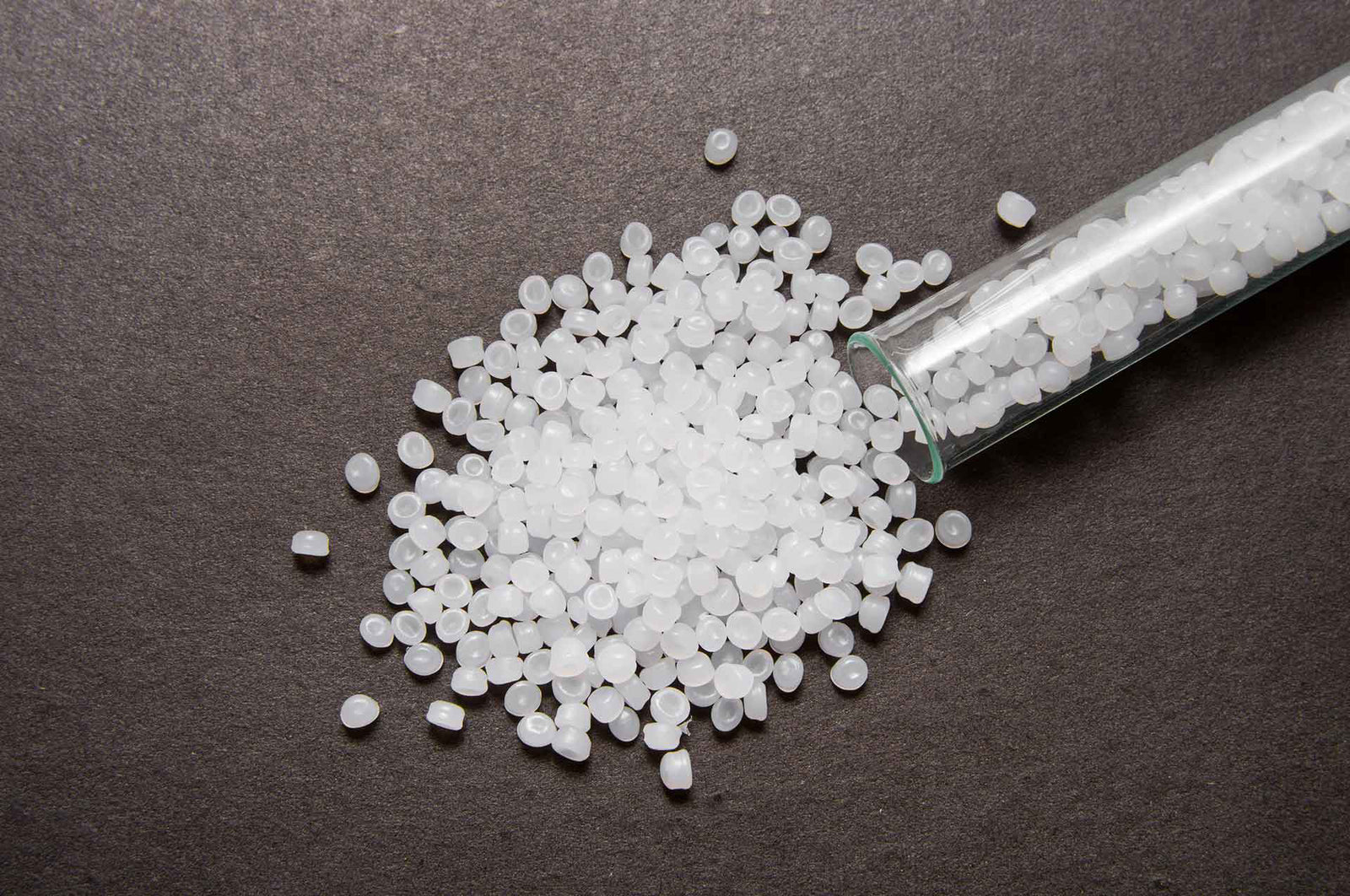
It is polyethylene, the most produced plastic globally, which is produced on a massive scale. One of its main benefits is durability as well as water resistance.
Key Properties of PE Plastic
These helmets have very effective protection against impacts from road debris, etc.
- They are highly flexible and yet very strong.
- They have good resistance to moisture and chemicals.
- Has a lower melting point than PP.
- This material has good dielectric properties.
Polycarbonate has numerous applications, mainly because it is available in a variety of densities.
Types of PE Plastic
Physical education is most frequently classified in accordance with the density of the population of a region.
1. Low-Density Polyethylene (LDPE)
- Soft and flexible
- Films and bags often make use of nylon.
2. High-Density Polyethylene (HDPE)
- Rigid and strong
- Utilized in pipework and containers.
One of the most significant advantages of PE is its adaptability to a wide range of applications.
PE Material Uses
Physical properties of this material make it suitable for applications requiring flexibility, durability, and resistance to environmental stress.
Common Uses of PE Material
- Plastic bags and packaging films
- Bottles and containers
- Water and gas pipes
- Insulation for wires and cables
- Household and industrial storage products
In both domestic and industrial applications, polyethylene performs extremely well.
Difference Between PE and PP
The distinction between PE and PVC is important so that the correct material may be chosen for a particular application.
1. Mechanical Strength
- The material has a much greater stiffness when it is cooled below its PP transition temperature.
- The polymer electrolyte has greater impact resistance than the liquid electrolyte.
2. Heat Resistance
- At higher temperatures, PP is more stable than PE. This is because PP has a higher melting point than PE.
- At lower temperatures, the PE loses its elastic properties and becomes soft.
3. Chemical Resistance
- Both polypropylene and polyethylene provide good chemical resistance.
- The performance of the PP system was only marginally better with the chosen solvent mixture.
4. Flexibility
- The PE system has a lot more flexibility in its application.
- The performance polymer material retains the object’s shape well.
5. Weight
- They are also both strong and flexible.
- PP is slightly less dense than PE.
PP vs PE Plastic: Application-Based Comparison
1. Packaging Applications
- For the packaging of flexible products and films, PE is generally preferred.
- PP is a material of choice for packaging containers such as yogurt cups and margarine tubs due to its rigidity.
2. Automotive Applications
- Because of its excellent heat and rigidity characteristics, PP is often utilized.
3. Medical Applications
Due to its compatibility with sterilization methods, many medical products are made of polypropylene.
4. Outdoor Applications
In environments outside or that are cold, PE performs better than PEB.
Cost and Processing Considerations
1. Processing Ease
- Both polypropylene (PP) and polyethylene (PE) are relatively easy to process using blow molding, injection molding, and extrusion.
2. Cost Efficiency
- In comparison with laminates, PE is generally cheaper for high-volume operations.
- Polypropylene offers a better performance-to-cost ratio for durable products.
- The decision as to whether to use or to lease equipment often depends on the user’s performance requirements rather than cost alone.
3. Environmental and Recycling Considerations
- Polypropylene and polyethylene are the materials from which PP and PE products are manufactured. These materials are recyclable and are classified as thermoplastics.
- A significant proportion of PE is recycled. HDPE has the highest level of recycling.
- Globally, the infrastructure for the recycling of paper and plastics is expanding.
- Selecting recyclable materials helps meet the sustainability goals and promote environmentally responsible manufacturing.
How to Choose Between PP and PE Plastic
Choosing Between Polypropylene and Polyethylene Plastic Products: Key Considerations
When determining which product to purchase—a product made out of polypropylene or polyethylene plastic—there are a few things to keep in mind.
The stiffness or flexibility which is required for the particular application has to be decided.
- Heat exposure conditions
- Chemical resistance needs
- Product lifespan
- Processing method
In order to ensure a product performs as required, it is essential that the properties of the material used are matched to the application conditions.
Conclusion
Choosing one material over another comes down to what the item needs to do. What stands out about polycarbonate is how stiff it feels, its ability to handle high temperatures, and its solid strength when under pressure—traits that help things last longer through repeated use. On the flip side, polyethylene handles bumps and drops well, bends without breaking, and keeps water out, so it tends to show up in stuff meant for outside or wrapping around goods.
One thing that helps pick between polyethylene and polypropylene? Knowing how each behaves in different jobs. Surya Compound & Masterbatches works only with plastics, shaping both PE and PP for many factory demands. Not every material fits every task – some bend further, others hold heat better. This firm builds custom blends so industries get exactly what they need. Each project shifts slightly, matching real-world performance to exact goals.