
Across a variety of industries, including packaging, the automotive sector, consumer goods, electronics and the medical industry, printing on plastic has become an essential procedure. Because plastic is non-absorbent and chemically resistant, this presents problems in the production process. Plastic printing is also flexible and non-porous. As a result special surface preparation is required before printing.
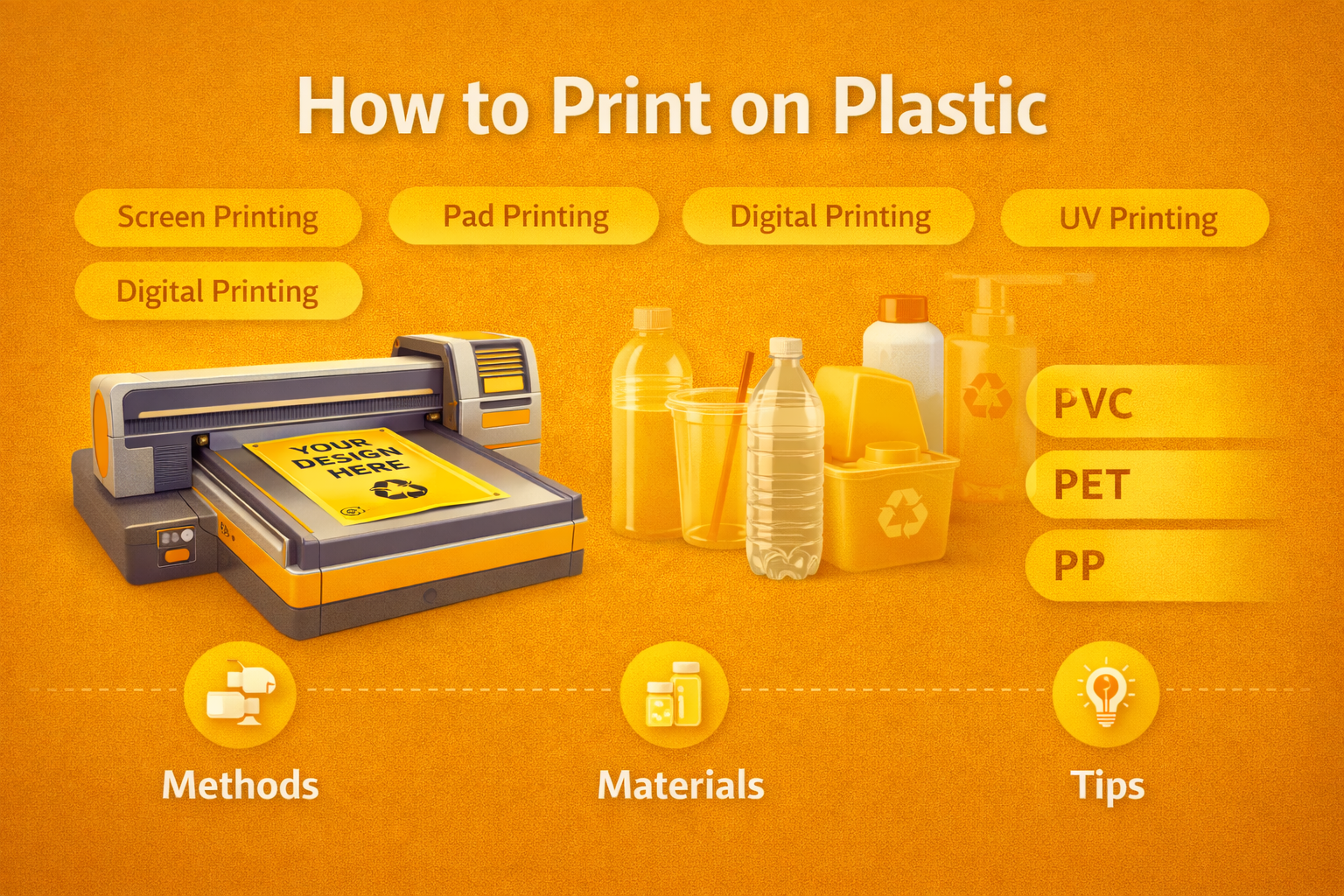
Correct plastic printing is crucial if you wish to print a range of materials including logos, product information, barcodes or graphics. For this type of work to be effective, clarity, durability and adhesion must be maximised. There are seven various forms of printing which are used for a variety of purposes including the industrial use, printing on plastic containers and printing on plastic sheets. These processes include industrial applications and the ways they work.
Things to Consider Before Printing on Plastic
A good starting point for any printing project is to grasp a couple of fundamentals.
Plastics include Polycarbonate (PC), Acrylonitrile Butadiene Styrene (ABS), Acrylic, Polyvinyl chloride (PVC), Polypropylene (PP), Polyethylene (PE), Polyethylene Terephthalate (PET), Polystyrene (PS), Polyurethane (PU), Polyamides (PA), etc.
- Surface finish (smooth, textured, treated, untreated)
- Durability requirements (scratch, heat, chemical resistance)
- Print volume (small batch vs mass production)
- Design complexity and color requirements
The choice of ink system and printing technology is influenced by a number of factors.
Screen Printing on Plastic
Screen printing is a popular choice for producing large quantities of plastic prints due to its reliability.
How It Works
- The ink passes through a fabric mesh screen onto the plastic surface.
- Each color is applied using a separate screen
Key Advantages
- Excellent ink adhesion on plastic
- Intensive inks offer a rich, vibrant colour tone.
- They have a high durability and are resistant to scratches.
- Common Applications
- Printing on plastic sheets
- Signage and panels
- Industrial labels
- Promotional plastic products
- Plastic materials are ideal for screen printing on flat or slightly curved surfaces.
UV Printing on Plastic
This cutting-edge printing technique involves the immediate curing of ink by ultraviolet light, in a similar way to the commercial use of UV in dentistry.
How It Works
- Inkjet printers employing ultraviolet (UV)-curable inks print on plastics.
- Ultraviolet radiation hardens the ink instantaneously.
Key Advantages
- Excellent adhesion on non-porous plastics
- Instant drying
- It has a high fade resistance as well as a resistance to scratches.
- Common Applications
- Plastic panels and boards
- Industrial components
- Decorative plastic products
- The UV printing method is notably suitable for the production on rigid plastic substrates.
Pad Printing on Plastic
Plastic items frequently have their design printed by the pad printing process.
How It Works
The plate is placed in contact with a rubber roller on top of a silicone sheet. Ink is then transferred from the etched plate to the rubber roller.
As the user glides the pen across the tablet’s surface, the stylus comes into contact with the latter.
Key Advantages
Printronics’ large format printer produces high-quality prints on a variety of media and shapes, including curves, textures, and irregular forms.
- High precision for small details
- Consistent print quality
- Common Applications
- Printing on plastic containers
- Caps and closures
- Medical devices
- Electronic components
- Items with intricate shapes are particularly suited for pad printing techniques.
Flexographic Printing on Plastic
Flexography is an extremely versatile printing technique most often utilized in the packaging industry for its rapid production.
How It Works
Flexible relief plates are used to transfer ink onto a film made of plastic.
Uses fast-drying inks
Key Advantages
- High production speed
- Suitable for roll-to-roll printing
- Cost-effective for large volumes
- Common Applications
- Plastic packaging films
- Labels and wraps
- Flexible plastic sheets
- Flexible packaging is extensively used in the consumer goods and food industries for packaging.
Laser Printer Print on Plastic
Laser printers can indeed print on plastic sheets using a specially designed sheet.
How It Works
- Laser toner fuses onto heat-resistant plastic media
- Requires compatible plastic sheets
Key Advantages
- Easy and accessible method
- Suitable for office environments
- Quick printing for small batches
- ID cards
- Overhead transparencies
- Nameplates and tags
- This technique is not suitable for all plastics; materials used in this process must be heat-resistant.
- Comparison of Printing Methods at a Glance
- Best for Flat Plastic Surfaces
- Screen printing
- UV printing
- Offset printing
- Best for Curved or Irregular Shapes
- Pad printing
- Best for High-Volume Packaging
- Flexographic printing
- Best for Small Runs and Customization
- Digital printing
- Laser printing (with compatible sheets)
- Importance of Surface Treatment in Plastic Printing
- Surface finish treatments are often necessary for printed plastics.
Common Treatment Methods
- Corona treatment
- Flame treatment
- Plasma treatment
- Plastic surfaces are treated in such a manner that they have a higher surface tension.
- Ink Selection for Plastic Printing
- The success of plastic printing also depends on choosing the right ink:
- Solvent-based inks for durability
- UV-curable inks for fast curing
- Specialty inks for chemical or heat resistance
- The suitability of ink is dependent on the type of plastic used and the printing process employed.
Industries That Rely on Plastic Printing
The process of plastic printing is used across many industries, including;
Manufacturing and tooling, laboratory equipment, consumer goods, medical and dental products, the aerospace industry, and electrical industries.
- Packaging and labeling
- Automotive and electronics
- Medical devices
- Consumer goods
- Construction and industrial equipment
Every sector has its own set of criteria which it must meet in relation to standards and efficiency.
Conclusion
In various applications the production of durable and high quality prints on plastic is dependent on understanding plastic printing. Each printing process, whether that be UV printing, screen printing on plastic or any other type, has to be specifically chosen to fit the requirements of the item being printed. These criteria consist of the material to be printed on, the volume of production and the design itself.
Choosing a suitable digital printing technique, ink and material will ensure the print finishes remain vibrant and also endure for a long time. Success in print applications depends on the development of new plastic materials and printing technologies. The Surya compound and masterbatches enhance the performance of advanced plastics by bringing materiaexpertise,se which not only helps to enhance printability but also ensures consistency and reliability of the end product in various types of plastic printing applications.