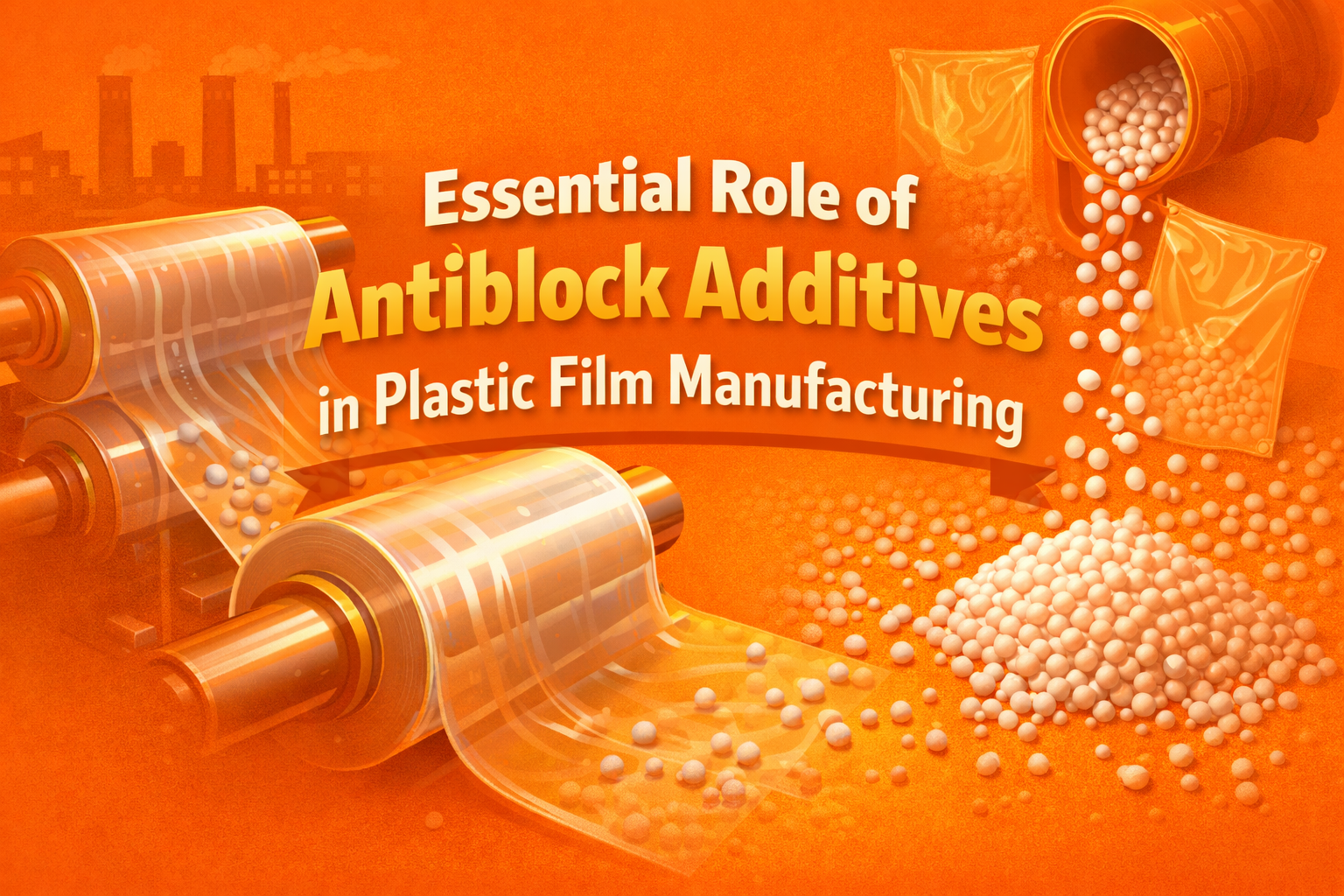
In plastic film production, blocking—the adhesion of adjacent film layers—is a chronic issue. Blocking complicates processing, handling, and end‑use performance. The solution lies in antiblock additives, especially when delivered via antiblock masterbatch materials, which embed microscopic particles in the plastic surface, dramatically reducing film blocking. This article explores how antiblock additives, antiblock masterbatch uses and materials, and cutting‑edge offerings from Surya Masterbatches drive efficiency, clarity, and functionality in modern plastic film manufacturing.
1. Understanding Blocking in Plastic Films
Blocking occurs when two freshly produced layers of plastic film—like polyethylene (PE), polypropylene (PP), PET, or PA—adhere due to Van der Waals forces, pressure, heat, or residual plasticiser and static charge. This results in:
- Difficulty unwinding rolls
- Film tears or stretching during conversion
- Reduced packing efficiency
- Negative consumer experience with sealed bags or trays
Blocking is most prevalent in packaging films, shrink/stretch wrap, agricultural laminates, and thermoformed trays—so it’s essential to prevent.
2. Antiblock Additive Fundamentals
2.1 What Are Antiblock Additives?
Antiblock additives are finely dispersed particles—organic or inorganic—mixed into plastic films to create micro-rough surfaces, reducing film-to-film contact area.
- Inorganic materials: silica (synthetic or precipitated), talc, calcium carbonate, and diatomaceous earth.
- Organic materials: erucamide, oleamide waxes
- Combinations: can include slip agents, antimicrobials, or biodegradable additives for multifunctional performance
2. How They Work
Particles protruding from the surface create asperities (tiny bumps) that break contact between layers, reducing the coefficient of friction (COF) and the separation force. Standard dosage ranges from 0.1% to 0.6% (1,000–6,000 ppm), based on film thickness, clarity needs, and polymer type.
3. Antiblock Masterbatch Material & Uses
3.1 What Is an Antiblock Masterbatch?
An antiblock masterbatch material is a concentrate of these additives mixed into a carrier polymer (PE, PP, PET, etc.). It is diluted during melt processing—typically at 3% to 6%—to achieve final film concentrations.
3.2 Benefits of Masterbatch Format
- Uniform dispersion: ensures consistent performance
- Accurate dosing improves reproducibility
- Safer handling: reduces dust and uneven mixing
- Multi-functional blends: combine antiblock, slip, anti-static, and biodegradable in one concentrate (e.g., Surya Masterbatches)
3.3 Common Antiblock Masterbatch Uses
Antiblock masterbatches are used in:
- Blown and cast films (mono- or multilayer PE, PP, PET, PA)
- Shrink/stretch and sealing films
- Food packaging and thermoformed trays
- Agricultural films and mulch
- Blow-molded or injection-molded articles, often with early-stage slip or transparent finishes
3.4 Examples in Industry
- Natural agents (talc, calcium carbonate) are affordable but can haze the film.
- Synthetic silica: provides clarity at lower loadings (500–2,000 ppm).
- Ampacet’s antiblock masterbatch (USA): increases LLDPE film clarity by 65% and gloss by 50% while improving COF
4. Technical Considerations & Practical Implementation

4.1 Particle Size & Distribution
- Smaller, spherical silica enhances clarity; large, irregular particles boost blocking resistance
- Selection depends on balancing optical vs performance needs
4.2 Compatibility & Carrier Polymer
- Choose carrier resin matching final polymer (e.g., PE carrier for PE film)
- Combined masterbatches (slip + antiblock) are popular for synergistic film ease
4.3 Processing Stability
- Ensure dispersion through extrusion, calendaring, or blown film processes
- High-purity agents (e.g., calcined aluminosilicates) reduce processing interference
4.4 Regulatory Compliance
- Agents must meet food contact approvals for packaging
- Surya Masterbatches provides documentation for regulatory compliance (e.g., food-safe PE carrier)
- Surya Masterbatches: Delivering High-Performance Solutions
5.1 Who They Are
Surya Masterbatches—a specialist in additive concentrates—offers a range of high-quality, customized masterbatches that include:
- Antiblock masterbatch uses: film clarity and processing efficiency
- Combi solutions: embedding antiblock with slip, antibacterial, and UV stabilizers
- Material compatibility: carriers tailored to PE, PP, PET, and PA processing
5.2 Why Surya Stands Out
- Custom formulations: optimize particle type, size, dosage
- Performance-driven: clarity, unwind behavior, production throughput
- Compliance-ready: documentation for global standards
5.3 Use Cases
Surya’s antiblock masterbatches are ideal for:
- Grocery and produce bags need clarity and fast dispensing
- Medical or food-grade films requiring regulatory compliance
- Industrial films and sheets with high-speed winding tolerance
6. Advanced Applications & Future Directions
6.1 High-Performance Optical Films
Masterbatches like Ampacet’s 102286 show the future lies in clarity-centric antiblock, replacing LDPE blends, enhancing output quality,
6.2 Combos with Slip & Antistatic
Combi masterbatches combining antiblock, slip, and antistatic are rising for mono/multi-layer extrusion, reducing additive inventory and easing downstream operations.
6.3 Biodegradable & Antimicrobial Extensions
Products like Wells’ Reverte™ combine antiblock with oxo-biodegradability; others embed antimicrobials for food-safe applications.
6.4 Particle Engineering
Refined synthetic silicas—with narrow diameter and surface properties—lower haze and optimize antiblock. Advanced engineering improves performance at minimal load
7. Challenges and Mitigation
7.1 Optical Clarity vs Performance
- Natural fillers may haze; use synthetic particles or lower loadings
- Advanced options offer high clarity as per Ampacet’s …
7.2 Additive Interactions
- High surface silica may absorb slip agents—formulations must account for surface chemistry.
7.3 Cost Considerations
- Synthetic agents cost more but require less material, offering ROI via clearer product and less usage
- Combi masterbatches reduce logistics and manufacturing complexity
8. Selecting the Right Antiblock Masterbatch
To choose the right product:
| Criteria | Consideration |
| Film Application | Blown, cast, laminate, shrink |
| Required Clarity | Opt for synthetic silica for clear films |
| Carrier Polymer | Match the masterbatch resin with the film resin |
| Additive Functions | Add slip, antistatic, biodegradable as needed |
| Processing Conditions | Ensure thermal/chemical stability |
| Regulatory Needs | Confirm food or medical compliance |
| Cost & Efficiency | Assess price vs performance ratio |
Conclusion
Antiblock additives, especially when delivered via masterbatch, are vital to modern plastic film manufacturing, enhancing processing, clarity, handling, and functionality. With thoughtful formulation, manufacturers can eliminate blocking issues, improve product performance, and simplify operations. Brands like Surya Compounds & Masterbatches lead with tailored solutions, compliant materials, and high-performance mixes.
In short, antiblock masterbatch materials are not optional—they’re essential to producing high-quality, efficient, and differentiated plastic films in today’s competitive marketplace.